www.newsbusters.org
CNN’s Cornish Likens Hegseth D-Day Speech to Language ‘Nazis Would Have Used’
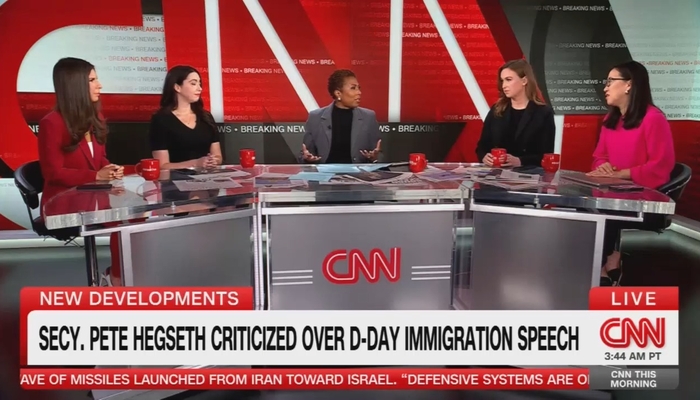
On Monday’s CNN This Morning, host Audie Cornish and her panelists discussed Secretary of Defense Pete Hegseth’s speech in Normandy over the weekend, which remembered the 82nd anniversary of D-Day and the U.S. and Allies' victory. Cornish likened a portion of his speech in remembrance of a victory over Nazi Germany to language “Nazis would have used” after Hegseth briefly mentioned European immigration issues.
After talk of the Iran war and LEGO propaganda, the morning program turned to Normandy and showed only the immigration portion of Hegseth’s around 13-minute speech. Here was what Hegseth said in that clipped portion:
Sadly, today, different European beaches are stormed by different dangerous ideologies. Beaches in Spain, in Italy, in Greece, in Bulgaria. Boats and men arrive. When will European capitals do something about that invasion? Or is it too late? I pray not, and I believe not.
On Monday's CNN This Morning, host Audie Cornish likened part of Sec. Pete Hegseth's Normandy D-Day remembrance speech to language that "Nazis would have used" after Hegseth mentioned European immigration issues. pic.twitter.com/SxTHEfFYWu
— Nick (@nspin310) June 8, 2026
Panelist Becca Wasser of Bloomberg took issue with Hegseth's mention of immigration and said he made the speech about politics.
Cornish asked if Hegseth was under orders to talk “ideology,” to which Wasser responded, “That moment was not for politics. That was a moment for remembrance. That was to remember those who gave the biggest sacrifice so that we in America and those in Europe could be free. And that was also a moment in that speech for remembrance that Secretary Hegseth gave in front of the very few members of the greatest generation that are left.”
To note, the rest of Hegseth’s speech was focused on the sacrifices made by soldiers on D-Day and not solely political, as the panel seemed to suggest.
Then, Cornish decided to liken Hegseth’s words to those who were defeated by the Americans in World War II:
Um, anybody else? What's going on there with Hegseth talking about it?
I thought it was weird to talk invasion or use language that, like, I don't know, Nazis would have used about people invading the homeland. It felt like a sort of dissonance there.
After Cornish’s Nazi comparisons and an apparent “dissonance” to the remembrance, AP reporter and CNN Analyst Sueng Min Kim agreed:
Clearly a dissonance. And again, as Becca said, I mean, there is a time and a place for politics. However. I mean, if you look at all the cabinet secretaries, I feel like Hegseth is the one that is reflexive - reflective of Trump the most.
She continued, “that is a Trump ideology, right there, saying that, you know, injecting politics into an arena where politics may not be appropriate.”
Cornish’s Nazi comparison fell short in the full context of the speech, where Hegseth remembered how America and its allies broke “the Nazi war machine” and helped “liberate a continent” from their rule.
But sure, let us just make more Nazi comparisons and dilute the term while there was a Senate candidate with a literal Nazi tattoo in Maine that was poised to become the Democratic nominee.
The transcript is below. Click "expand":
CNN This Morning
June 8, 2026
6:42:55 AM Eastern
(...)
AUDIE CORNISH: I have to ask one more thing, Becca, because I have you here and we often talk about Pete Hegseth, the Defense Secretary, what he's up to. And over the weekend, he was in Normandy, and he was marking the D-Day anniversary. And people are talking about his speech because he started to talk about - actually, I'm going to play it for you so you can hear. Again, this is supposed to be Memorial Day. Here is what the Defense Secretary had to say.
[Cuts to video]
SEC. PETE HEGSETH: Sadly, today, different European beaches are stormed by different dangerous ideologies. Beaches in Spain, in Italy, in Greece, in Bulgaria. Boats and men arrive. When will European capitals do something about that invasion? Or is it too late? I pray not, and I believe not.
[Cuts back to live]
CORNISH: So, is he like under orders to always talk domestic, sort of, ideology in these contexts?
BECCA WASSER: I don't know about that, but let me tell you what I do know. That moment was not for politics. That was a moment for remembrance. That was to remember those who gave the biggest sacrifice so that we in America and those in Europe could be free. And that was also a moment in that speech for remembrance that Secretary Hegseth gave in front of the very few members of the greatest generation that are left.
And so they are standing on the very beaches that they landed on on that day, remembering what they saw and what they lost, things that, frankly, we today cannot even fathom. And that moment was supposed to be for them.
So, it's supposed to be about remembrance, not politics. And that's where I come down on it.
CORNISH: Um, anybody else? What's going on there with Hegseth talking about it?
I thought it was weird to talk invasion or use language that, like, I don't know, Nazis would have used about people invading the homeland. It felt like a sort of dissonance there.
SEUNG MIN KIM: Clearly a dissonance. And again, as Becca said, I mean, there is a time and a place for politics. However. I mean, if you look at all the cabinet secretaries, I feel like Hegseth is the one that is reflexive - reflective of Trump the most.
I mean, this is - I mean, that is a Trump ideology, right there, saying that, you know, injecting politics into an arena where politics may not be appropriate. I mean, that's something that the president does all the time. I mean, that's - I mean, that
CORNISH: Compared to like a Rubio or some other kind -
KIM: Right, I mean, that is someone that knows that the president is always watching.
(...)








 New Posts (Home)
 ChatBox
 Popular Posts
  Game Zone
 Top PodCasts