reactormag.com
Devil in Silver: Chinaza Uche on How Coffee’s Pivotal Scene Was a “Different Experience”
Movies & TV
The Terror: Devil in Silver
Devil in Silver: Chinaza Uche on How Coffee’s Pivotal Scene Was a “Different Experience”
Reactor interviewed Uche about playing Coffee on the Shudder series.
By Vanessa Armstrong
|
Published on June 9, 2026
Photo Credit: Emily V. Aragones/AMC
Comment
0
Share New
Share
Photo Credit: Emily V. Aragones/AMC
Warning: This post contains spoilers through the fourth episode of The Terror: Devil in Silver, “A Number in the System.”
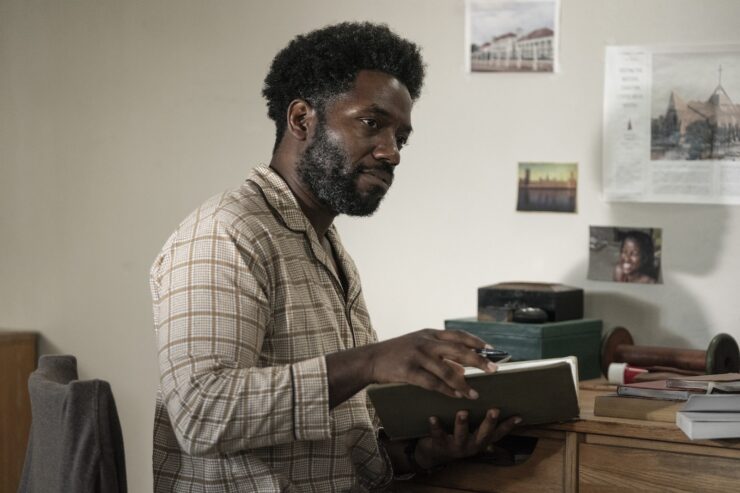
In The Terror: Devil in Silver, Coffee is a patient at New Hyde who, for much of the series, holds out hope that he can reach someone who can make things better at the institution. In his last episode, he loses that hope but still fights on, sloshing through a room full of blood, guts, and bodies in hopes of saving his friends, before dying by police fire as he flees out of the silver door in terror.
It’s a tragic end for him and an ending that Chinaza Uche, who plays Coffee, told me is even more tragic because “even when he has given up on everything, his impulse is still to try to help and still try to move forward to something positive.”
I talked with Uche about what attracted him to playing Coffee—“I’m always interested in exploring characters that we don’t always listen to”—and what it was like filming that gory scene where he’s slipping and sliding though viscera.
Read on for our full discussion.
Photo Credit: Emily V. Aragones/AMC
This interview has been lightly edited for clarity and brevity.
Coffee on the show is almost like a voice of hope in a lot of ways, at least until the end. Did you feel that through the character?
Yeah, I think I really read the scripts and I was like, this is amazing, and it reminds me of people I know, and I, and I did feel his aspiration for a better world, his sense of knowing that the world could and should be better, and the difficulty in living when it’s not living up to that.
There’s a telling thing he says at one point, and I’m paraphrasing here, but he says I thought people didn’t know that this system was so broken, but I’m realizing the system is working perfectly. And I thought that summed up the show so well. It’s a horror show, but it’s the system that’s evil. Was exploring that something that interested you?
There’s multiple kinds of horrors in the show, and I think the devil, as a finite thing, that is something you can possibly defeat. And a system you can also defeat, but in some ways it’s almost more overwhelming. And I just felt like [the show] was talking about real people, so I think all the political stuff is baked in, because there are people in spaces like this who feel like they cannot get out and feel like their voices aren’t being heard. And that is real life, that is factual, and I’m always interested in exploring characters that we don’t always listen to.
Photo Credit: Emily V. Aragones/AMC
I want to talk about Coffee’s last episode. It’s a very shocking and upsetting moment—and before that, there was a point before he goes into the back rooms where you can feel like something’s changed in him. He gives his change to Loochie, and things like that. Can you talk about what was going on from your perspective with the character when he made those choices?
I feel like Dorry’s betrayal is such a profound heartbreak for him, and such a fracture in this found family that he has. He gives up hope, but I think what’s cool is that he goes like, “Eff it, let’s go, blazes out. Even without an end in sight, I still know what’s right and I’m going to move towards that.” I do think that is tragic, and it’s tragic that even when he has given up on everything, his impulse is still to try to help and still try to move forward to something positive. But I hope he feels like a real person and not just a good person, because that actually hurts even more, because we know how hard it is to keep going forward.
What about the logistics of the very messy scene at the end, in the room behind the silver door with the blood and bodies? It looked very messy. I don’t think you’ve done something like that before?
[Laughs.] No! I kind of find that fun. I know it sounds weird, but they made a big pile of the gunk before I even got in the room, and they were like, “Do you want to jump in?” And I just jumped in. So there were two parts. There’s a part that’s almost like dance, where they’re like, “Well, you got to interact here, interact here, and get here,” and there’s a part of your brain that’s like doing that. And then there’s this cool thing that happens, where you’re doing your dance, and then something else happens and your imagination is so powerful and you’re in this thing. It also really helped when there’s dead bodies being played by actual actors in a room. So they’d be like, “Oh, could you just move?” It was a really… they built that whole room, filled it with gunk, bodies, all kinds of stuff. And then you just go in it and you let your imagination go.
Photo Credit: Emily V. Aragones/AMC
How long did that scene take?
I think it might have taken a day, actually kind of quick, but it was the whole day. Our lovely crew would have to reset the blood and guts, so the whole thing is such a wild, silly amazing thing.
Did you have to change outfits and get re-gucked?
We had numerous outfits, and sometimes you’re like, “Oh no! They didn’t get that gunk off and you got to change!” But yeah, that was a whole thing.
Is it something you’d want to do again?
I’m open to things that push my imagination. I mean it was difficult, of course, but it’s a different experience, so I enjoy that. I would do it again.
And for my last question, what do you viewers who watch the show walk away with, in addition to being entertained?
I feel like there’s so many different things, but one is, what are the parts of yourself that you’re afraid of? Because I think on some level, how we move through the world is in relationship to these personal devils that we carry, and if we can keep them in place or not, or relate to them, or own them, or whatnot.
So that’s one thing. And then, of course, there’s the sense that there are people whose lives we don’t spend time thinking about, and we probably could and should, because they’re humans, and they could be us, they could be someone that we love, and they are nuanced and feel and think. And I know that there are inpatient facilities that are really difficult to get out of, that people do feel abandoned, and that is worth our thought and our empathy.
The Terror: The Devil in Silver is now streaming on Shudder and AMC+. [end-mark]
The post <i>Devil in Silver</i>: Chinaza Uche on How Coffee’s Pivotal Scene Was a “Different Experience” appeared first on Reactor.








 New Posts (Home)
 ChatBox
 Popular Posts
  Game Zone
 Top PodCasts