reactormag.com
Boldy Going Into Print: The Star Trek Adaptations of James Blish
Books
Front Lines and Frontiers
Boldy Going Into Print: The Star Trek Adaptations of James Blish
Blish’s adaptations of the original series bring additional detail and nuance to the scripts…
By Alan Brown
|
Published on June 9, 2026
Comment
0
Share New
Share
In this bi-weekly series reviewing classic science fiction and fantasy books, Alan Brown looks at the front lines and frontiers of the field; books about soldiers and spacers, scientists and engineers, explorers and adventurers. Stories full of what Shakespeare used to refer to as “alarums and excursions”: battles, chases, clashes, and the stuff of excitement.
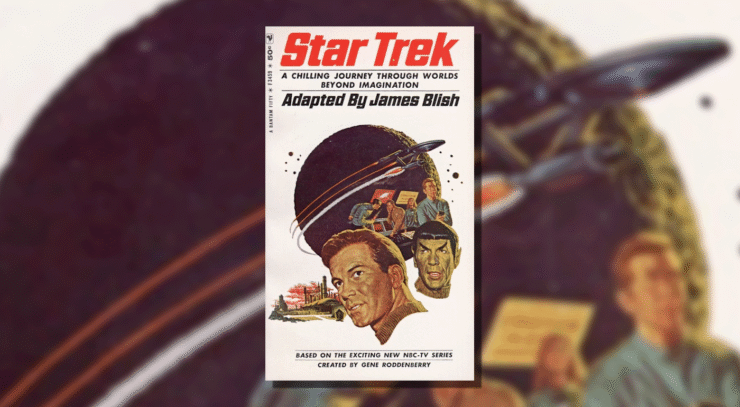
Today, I’ll be taking a trip down memory lane to my first introduction to the Star Trek universe almost sixty years ago in the form of the episode adaptations written by James Blish. For reasons I will explain below, I was not able to watch the show on television, and so I first experienced the adventures of the crew of the Starship Enterprise in a series of books. Recently, I was at my favorite local purveyor of printed materials—Fantasy Zone Comics and Used Books, in North Kingstown, RI—looking at some older science fiction books they had just acquired, and one of them was the original collection of episode adaptations, simply entitled Star Trek, in the original Bantam paperback edition from 1967. That cover, with its heroic portrayal of Kirk, a distinctly green-skinned Spock, and the Enterprise whooshing across the face of a planet, immediately brought back a flood of memories from my youth. Opening its pages and smelling that old book smell, I was transported back to a time when science fiction, and in fact, the whole world, was new to me.
In addition to that paperback, I looked at two other books for this column. Along with Star Trek, my bookstore also had the next volume of the series, Star Trek 2. This one was not quite as new, being from a seventeenth printing of an edition that first appeared in 1968 (the large number of reprints over a few short years shows just how popular these books were). The third volume I acquired is more recent, an omnibus edition containing selected episode adaptations from the entire series, which I purchased at a Barnes & Noble. It is entitled Star Trek: The Classic Episodes, and is one of those reprinted books they sell in faux leather covers with metallic lettering, gilt edges on the pages, and color illustrations inside the covers. This one was published by Del Rey as a Sterling Books Edition in 2016.
About the Author
James Blish (1921-1975) was an American science fiction and fantasy author, best known for his innovative and widely anthologized story “Surface Tension,” his Cities in Flight series, and his broadly popular adaptations of Star Trek television episodes. He became part of science fiction fandom in the 1930s, and joined the Futurians, a seminal fan group based in New York. He had a degree in microbiology, worked as a laboratory technician, and studied zoology. Blish’s career began to gather steam around 1950, and that decade was among the most productive and innovative of his career. His novel, A Case of Conscience, which blends science fiction with religion themes, won the Hugo Award in 1959. While his work on the Star Trek series dominated his later writing career, he continued to produce original work as well. Blish was voted into the Science Fiction Hall of Fame in 2002.
Entering the Star Trek Universe Through Print
When I was growing up in a small town in northern Connecticut, we only had a black and white TV featuring a small screen in a big wooden case. It only got two channels, CBS and ABC, because the nearest NBC affiliate was on the other side of the state, and its signal was blocked from us by some high hills. I was already an avid science fiction fan, having been weaned on my father’s old Tom Swift adventures and magazines like Analog. So, when my friends started talking about a new science fiction show on NBC, Star Trek, I was frustrated. But then I got my hands on the books containing the episode adaptations (as I recollect, it was my older brother Danny who bought them, and I borrowed them)—and I was immediately hooked.
The stories offered a lot of variety as the Enterprise traveled from star to star, but the core cast of characters and the backdrop of the ship established a consistent setting for the adventures. And what a cast it was, with the dashing Captain Kirk, the cynical doctor McCoy, and the logical science officer Spock representing the id, ego, and superego of the crew, forming one of the greatest partnerships in the history of fiction. Close behind them were a strong secondary cast including the redoubtable engineer Scotty, the impulsive helmsman Sulu, the unflappable communications officer Uhura, the empathic yeoman Rand, and the competent nurse Chapel. Their adventures sometimes strayed from the scientific to the fanciful, but they were always entertaining. One element of the stories has not aged well, and that is a pervasive sexist attitude throughout, shown in Kirk’s promiscuous behavior, and the dismissive treatment Yeoman Rand receives from the writers (which is evident on the back cover, where she is described as “the most popular member of the crew,” and a “truly ‘out of this world’ blonde”). For all the show did to promote racial and sexual equality, it fell short of the mark in the gender department.
In later years, when I finally got to see the series in syndication (and in color), I began to realize that there were differences between the written versions of the stories and what appeared on screen. Blish had added scientific details to the stories, additional descriptions and dialogue, and occasionally altered the stories themselves. Because he was able to describe the inner thoughts of the characters, they had a depth that their on-screen versions sometimes lacked. Even the episode titles in the book were sometimes different from the titles used for the TV episodes. It was decades before I finally watched the entire original series in order from beginning to end, a remastered version with new special effects that appeared in the early 2000s. And that was when a lot of those differences became clear to me.
Blish’s original series episode adaptations kicked off one of the most successful science fiction publishing franchises in history. In addition to the episode adaptations, there were original adventures, as well as novelizations of the movies. And those stories continued as new shows were added to the Star Trek universe, including The Next Generation, Deep Space Nine, Voyager, Enterprise, and others. While I read a Star Trek book here and there, I generally didn’t try to keep up with this flood of new material. Because I was unsatisfied with the on-screen ending of the Enterprise show, however, I did read the novels that continued those adventures, and I felt like they gave the story a much more fitting conclusion.
Star Trek and Star Trek 2
The books do not follow broadcast order, and the first story is “Charlie’s Law,” the tale of a teenaged survivor of a wreck who has been given almost god-like powers by an equally gifted alien race. Right from the start, Star Trek episodes did not shy away from presenting developments that would completely upset the status quo in the galaxy, something that could cause problems for writers of later episodes. “Dagger of the Mind” presents a mad scientist who uses mind control on people, including Kirk, and it is a good thing the effect of his machine can be easily reversed at the end of the episode. “The Unreal McCoy” is the story called “The Man Trap” in its TV incarnation, and was selected as the first episode to air. It is the horror-tinged tale of a man who has a relationship with a shape-shifting alien that takes the form of his late wife, and who looks the other way as the alien sucks all the salt out of the bodies of its victims.
“Balance of Terror” features the first appearance of the Romulans, a race that has clashed with the Federation before, but has never been seen. The episode portrays a surprising amount of mistrust and bigotry toward Spock, especially when the crew learns that Romulans bear a strong resemblance to Vulcans. The story has some of the best battle scenes in the original series (and also seems to suggest the Enterprise’s speed is limited by the speed of light, something that directly contradicts what we learn in later episodes). “The Naked Time” is a chaotic adventure involving a disease that causes outrageous, and even violent behavior, with the Enterprise caught in a deteriorating orbit around a planet coming apart at the seams. It has one of the best lines in the original series (which I am surprised made it past the censors of the time). A sword-wielding Sulu says to Uhura, “Aha, fair maiden,” to which she dryly replies, “Sorry, neither.”
The next episode, “Miri,” visits a colony that created a virus to stave off death, but which only extended childhood, which ended with death after long-delayed puberty. The planet is inhabited by ancient and unruly children, the landing party is immediately stricken, and McCoy must develop a vaccine on the fly. To do this, they use a portable computer built around a disembodied cat’s brain, which I think must be a Blish embellishment. But beyond that odd element, he uses his knowledge of biology to wrap the episode in a lot of plausible-sounding scientific terminology. The final story in the tale, “The Conscience of the King,” is a story of character, not science, where the Enterprise crew finds a genocidal dictator hiding as a traveling actor, and accompanied by a daughter who is willing to kill to keep her father’s secrets.
The second volume starts with “Arena,” where Kirk and the lizard-like captain of a Gorn vessel are transported by powerful aliens to a planet where they must fight face-to-face. Once there, Kirk gets creative in building a weapon from the rawest of materials. In “A Taste of Armageddon,” the Enterprise transports an ambassador to a pair of warring planets where computers determine the outcome of battles, and casualties report voluntarily for termination—until the Enterprise is designated as a casualty and the crew decides to disrupt the murderous status quo. The Enterprise is on her way to Earth in “Tomorrow is Yesterday” when she interacts with a “dark star” (and Blish comes a whisker away from calling it a black hole, a term that was only just gaining traction at the time). That interaction pushes Enterprise back in time to the present, where an unfortunate fighter pilot ends up aboard, and they must not only figure out a way to get home, but also return him unharmed to prevent history from changing.
“Errand of Mercy” first introduces readers to the Klingons (oddly and archaically described as a being “originally of Oriental stock,” as if they were from Earth). This warlike race is contesting the Federation for the border planet of Organia, and both sides are shocked when the peaceful Organians prove more than capable of taking care of themselves. Kirk is on trial in “Court Martial,” where it appears he panicked and released a manned pod prematurely, killing a crewmember…but appearances prove deceiving. “Operation—Annihilate” pits the Enterprise against amorphous alien parasites who are spreading from star to star, taking over the population of whole planets, and must be stopped. The next episode is one of the best, “The City at the Edge of Forever,” where Kirk, Spock, and McCoy inadvertently travel back into Earth’s past, and Kirk falls in love with a woman destined to die a tragic death. But if he rescues her, history will follow a dark and bloody course that will destroy the Federation before it ever existed. There is a note from Blish on this one, which was originally scripted by Harlan Ellison, and whose script was changed by the studio. This caused much controversy, and Blish explains that in his adaptation, he attempted to restore some of the elements lost from that original draft.
The volume ends with “Space Seed,” where the Enterprise discovers a slower-than-light starship full of genetically enhanced humans in suspended animation, led by “Kahn,” a dictator who nearly tore Earth’s civilization apart during the Eugenics Wars of the 1990s. He attempts to take over the Enterprise, but fails (and this episode was later built upon by the writers of the best Star Trek movie ever, The Wrath of Khan, who used a different spelling of the name from what appeared in the book).
Star Trek: The Classic Episodes
This volume contains most of the episodes of the original series, drawn from an earlier trilogy of omnibus books that collected every episode. In addition to being nicely bound, the book starts with an excellent historical introduction by Norman Spinrad. The first episode included is Blish’s adaptation of the original pilot episode “Menagerie,” with the original crew, and without the framing material featuring Kirk, Spock, and McCoy that was added later. It also presents each adaptation alongside production credits detailing the name of the writer of the original screenplay, the name of the director, and the date the episode originally aired. For those who are content with a limited selection of episodes, it is a fine and durable addition to their library shelves. I do have to admit, though, that as handsome a volume this is, it was not as enticing as the look (and smell) of that old original paperback volume from the 1960s. I did dip into this volume after reading my two paperbacks to enjoy one of my favorite episodes, the light-hearted adventure “The Trouble With Tribbles.”
Final Thoughts
While authors and fans are sometimes dismissive of adaptations and novelizations based on film and television, in the hands of a gifted writer like James Blish, the product can be something entertaining and worth of respect—a piece of art in its own right. And most of these scripts were excellent, giving Blish a strong foundation to work with. Because I first read these stories at a tender young age, and imprinted on them like a baby duck imprints on its mother, revisiting them again was quite enjoyable.
I now look forward to any comments you might have on these original Star Trek adaptations. And of course, if you want to chime in on other Star Trek books, that would be welcome as well.[end-mark]
The post Boldy Going Into Print: The Star Trek Adaptations of James Blish appeared first on Reactor.








 New Posts (Home)
 ChatBox
 Popular Posts
  Game Zone
 Top PodCasts