reactormag.com
The Adventures of Baron Munchausen: The Life and Times of a Master Storyteller
Column
80s Fantasy Film Club
The Adventures of Baron Munchausen: The Life and Times of a Master Storyteller
Revisiting Terry Gilliam’s wildly ambitious, extravagant celebration of the power of imagination.
By Tyler Dean
|
Published on June 9, 2026
Credit: Columbia Pictures
Comment
1
Share New
Share
Credit: Columbia Pictures
In this column, we’re looking back at the 1980s as their own particular age of fantasy movies—a legacy that largely disappeared in the ’90s only to resurface in the 2000s, though in many ways, the fantasy films of the Eighties are far weirder and less polished than what we got in the aughts. In each of these articles, we’ll explore a canonical fantasy movie released between 1980 and 1989 and discuss whatever enduring legacy the film has maintained in the decades since.
For a more in-depth introduction to this series of articles, you can find the first installment here, focusing on 1981’s Dragonslayer. Last time we looked at the somewhat soulless, toy-driven fiasco that was Masters of the Universe. This time we are taking on one of film’s most adept, divisive, and least bankable masters, Terry Gilliam, and his 1988 film The Adventures of Baron Munchausen.
This was the first Terry Gilliam film I had ever seen. I watched it on cable as a kid and probably saw it before I was aware of anything else Terry Gilliam had done, including Monty Python. I distinctly remember watching it and absorbing its strange internal logic as mythological fact. For years afterwards, I believed there was a tradition where the specter of death could be banished by lighting a candle because of one scene in the film. In rewatching, that is not even a rule in the film itself, but such was the power of Gilliam’s filmmaking that my child brain assumed it must be a heretofore undiscovered tradition if it was presented so plainly and without explanation.
Loosely based on the tall tales of real-life fabulist, Hieronymus Carl Friedrich, Freiherr von Münchhausen (whose stories were further embellished by Rudolf Erich Raspe in the 1785 novel, Baron Munchausen’s Narrative of His Marvellous Travels and Campaigns in Russia and from whom we derive the DSM-listed mental illness and its by-proxy variant), The Adventures of Baron Munchausen takes place in an 18th-century town besieged by the army of the Ottoman Empire. The Sultan and the town’s mayor, The Right Ordinary Horatio Jackson (a hammy and delightful Jonathan Pryce), turn the siege into an absurd exercise in the Enlightenment’s obsession with logic and reason (complete with scheduled surrenders and a disdain for acts of heroism).
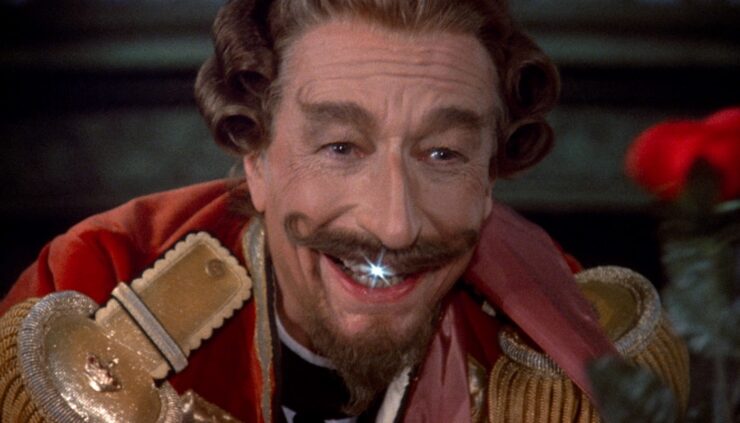
In the meantime, Henry Salt and his nine-year old daughter Sally (Sarah Polley, in one of her first roles) run a downtrodden theater company putting on a production of The Adventures of Baron Munchausen. A man claiming to be the real Baron (John Neville) interrupts the production to explain to the audience that his own past with the Sultan is responsible for the siege, explaining how with guile and help from his supernaturally gifted companions, he’d stolen the Sultan’s treasure. When Jackson demands that he be executed, the Baron and Sally escape and embark on an adventure to find his companions and defeat the Sultan.
They visit the King of the Moon (an uncredited Robin Williams), meet Venus and Vulcan (Uma Thurman and Oliver Reed), are swallowed by a monstrous whale, and narrowly escape the Angel of Death who is hunting the Baron at every turn. Once he has recovered his loyal companions, they defeat the Sultan—but during his victory celebration, Jackson shoots and kills the Baron and the town mourns at an elaborate funeral. Thereupon, in a Beggar’s Opera-style twist, we return to the night of the performance where a still-very-much-alive Munchausen explains that it was only one of the myriad times when he had been killed. The Baron then tells the town that they are safe from the Ottomans. Jackson demands that Munchausen be arrested, but the townspeople push past him and open the city gates. They find the Sultan has fled and the siege has been lifted. Munchausen smiles and rides off into the sunset.
The film supposedly cost a whopping $46 million (though Gilliam disputes the final cost) and, due in part to corporate infighting, was only released on 100-odd screens in the US and recouped a paltry $8 million. Despite this, it garnered critical praise, was nominated for four Oscars, and won three of the four BAFTAs for which it was nominated (Best Costumes, Makeup, and Production Design).
But does it hold up to a rewatch nearly 40 years later (and 340 years after the original Baron Münchhausen began telling stories)? Well, like most Gilliam projects, it’s a mixed bag—though, I’d argue, one of his more successful endeavors. The film looks great. There’s a deep obsession with the intricacies of Baroque-era stagecraft, and in both form and color palette, Gilliam borrows liberally from Salvador Dalí and Giorgio de Chirico. You can also see the same pull towards George Méliès and his meticulous in-camera trickery to which several of his fellow auteurs would later pay homage, particularly Francis Ford Coppola (in 1992’s Bram Stoker’s Dracula) and Martin Scorsese (in 2011’s Hugo). The costumes and sets are strange and delightful while still being cohesive enough to give the film a clear aesthetic.
The movie is filled with great performances as well. John Neville, who had been a successful theater actor through most of his career, embraces his only starring role and knocks it out of the park. His winning charisma, shot through with more than a dash of self-absorbed petulance, provides an irresistible center in a film that otherwise would feel hopelessly scattered. Jonathan Pryce, Gilliam’s muse across many films, turns in a deliciously droll caricature of a bureaucrat collapsing under the weight of his own effete poshness. Robin Williams delivers ten minutes of his signature coked-up style of stand-up, Oliver Reed mean-mugs while literal steam pours out of his ears as the cuckolded Vulcan, and Uma Thurman, only seventeen at the time of filming, manages to pronounce the word “floozy” with such a piercing, electric violence that I honestly will never stop hearing it in her voice.
Sarah Polley also manages to hold the expansive film together with an intelligence and earnest frustration that establishes her as the only adult in the room—the fact that she is the film’s only child actor (other than the teenaged Thurman) notwithstanding. That latter feat is somewhat remarkable given that, according to Polley, the set was a profoundly dangerous place, saying in an interview that “there were so many explosions going off so close to me, which is traumatic for a kid whether it was dangerous or not […] It was physically grueling and unsafe.” In her 2022 memoir, she commented that it is “hard to calculate whether [Gilliam’s films] were worth the price of the hell that so many went though over the years to help him make them.” Though she also gave her blessing for fans to love the film, even knowing how awful it was to make.
In spite of the stunning visuals and performances, the movie has its downsides as well. It’s just over two hours long, which does feel, at times, interminable given how much disconnected ground the film covers. And, despite how prominently they feature, Munchausen’s band of companions—played with relish by Charles McKeown, Winston Dennis, Jack Purvis, and Eric Idle (every Terry Gilliam film from the ’80s is required to feature at least one of his Monty Python collaborators)—are mostly just window dressing, given not quite enough to do. Depending on how you feel about The Beggar’s Opera and Brecht’s The Threepenny Opera, the film’s particular brand of truth-agnostic, tall-tale picaresque may also not feel like it forms quite enough of a cohesive whole to justify itself. Like many Gilliam movies, it is stunning and delightful from scene to scene, while always falling short of coming together completely.
Despite the fact that the Rt. Ordinary Horatio Jackson proclaims that Munchausen, escaping in a makeshift hot air balloon assembled out of undergarments, “won’t get far on hot air and fantasy,” The Adventures of Baron Munchausen does seem to have had a long afterlife, in terms of its influence. While all three of Gilliam’s “trilogy of imagination” films (Munchausen, Brazil, and Time Bandits) are visually spectacular and surreal, this one seems to have had the biggest impact on the visual language of later films. Tarsem Singh, who directed The Cell (2000), The Fall (2006) and Immortals (2011) feels like the most obvious of disciples. Likewise, there is a bit of Baron Munchausen in the Wachowski Sisters’ depiction of cartoonishly baroque cruelty in 2015’s Jupiter Ascending (even if that film, which features a cameo from Gilliam, seems more directly influenced by Brazil).
Perhaps less fortunately, the film also seems to have provided a model for a sort of highly stylized Orientalism that is both visually striking and pretty darn racist. Zack Snyder, a professed admirer of Gilliam’s, definitely seems to have been inspired by Gilliam’s visual portrayal of Ottoman brutality and excess in Munchausen when he adapted Frank Miller’s deeply Orientalist graphic novel 300 in 2006. Obviously, as literary critic Edward Said would tell us, Orientalism is a centuries-old phenomenon—but Gilliam bears some responsibility for making it stylish and thematically intriguing for a new generation of filmmakers. To Gilliam’s minor credit, Baron Munchausen at least makes the point that Western rationality is also a flawed system that is similarly barbaric to its Eastern counterpart. Snyder and Miller removed even those paltry counterpoints.
In spite of its epic failure at the box office, the film’s reception only seems to have encouraged Gilliam’s style of financially reckless filmmaking and helped to fuel a reputation that has benefitted Gilliam himself a great deal. He has produced a few financially solvent movies, but Gilliam is known for blindingly costly boondoggles that, even as they fail to impress investors, manage to become critically respected cult classics. The fact that Baron Munchausen’s chaotic production and huge budget resulted in a movie beloved by critics and diehard fans certainly helped some of his other troubled productions (with the exception of his cursed adaptation of Don Quixote), opening up a lane for directors to argue for the importance of the art even when financial incentives would caution against it. Gilliam helped to cast a mold where financial failure combined with wildly ambitious filmmaking was no longer a direct route to Hollywood exile. Edgar Wright, Quentin Tarantino, David Fincher, Brad Bird, and Ridley Scott have all, in the years since, made cult classic flops whose box-office failure has somehow only increased their standing as visionary directors worth employing. Gilliam wasn’t the first to do this, but he was, arguably, the first to make it his personal brand.
But what do you think? Is The Adventures of Baron Munchausen among your favorite Gilliam films? Did it change the way you viewed cinema when you caught it on cable in the early ’90s? Do you also think it criminally underutilizes Eric Idle? Let me know in the comments, and be sure to join us next time when we move from an artsy flop that attained cult classic status to an animated flop the studio tried to bury for nearly thirty years with Disney’s attempted adaptation of Lloyd Alexander’s Prydain books, The Black Cauldron (1985).
The post <i>The Adventures of Baron Munchausen</i>: The Life and Times of a Master Storyteller appeared first on Reactor.








 New Posts (Home)
 ChatBox
 Popular Posts
  Game Zone
 Top PodCasts