www.upworthy.com
High schoolers create device to keep seniors with Parkinson’s from falling, inspired by cats
Difficulties with balance are one of the more recognizable symptoms of Parkinson’s disease. The symptom can lead to falling and serious injury, as well as loss of independence.
However, Calgary High School students Allen Guo-Lu and Luotong Shi came up with an inventive way to “give back to the community” and help Parkinson’s patients avoid these precarious situations: a 3D-printed wearable “tail” that, quite literally, follows them wherever they go.
The device operates on the principles of biomimicry, which is basically a fancy way of saying humans creating technology that copies time-tested methods used by Mother Nature.
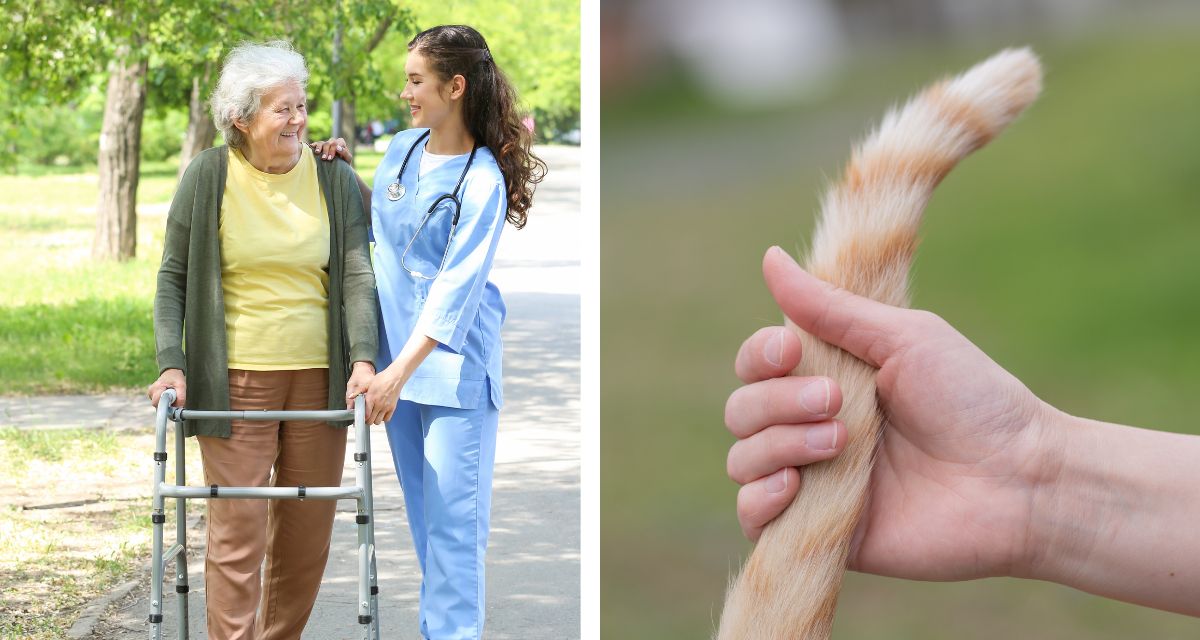
In this case, inspiration comes from cats and other mammals who use their tails, i.e., an extension of their spine, to counterbalance their center of gravity and stabilize themselves. Several tubes extend from a belt and act as “tendons” which move the “tail” according to what input they are receiving from built-in sensors.
This portable tech ranges from around .8-2.6 pounds, depending on the patient’s progression and support needs, and a companion smartphone app allows users to adjust the tail’s sensitivity to their specific body and gait.
Ko Currie with Parkinson Canada shared why it’s so important that young people take an interest in Parkinson’s research with CBC.
“Whether that’s new young scientists, young investigators — the more people we can get into the field…the more we’ll see big discoveries moving faster and faster and getting in the hands of real people that need it.”
However, while the tail was intended to help those with Parkinson’s, Shi noted that it can “benefit” anyone with balancing issues. And considering parts for it cost around $100, it might be a viable low-cost option for assistive aid.
Shi and Guo-Lu’s device won them the University of Calgary Chancellor and Senate Award at the Calgary Youth Science Fair, and was a finalist at the Canada-Wide Science Fair in Edmonton last week.
Their invention joins a growing list of medical and scientific breakthroughs conceived by teenagers.
In 2013, then-15-year-old Jack Andraka gained international attention for developing a low-cost method that showed promise for detecting pancreatic cancer. More recently, students around the world have designed affordable prosthetic limbs using 3D printing technology, created smartphone-based diagnostic tools, and developed devices aimed at improving accessibility for people with disabilities.
These breakthroughs are prime examples of how young researchers often bring fresh perspectives because they are less constrained by conventional thinking and more willing to experiment with unusual concepts.
It also demonstrates the value of encouraging students to pursue science, engineering, and medicine. When young people are given opportunities to explore, create, and test their ideas, the results can extend far beyond the classroom. A school project can evolve into a practical tool that improves daily life, and a teenager’s curiosity can spark advances that benefit entire communities.
It’s a promising notion that the next generation of scientists may already be hard at work solving some of today’s most pressing challenges.
The post High schoolers create device to keep seniors with Parkinson’s from falling, inspired by cats appeared first on Upworthy.








 New Posts (Home)
 ChatBox
 Popular Posts
  Game Zone
 Top PodCasts