www.wearethemighty.com
Flintlock to firepower: The grunt’s 250-year quest for a weapon that actually works
If you ask a civilian to picture the history of American warfare, they’ll imagine the greatest hits. It’s a highlight reel of bravery and intestinal fortitude: Minutemen standing firm at Lexington, Marines raising the flag at Iwo Jima, the Rangers scaling the cliffs of Pointe du Hoc.For 250 years, the U.S. military has been searching for the “Goldilocks” weapon to place into their brave hands, a rifle that is light enough to carry, accurate enough to hit a man at 500 yards, yet reliable enough to work when it’s drenched in the mud, sweat, and confusion of combat.Also Read: The M2 .50-caliber ‘Ma Deuce’ will live foreverBut every standard-issue weapon in American history has been a compromise of some sort. We trade accuracy for speed, then we trade speed for weight. Today, we trade lethality for volume. Every generation of warfighters has had a legitimate reason to complain about their issued gear.Until now?To understand why the next-gen weapons being integrated are such a sharp departure from tradition, you have to understand the misery that came before it. This is the history of American firepower, told not by the generals who made the handshake deals to obtain the guns, but by the grunts who had to bleed for them.
1776–1840: A Ball and a Prayer
The history books love to quote the order: “Don’t fire until you see the whites of their eyes.” It paints a picture of dead-eyed discipline and American soul.Reality was far simpler: If you fired any sooner, you were wasting gunpowder.Although fondly remembered, the “Brown Bess” and early American smoothbore muskets were essentially nasty fireworks. There was no rifling in the barrel, so the ball bounced down the tube like a marble in a drainpipe, somehow exiting with a trajectory best described as “whatever.”
Note that everyone more than six feet away is still alive.
All of this assumes, of course, that you were lucky enough to be issued a man-sized musket in the first place. The early Continental Army wasn’t so much a professional force of nature like the kind we see today. The force that helped win the American Revolution was more of a “bring-your-own-blunderbuss” type of unit. Militias would often show up carrying duck-hunting shotguns, rusty hunting rifles, or whatever grandma used to shoo the vermin out of her garden.Even when issued to a soldier of the Revolution, the musket of the era was enough to haunt their dreams anyway. First, you had to tear the paper cartridge with your teeth, taste the bitter charcoal of black powder, then ram the ball home.You also had to hope the flint sparked. And if it was raining? You were holding a ten-pound club. Anxiety here wasn’t occurring due to the weight of the rifle; it was from feeling helpless. Imagine standing in a line formation, watching a mass of British regulars single-mindedly march toward you, knowing your weapon could be less effective than a slingshot.Here is where the U.S. Army made its first major compromise: they chose speed of loading over accuracy. Some tales said the Kentucky Long Rifle could hit a squirrel at 200 yards, but it took a full 60 seconds to reload. Most muskets took a skilled soldier about 20 seconds (less experienced soldiers would generally take about 45 seconds). Volume won the argument at the time, and the grunt paid the price.Did it get better by the time the British came back for round two? Not really. By the War of 1812, the technology had effectively flatlined. Our boys marched into battle carrying the Model 1795 Springfield, which was a pale imitation of the French Charleville, which was basically just a touched-up Brown Bess. Forty years of independence, and the grunt was still standing in the rain, praying his flint was dry, holding a weapon that hadn’t evolved an inch.
1846–1865: Rifling and Resolve
Between the black powder chaos of the Revolution and the metallic cartridges of the West, the grunt had to now survive a lovely intermission: The Mexican-American War and the Civil War.The 1846 invasion of Mexico gave us a taste of the future. Some units were issued the M1819 Hall Rifle, an early breech-loader that allowed you to reload without standing up. It was faster, smarter, and safer. Naturally, the generals hated it.Army brass argued that if soldiers could reload faster, they would waste their precious ammunition. So, despite the tech being available, the Army largely stuck to its muzzle-loading roots. Old habits don’t die hard; they linger on for what feels like eternity.Eternity is what the Civil War must have felt like, and the Springfield Model 1861 was forged in it.This weapon would have actually been special had it not been for leadership’s shortsightedness. It used the “Minié ball,” a conical bullet that would expand, then grip the rifling of the barrel. All of a sudden, the effective range jumped from 80 yards to 400 yards, which, to a grunt, is like hitting the lotto.The “suck factor” here wasn’t the accuracy or the weight; it was the tactical decision-making, if you’d like to call it that. The generals were still fighting with ancient playbooks, marching men in tight formations against weapons that could pick a button off a dress uniform at three hundred paces. There have been Hungry Hungry Hippo players with greater tactical acumen.Furthermore, the muzzle-loader had a fatal flaw: you had to stand up to reload it… Yeah, no thanks. You pour the powder, ram the rod, and cap the nipple. You can’t do that effectively while prone in the mud, so for four years, the American infantryman faced an existential choice: Stand up and reload (and probably get shot), or lie down and be defenseless.The world asks how American troops are so capable in combat. The answer is simple: look to our elders, who had to stand tall to load while the air filled with lead flying at 1,000 feet per second.
Also the smoke. People forget all the smoke.
1873–1890: The Copper Rush
Entering the post-Civil War frontier, we finally had breech-loaders. No more ramrods here, folks. The Trapdoor Springfield was a single-shot .45-70 savage. It hit like a freight train, eventually finding itself derailed more often than not.The Army, to save a few pennies, issued copper-cased ammunition instead of brass. It might have been cheaper, but copper is soft. When the rifle got hot during a sustained firefight, the copper case would expand and fuse to the steel chamber walls. The extractor would rip through the soft rim, leaving the empty shell stuck in the breach.Leaving its rifleman in the middle of a firefight with only a big stick.This wasn’t just a mild inconvenience; it was a death sentence. At the Battle of the Little Bighorn, cavalry troopers were found dead with their pocket knives out, not to fight the Sioux, but more likely because they were frantically trying to pry jammed casings out of their rifles while being overrun.This era taught the infantry a lesson that is indelibly etched into our genetic code: Reliability is the only spec that matters. A gun that doesn’t shoot is expensive, cumbersome junk.
If you’ve ever read about Custer’s last stand, you know this painting is generous.
1898–1911: Outgunned and Underpowered
The turn of the century was a rude awakening for American military planners. We marched into Cuba during the Spanish-American War carrying the Krag-Jørgensen. It was a beautiful rifle, make no mistake, with an action as smooth as a Ken doll; it also had about as many useful features in combat as a Ken doll.Why? For starters, you had to load cartridges one by one into a side gate. Meanwhile, on the other side, the Spanish on San Juan Hill were armed with German Mausers fed by “stripper clips.” They could staggeringly reload five rounds in one second; our boys were fumbling with loose rounds while enduring continuous fire. Heavy casualties were incurred because our gear was “gentlemanly” while the enemy’s was industrial.Battles in the Philippines during the Moro Rebellion would soon prove problematic; it’s also where the poles shifted from rifles to sidearms.Our standard-issue .38 Long Colt revolvers proved to be about as lethal as snowballs against the Moro “Juramentados”, warriors who would bind their limbs, enter a trance-like state, and charge. Reports flooded in of soldiers emptying their .38s into a charging attacker’s chest, only to be hacked to pieces by a bolo knife before they even knew what was happening.This naturally led the Army to panic, flailing their arms around in vain until they could come up with a modern, infallible plan. Their solution? Let’s dust off old .45 revolvers from the Indian Wars and rush them to the jungle asap. We assume all leadership leapt jubilantly into the air as one, with hand-rolled tobacco dangling from their lips, spilling whiskey and rye, after this gem of an idea was introduced.But it worked like a charm. The dense slug of a .45 would actually knock the Moro warriors down, and a lesson was relearned: science is pretty badass.Desperation sparked the demand for a new automatic sidearm, leading John Moses Browning to deliver us the M1911. For all intents and purposes, this can be seen as a thick, durable apology to the guys who fell holding those .38s.
Almost any stance works.(National Archives)
1936–1960: The Cult of Wood and Steel
If there is a “Golden Age” of American small arms, this is it. The ingredients used basically defined the generation: heavy wood, milled steel, and recoil that put hair on your chest.By this era, the M1911 was already legendary.The Cult of the .45 ACP would start here.The lore was simple, yet effective: If you hit a man with a 9mm, you might make him mad. If you hit him with a .45, his soul leaves his body before he hits the ground.It was heavy; it held only seven rounds, and it kicked an entire generation into a culture of “stopping power,” the belief that one hit should end a fight. Period.Next to the 1911, the M1 Garand is arguably the most beloved weapon in our history. General George S. Patton personally called it “the greatest battle implement ever devised,” and for once, this wasn’t hyperbole. It gave the American GI a semi-automatic advantage that defined World War II. While the Germans were working bolt-action Mausers, Americans were pouring eight rounds of .30-06 downrange as fast as their fingers could pull the trigger.It sounds great on paper, so let’s drill down deeper and see if it holds up. The M1 weighed 9.5 pounds empty. By the time you added a bayonet and a sling, you were hauling a sledgehammer. And don’t forget “M1 Thumb,” the rite of passage in which the bolt slammed shut on your digit with enough force to crack bone. Perhaps nostalgia has wrapped you in a warm blanket. It was good enough to defeat Fascist Italy, Nazi Germany, Imperial Japan, and even packed a wallop the North Koreans and Chinese wouldn’t soon forget.Yet, we would spend the next 50 years forgetting those lessons learned, only to relearn them the hard way in the decades to come.
Some things become legendary for a reason. (U.S. Army/Robert E. Field)
1960–2010: Plastic Panic
In the jungles of Vietnam, the philosophy of American firepower shifted almost overnight. The Army decided that “stopping power” was a faux pas, and “fire superiority” was just groovy.The M16 was born.To the grunt raised on the M14 and the Garand, the M16 looked like a child’s toy. It was made of aluminum and plastic. It fired a tiny .22 caliber bullet (5.56mm) that looked like it belonged in a varmint rifle. The smoke pit spewed forth its unique brand of rumor and review: “It’s made by Mattel.” “It breaks in half if you drop it.”The M16’s debut could be described as a disaster, fueled by the “original sin” of military procurement. The Army changed the gunpowder spec without testing it, causing the rifle to quickly malfunction, and in a stroke of genius (or of the occipital lobe) told troops the rifle was “self-cleaning.”You’d think the higher-ups would admit a mistake was made and immediately address it, but nope, instead they doubled down hard by not issuing cleaning kits. We lost good men to jammed rifles in the Ia Drang Valley, creating a trust issue, to say the least, that lasted decades.Eventually, “they” got it almost right, as the M16 morphed into many service members’ favorite, the M4 carbine.For the last two decades, the M4 had been the extra appendage of the U.S. military during the Global War on Terror. It was lightweight, portable, and “good enough.” It solved many reliability issues. Plus, it was super easy to carry. Unfortunately, it was designed for volume rather than viciousness.The M4 worked fine when we were fighting insurgents in soft clothes, wearing sandals with socks, up close and personal. But in the mountains of Afghanistan, grunts found themselves pinned down by machine-gun fire from 800 meters away, well outside the M4’s effective range.We were hitting bad guys, and they weren’t falling down. We had optimized for weight and capacity, but we had lost the ability to reach out and touch someone without burning through valuable .50 cal or 7.62 ammo.
Staff Sgt. Eric Higgins, an infantryman with the Pennsylvania National Guard, takes aim with an M16 rifle.(U.S. Army National Guard/Sgt. Seth Cohen)
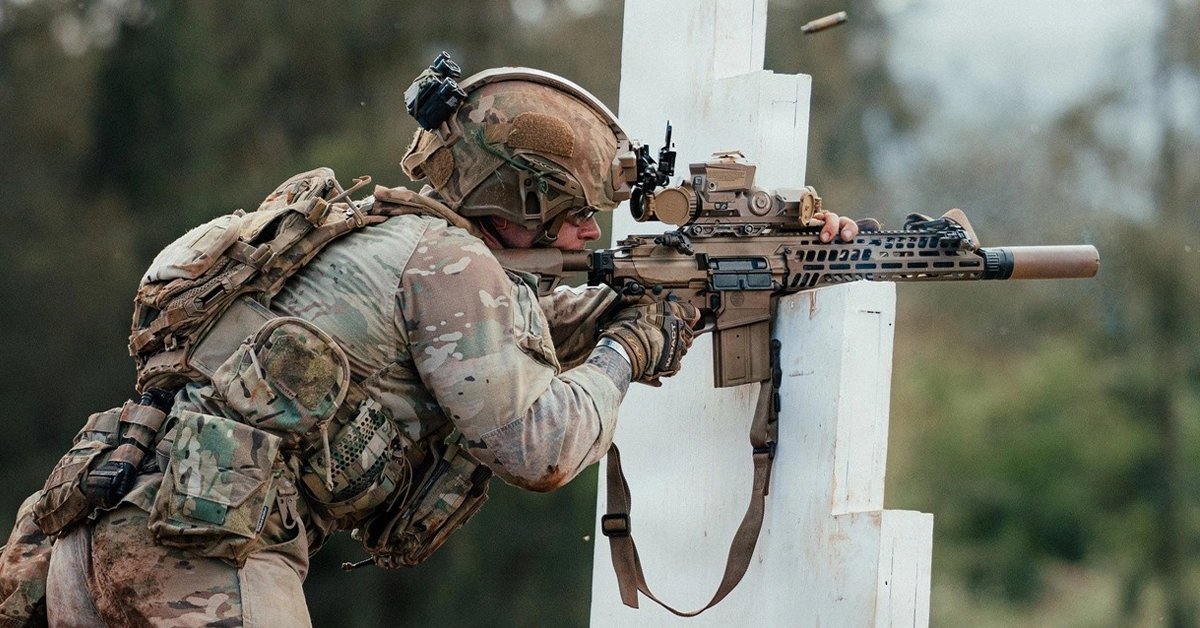
Here we are, present day, during the most controversial rollout since the M16. But before we get to the rifle that eats tank armor, we have to talk about the sidearm.Once upon a time, we were stuck with the Beretta M9. It was fine, if not vanilla; a heavy chunk of metal that was quite serviceable, but like the M4, it was aging out. Then Sig Sauer waltzed into military history, introducing the M17 and M18.Replacement wasnt the main goal; there was a novel idea that came to form, one on par with Einstein’s very best, that human hands might actually come in different sizes. Their new Modular Handgun System (MHS) is built around this transcendent theory: a fire-control chassis that lets you swap grips in order to fit the shooter, rather than forcing the shooter to adapt to the gun.Whether you are carrying the full-size M17 or the compact M18 (which the Marines snatched up immediately), you are wielding a striker-fired system that finally punts the external hammer and comes optics-ready right out of the box.Sig Sauer attempted to take a massive leap forward, but make no mistake: ingenuity can get you far, but ingenuity without clear focus can lead to chaos.The Army assessed the near-peer threats on the horizon, specifically adversaries like China that are fielding high-quality body armor, and realized the M4 was becoming obsolete. The 5.56mm round simply cannot penetrate modern ceramic plates at range; our adversaries are keenly aware of this flaw, so we do what we do best: adapt and overcome.Sig Sauer got the call, and the XM7 (now the M7) was called into the game.Many will explain, in a high-pitched whine, that their new rifle is sooo heavy. They aren’t wrong. Once you bolt on the suppressor and the optic, you are humping a 13-pound system, after a few clicks, that really sucks. There is no way to sugarcoat it; carrying this thing over distance or up a mountain is going to be a smoke session.But here is why the “suck” is worth it.We aren’t just changing guns; we are changing how our troops conduct warfare. The M7 fires the new 6.8x51mm Hybrid cartridge. This isn’t just about bigger bullets; the case itself uses a steel base to handle insane pressure. We are talking about 80,000 psi of chamber pressure, roughly the same breech pressure as the main gun on a tank.The result? It punches through body armor that would eat a 5.56mm round like a snack. It makes an enemy’s “cover” as useful as if they pitched a penny into a fountain and wished for safety.Maybe more impressive than the weapon itself is the XM157 Fire Control optic that the M7 is paired with. It’s not just a scope; it’s basically baby’s first ballistic computer. It has the only feature a high school graduate with a gun would need: a laser rangefinder that instantly calculates drop and windage. You’re welcome, America.Think about what that means. For 250 years, hitting a moving target at 600 meters was an art form reserved for snipers. It effectively gives every grunt a sniper’s brain without needing to understand Einstein’s theories.
(U.S. Army/Patrick A. Albright)
The M7 is an absolutely jarring shift. It ends the NATO standard of swapping ammo with our allies, cuts the standard combat load from 210 rounds down to 140(ish), just because the ammo is so heavy. It kicks like an ornery mule, it’s loud, and it’s pretty chonky.And once again, for the first time in a long time, the U.S. military isn’t compromising on lethality.We spent the Civil War compromising on reliability. We spent the last 50 years compromising on range and stopping power to save weight. How many lives might have been saved if building the best weapon mattered more than anything else?The XM7 is the Army admitting that in a near-peer fight, the comfort of the troops doesn’t matter as much as their safety, coupled with an advantage over any adversary. What matters is that when you pull the trigger, the weapon does what it is supposed to: the enemy goes down and stays down.Grunts will always hate the weight; some things will never change, and haven’t changed since the first warriors complained about their rocks or sticks being too heavy. But when the enemy is wearing armor and shooting back from half a kilometer away, the XM7 and the other weapons in development will be there for you and your mates. The era of the “poodle shooter” is just about over. The era of overwhelm is beginning.Never forget the troops who carry this gear. When you find the time, take a minute to remember the thousands upon thousands of men and women who held these weapons. They carried them to protect their neighbors against enemies so they, and future generations, hopefully, wouldn’t have to.
Don’t Miss the Best of We Are The Mighty
• The M72 LAW: the tube that toughened the Infantry• The M60 ‘Pig’ caught plenty of hate, but the love was real• Why the M240B earned cult status with GWOT veterans
America250
Revolutionary War
How Henry Knox became the artillery genius of the Revolutionary War
By Daniel Tobias Flint
History
Flintlock to firepower: The grunt’s 250-year quest for a weapon that actually works
By Adam Gramegna
Revolutionary War
The Revolutionary War battle that forced Americans to choose sides
By Daniel Tobias Flint
History
Nathanael Greene: The Revolutionary War’s most underrated leader
By Daniel Tobias Flint
Revolutionary War
How a plain-language pamphlet created America’s revolutionary mindset
By Daniel Tobias Flint
The post Flintlock to firepower: The grunt’s 250-year quest for a weapon that actually works appeared first on We Are The Mighty.








 New Posts (Home)
 ChatBox
 Popular Posts
  Game Zone
 Top PodCasts