www.theblaze.com
NA-NUKE OF THE NORTH: Former top general says Canada needs nuclear weapons
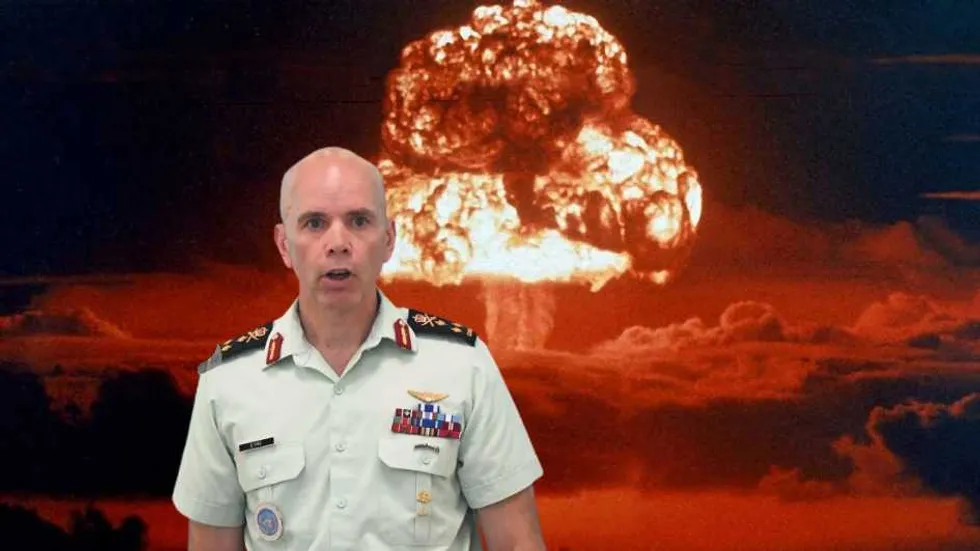
Former Chief of Defence Staff Gen. Wayne Eyre (Ret.) suggested Monday that Canada can only be a truly sovereign nation if it possesses nuclear weapons.The declaration might ordinarily be dismissed as the reckless words of a retired soldier nostalgic for the day-to-day military operations he once commanded. But Eyre was the highest-ranking member of the Canadian armed forces, a position roughly equivalent to chairman of the Joint Chiefs of Staff in the United States.The suggestion that Canada should pursue nuclear weapons amounts to a massive repudiation of its defense relationship with the United States, its closest ally.Eyre made the comments at a conference hosted by the Conference of Defense Associations Institute, an organization largely run by former generals and admirals that lobbies the government for increased defense procurement spending.“I would argue that we will never have true strategic independence absent our own nuclear deterrent,” he told the event, according to the Globe and Mail. Minister of National Defense David McGuinty was quick to reiterate the Canadian government’s long-standing commitment to nuclear non-proliferation, emphasizing that Canada should remain a purely conventional power operating within the nuclear capabilities of NATO and NORAD.Nuclear 'options'But Eyre appears to be operating from his own defense doctrine.“Here in Canada, let’s keep our options open,” he said.“We’ve got a good nuclear enterprise here,” he added. “If conditions change, we’ve got the civilian infrastructure. We’ve got the scientists.”Eyre’s remarks have not drawn any response from the U.S. military or from War Secretary Pete Hegseth. But the suggestion that Canada should pursue nuclear weapons amounts to a massive repudiation of its defense relationship with the United States, its closest ally.Although Canada contributed scientists and researchers to the Manhattan Project that produced the first atomic bomb, it did not develop its own nuclear arsenal during the Cold War, choosing instead to remain under the American nuclear umbrella.While Eyre’s cavalier attitude toward nuclear weapons may evoke comparisons to the right-wing hawks lampooned in Stanley Kubrick’s "Dr. Strangelove," Eyre was, in practice, a viscerally woke military leader. He was appointed by former Prime Minister Justin Trudeau and appeared to draw inspiration from Trudeau’s ideological priorities.RELATED: FREE ALBERTA! Nod from US energizes Canada sovereignty movement Win McNamee/Getty ImagesDressing downUnder Eyre’s leadership, the CAF strictly adhered to DEI policies that produced some of the most liberal dress and deportment standards of any modern military. Mandatory haircuts were eliminated. Both men and women were permitted to grow their hair to any length, dye it any color, and wear nail polish. Uniform requirements were loosened to the point that the “dress of the day” could effectively be whatever a service member chose.Public backlash followed. So many objections were posted to the CDS’ X account that Eyre shut down the comments section entirely.“In recent months, we observed a concerning increase in malicious and misinformative engagements that proved detrimental to the Canadian Armed Forces’ ethics, values, and communication objectives,” National Defence spokesperson Andrée-Anne Poulin explained in an email. “Considering this, we made the decision back in January to close the comments section on the CDS X account.”Bombs awayWhat many Canadians may not realize is that three Canadian military bases hosted nuclear weapons owned by the United States Air Force between roughly 1965 and 1984. Air Force wings at Comox, B.C., and Bagotville, Que., had access to American Genie missiles that could be loaded onto CF-101 Voodoo fighter jets operated by the CAF.Yet unlike today’s tendency among politicians such as British Prime Minister Keir Starmer and French President Emmanuel Macron to speak about war with Russia as though it would not risk catastrophic nuclear consequences, Cold War-era military and political leadership largely agreed on one essential point: A nuclear conflict would be unwinnable for all sides and therefore had to remain unthinkable.








 New Posts (Home)
 ChatBox
 Popular Posts
  Game Zone
 Top PodCasts