www.wearethemighty.com
How ‘Major Payne’ became a Marine Corps comedy classic
When “Major Payne” hit theaters in 1995, it arrived disguised as a broad military comedy, led by Damon Wayans at the height of his pop-culture reach. On the surface, the film looked like a simple fish-out-of-water story: a hyperlethal Marine Corps officer forced out of combat and reassigned to train a group of wildly undisciplined junior ROTC cadets. What followed, however, became something far more enduring than a mid-90s comedy. Over time, “Major Payne” embedded itself deeply into Marine Corps culture, popular memory, and internet folklore, earning a strange but sincere place of honor as a timeless classic.Nearly three decades later, the film remains quoted in barracks, referenced in classrooms, recycled endlessly as memes, and rewatched by generations who were not even alive when it premiered. Its staying power says something important not just about comedy, but about how Marines and Americans more broadly use humor to understand discipline, transformation, and identity.
Also Read: The rivalry between ‘Hollywood Marines’ and Parris Island Marines
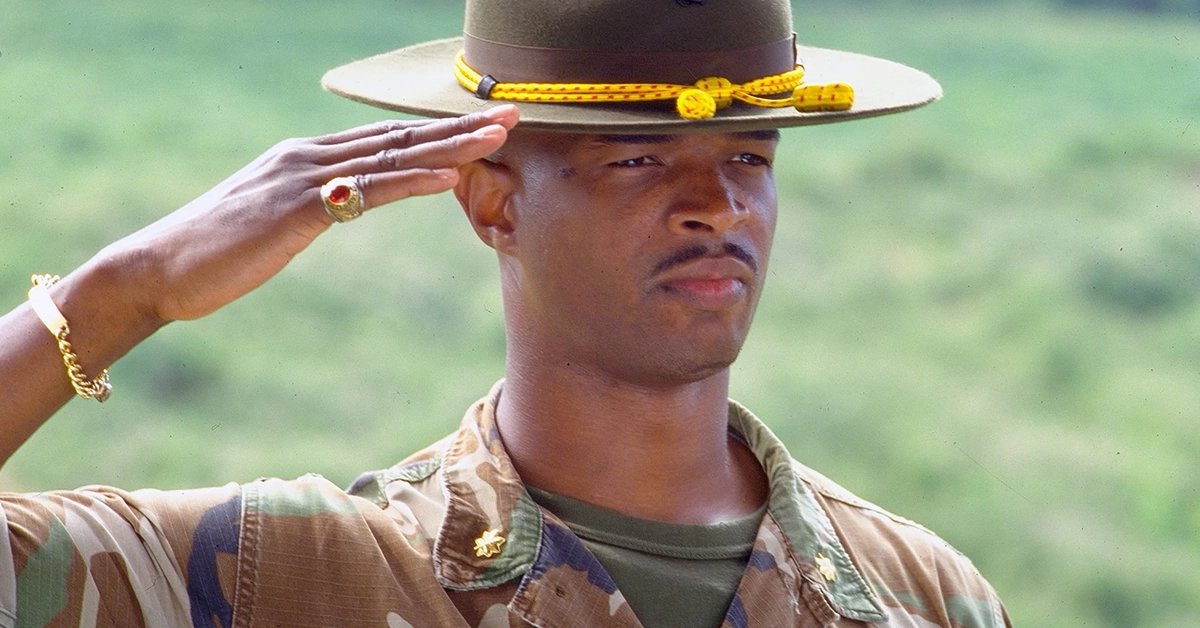
Major Benson Winifred Payne is an exaggeration so extreme that he borders on cartoonish. He is emotionally stunted, socially incapable, and entirely defined by violence, discipline, and the Marine Corps. He speaks in blunt declarations, solves problems through intimidation, and views compassion as a tactical weakness. In reality, a figure like Payne would be a nightmare in most environments.And yet, Marines recognized something familiar.Payne is not a realistic Marine officer, but he is a concentrated embodiment of Marine archetypes: the combat-focused warrior lost outside the battlefield, the drill instructor energy turned up to eleven, the professional whose entire identity is wrapped in mission accomplishment. His inability to function in civilian life mirrors a real post-service anxiety many veterans understand, even if the film plays it for laughs.The genius of “Major Payne” is that it never pretends he is healthy or well-adjusted. Instead, the humor comes from watching that hyper-rigid Marine ethos collide with a world that does not operate on formations, cadence, or fear. Marines laugh not because Payne is accurate but because he exaggerates truths they recognize.
Discipline is the Heart
At its core, “Major Payne” is not a war movie. It is a transformation story. The cadets are unmotivated, undisciplined, and disinterested. Payne’s methods, screaming, intimidation, and absurd punishments, are played for comedy, but they also echo a familiar training arc: break them down, build them back up, give them confidence and cohesion.This is where the film quietly aligns with Marine Corps values. Despite all the jokes, the movie ultimately argues that discipline creates purpose, teamwork creates confidence, and standards matter. The cadets do not become Marines, but they do become something better than they were.Importantly, Payne changes too.The Marine who initially dismisses children as weak liabilities gradually learns leadership beyond fear. He discovers that motivation is not only enforced, it is earned. That evolution mirrors a lesson every good Marine leader eventually learns: authority alone is not leadership.The film’s emotional climax is not a battle it is Payne choosing to invest in others rather than retreat into violence. That arc gives the movie its heart and explains why it has endured beyond cheap laughs.
A Complicated Relationship with the Marine Corps
Officially, “Major Payne” is not a Corps-endorsed film. It exaggerates, caricatures, and freely ignores realism. And yet, Marines have embraced it anyway.Why?Because Marines understand satire when they see it. The film does not mock the Corps from the outside, it pokes fun from within. It exaggerates traits Marines already joke about themselves, intensity, rigidity, and obsession with toughness, without portraying Marines as incompetent or cowardly.Unlike films that turn military figures into buffoons, Major Payne treats competence as a given. Payne is lethal, effective, and mission-oriented. His problem is not that he is bad at being a Marine, it is that he is too good at it for the wrong environment.That distinction matters. Marines tend to reject portrayals that diminish professionalism. They tolerate and often love portrayals that exaggerate it.
From VHS to Viral
If “Major Payne” had existed only in the era of VHS tapes and cable reruns, it would still be fondly remembered. But the internet transformed it into something bigger. The movie is endlessly memeable. Nearly every scene contains a line or visual that works perfectly out of context:
“Let me show you a little trick to take your mind off that pain.”
“If he is still in there, he ain’t happy.”
Payne’s deadpan stare.
(Universal Pictures)
These moments circulate constantly across military social media, veteran pages, and humor accounts. They function as cultural shorthand. You do not have to explain the joke if you know, you know.Memes have allowed the film to reach new audiences. Young Marines, students, and civilians all discover the character first through clips rather than the full film. In doing so, the movie has achieved something rare: it feels perpetually current.
A Gateway to Marine Culture
For many civilians, “Major Payne” serves as an early introduction to Marine Corps culture, albeit a distorted one. While no one should confuse it for a documentary, it communicates real themes of intensity, hierarchy, discipline, and the emotional cost of being forged into a warrior.Teachers, veterans, and parents often use humor as a bridge, and this movie works remarkably well in that role. It opens the door to deeper conversations about why the military values discipline, how leaders adapt, and what happens when someone struggles to transition out of uniform. The laughter makes the lessons accessible.
(Universal Pictures)
The reason it endures is not nostalgia alone. It survives because it understands something fundamental about Marines and about American military culture more broadly. Humor is how we process pressure.Marines joke about drill instructors because they respect them. Veterans laugh at exaggerated portrayals because they have lived versions of that intensity. Comedy becomes a coping mechanism, a bonding ritual, and a way to tell hard truths without bitterness. “Major Payne” succeeds because it laughs with the culture, not just at it.In an era where military portrayals often swing between grim realism and shallow spectacle, the film occupies a rare middle ground. It is absurd, affectionate, critical, and sincere all at once.
A Timeless Classic Whether Hollywood Meant It or Not
No one involved in “Major Payne” likely imagined it would still be quoted nearly 30 years later, still shared in meme form, still watched by new generations of Marines and civilians alike. Yet here it is immortalized not by awards or critical acclaim, but by cultural adoption.
That is how classics are made: Not by perfection, but by resonance.
“Major Payne” may be ridiculous, but it understands discipline. It may be exaggerated, but it respects transformation. And it may be a comedy, but it honors something very real: the strange, intense, and often humorous world of the Marine Corps.
Don’t Miss the Best of We Are The Mighty
• ‘The Iron Major:’ James Capers Jr.’s long road to the Medal of Honor• How a Marine NCO was crowned king of a voodoo island in Haiti• EJ ‘Skullcrusher’ Snyder is sometimes naked but never afraid
Entertainment
Movies
How ‘Major Payne’ became a Marine Corps comedy classic
By Daniel Tobias Flint
Entertainment
What ‘Arc Raiders’ gets right about choosing when not to fight
By Clay Beyersdorfer
Entertainment
EJ ‘Skullcrusher’ Snyder is sometimes naked but never afraid
By Daniel Tobias Flint
Movies
6 War movie legends who died in 2025
By Shannon Corbeil
Entertainment
Snoopy was much more than just a World War I flying ace
By Bethaney Phillips
The post How ‘Major Payne’ became a Marine Corps comedy classic appeared first on We Are The Mighty.








 New Posts (Home)
 ChatBox
 Popular Posts
  Game Zone
 Top PodCasts