www.civilwarmonitor.com
The Soldier’s Ailment
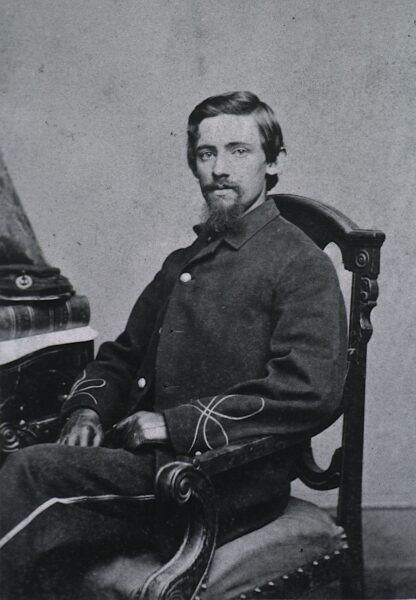
National Library of MedicineUnion surgeon J. Theodore Calhoun
On February 10, 1864, J. Theodore Calhoun delivered a paper titled “Nostalgia as a Disease of Field Service” before an assemblage of medical officers from the Second Division, III Corps, Army of the Potomac, of which he was surgeon-in-chief. Calhoun’s thoughts on the causes and prevalence of nostalgia—or homesickness—among Union soldiers reflect an understanding of the phenomenon based on wartime observation and medical knowledge at the time. They’re published in full below:
Home sickness, or, as it is more professionally termed Nostalgia, … is a disease, or a complication of diseases, to which soldiers are peculiarly subject. I propose in this paper to consider the disease, not as affecting soldiers generally, but those serving in the field, exclusively.
It is not to be wondered at, that numerous cases of Nostalgia should occur in our armies, when we reflect on how its regiments were raised. At the commencement of the war every one was of the opinion that it would be of short duration (a delusion which, judging from the tone of the Northern press, too many are yet cherishing). Regiments were formed in a day or a week. Many impelled by the noblest of motives, left their daily avocations without a thought for the future. Fathers left their families, husbands their wives, young men their hearts idols, and, enlisting under the old banner, were soon at the seat of war. But the rough fare, the hard knocks of a soldier’s life, will dispel an enthusiasm, although incited by the best of motives.
Soon came a yearning to go home, the time they had expected to have been absent had gone by, their business was suffering, their families wanted them at home, they longed again for the luxuries to which they had been accustomed, a good bed, a cheerful fireside and the delicacies of the table.
And now, as our armies are recruited with unwilling men, either conscripted or bought up by enormous bounties, none of them animated by the patriotism or manliness of our early volunteers, we have every cause necessary to the production of nostalgia.
Ours is emphatically a letter-writing army. At all times, and amid the most varied scenes the American soldier is in correspondence with home. Whilst in the rebel lines after the battle of Chancellorsville, some of the rebels remarked to me upon the passion for letter-writing existing in our army and in proof, that they had killed not a few of our men with letters in their pockets, dated on that bloody field.
The constant correspondence with home serves to keep vividly before the imagination the home scenes and home ties. Furloughs (except as a reward for re-enlistment) are but granted in great emergencies, and scarcely then.
Is it strange then that men have sickened, and I doubt not died, from home sickness? I remember one case that occurred on the Peninsula which was most distinctly marked. Lieut. ——— of the —— Excelsior Regiment, shortly after entering on the Peninsular campaign, complained that he was sick, but could not localize his ailment at all. ‘‘He was sick and wanted to be sent home.” Every function of the several organs of the body seemed to be well performed, and I formed my opinion that it was a case of simple nostalgia, and such, upon inquiry, it proved to be. Without detailing at length the subsequent history of the case, which was that of home sickness in general, attended with the usual loss of appetite and general impairment of functions, consequent on the mental disorder—it is sufficient to say that, every other means failing, he was at last sent home, from whence he tendered his resignation. There was no doubt that he would have died, had he remained in camp.
But I fancy that pure uncomplicated cases of nostalgia, requiring treatment, are seldom met with in the field. It is more frequently a complication or a cause of other disease. The very existence of nostalgia, presupposes a state of mental depression, extremely favorable to the contraction of disease. The typho-malarial fever and camp diarrhoea are diseases asthenic in their character, and always characterized by marked depression of all the vital functions. The state of mental depression, that is co-existent with nostalgia, acts as a predisposing cause of these diseases, or as I have frequently found, is co-existent with them. Sometimes the nostalgia is, on the contrary, produced by other diseases. The patient becomes disgusted with his condition, and sighs for the comforts of home, until his yearning for home scenes becomes morbid. But be the nostalgia the cause, or the result of diarrhoea, dysentery or typhoid fever, it is in either event a complication to be dreaded as one of the most serious that could befall the patient.
It has been long known that with certain nationalities, nostalgia is more than usually prevalent. The Swiss, the inhabitants of Savoy, and the Laplanders are prominent examples. It has been my experience, that troops from rural districts—farmers—are much more susceptible than those from cities, or who are merchants or mechanics.
It is a matter of common remark in this army that troops from the country have a much larger percentage of deaths than those recruited in the cities. It is my belief that in very many cases to the peculiar susceptibility to nostalgia of those from the rural districts, is the fact to be attributed. Why they should be more liable to get homesick, is perhaps due to the fact, a country boy is more at home, has less temptation to leave it, and thinks more of it and its influences than he who in the city spends his days in the workshop or counting room, and his nights at the thousand and one places of amusement a city affords. Again, a city bred boy gets his meals at the restaurant or the boarding house—if not all of them, generally one of them (dinner). In the country, on the contrary, the boy lives at home, and seldom takes his meals at other than the family table. The result is that the soldier from the city cares not where he is, or where he eats, while his country cousin pines for the old homestead and his father’s groaning board.
Now let me give a few examples to bear out the view just taken. The Third Excelsior Regiment of this division, composed mostly of troops from Western New York, while in camp in Lower Maryland, lost quite a number of men from a low form of fever, while the other regiments, immediately surrounding, had a comparative immunity from sickness. The cause of this could not be the camp site, its police, or its surroundings. The men drank the same water; ate the same food as the other regiments; were much better hutted, and had an excellent commander and the best of medical officers. Home sickness, as I think, was the complication that turned the scale against life. The Fourth Excelsior, a regiment of New York City Firemen, lay close to them, and were in a much worse camp, hygienically considered, yet, I think, did not lose a man.
Harper's WeeklyThe 73rd New York Infantry, also known as the Fourth Excelsior Regiment.
A more striking instance was the One Hundred and Twentieth N.Y. Vols. When I took charge of the division, about one year since, they were losing men by death daily. That it was not due to local causes was proved by the fact that adjoining regiments, exposed to the same local influences, lost none, and of the patients at our division hospital, with the same diseases, (typho-malarial fever and camp dysentery) those from the One Hundred and Twentieth died under the same treatment that the others got well on. The regiment is from one of the river counties of New York State. Nearly all who died were farmers. Those who were sent on furlough got well, while those who remained died. But a still further proof is present. The battle of Chancellorsville cured the regiment, and it has since enjoyed as good health as any in the division.
This leads me to the remark, that Battle is to be considered the great curative agent of nostalgia in the field. The One Hundred and Twentieth was a new regiment, comparatively. They, without ever having been in battle, were brigaded with the veteran Excelsiors—they had no esprit-du-corps—they were home-sick. Nearly one-half of the express boxes sent to the division at Falmouth, were for that one regiment. The regiment was but a regiment in name—its thoughts were all at home, while its members were here.
At Chancellorsville they fought nobly—they won a name—they had something to be proud of—they gained an esprit-du-corps—their thoughts were turned from home, and they felt they were men and soldiers; peers of the veterans with whom they associated; and from that day to this, there has been but little or no sickness, and but two or three deaths.
Nostalgia is an affection of the mind. It must be treated with that view. Any influence that will tend to render the patient more manly, will exercise a curative power. In boarding schools, as perhaps many of us will remember, ridicule is wholly relied upon, and will often be found effective in camp. Unless the disease affects a number of the same organization, as in the case narrated above, the patient can often be laughed out of it by his comrades, or reasoned out of it by appeals to his manhood; but of all potent agents, an active campaign, with its attendant marches, and more particularly its battles, is the best curative.
When men have passed through the baptism of fire together, they feel that they have something in common. They have a common name, a common fame, and a common interest which diverts their thoughts away from home.
What effect has a furlough system upon the cause and cure of nostalgia? I believe it is for good.
Take into consideration the manner in which our volunteer armies were raised—that few, if any, of our citizen soldiery, expected to be away from home a year, and it can be understood what an incentive there was for men to wish to go home. Few of our commanders looked at a furlough system from a hygienic stand point.
Library of CongressUnion general Joseph Hooker
When General Hooker took command of the army, after it had been well nigh demoralized (principally through the teaching of the northern press which had studiously inculcated a distrust of the abilities of its commander) he at once adopted a furlough system in which furloughs were granted as rewards. It was a fine stroke of policy, and, added to his other order, granting supplies of vegetables, his well fed army, with the hope of a furlough as a reward for good conduct, in an incredibly short space of time recovered its lost morale. I believe Hooker’s furlough system to have been a grand hygienic measure. Let a man know that by good conduct he will sooner or later become entitled to a furlough, and he won’t be home-sick; neither will he have the incentive to desert.
The prospect of a furlough makes men fight better. In the rebel army a man who is wounded receives a furlough. When at Banks’ Ford, after Chancellorsville, I heard several of Wilcox’s Alabama Brigade lamenting their ill luck at not getting wounded, as they so wanted to get home again; and we have all of us seen the countenances of wounded officers in our army light up at the prospect of ‘‘20 days.”
Furloughs are now granted to 20 per cent of those sick in general hospital. The military policy of such a system we have no business to consider, and the hygienic effect upon general hospital patients need not here be discussed; but while advocating a furlough system as a hygienic measure in the field, I am of the opinion that the morale of troops in the field is rather injured than otherwise, by the privilege patients in hospital enjoy. Bad men malinger to get sent to hospital that they may obtain furloughs, while good men, too good soldiers to be guilty of this crime, get home-sick in reading letters from their less scrupulous comrades at home.
But when nostalgic patients in the field cannot be granted furloughs—cannot be laughed out of it, and there is no campaign in progress, they should be kept at work. Idleness is a provocative of home sickness. Let the patient be hard at work all day, and he will have a relish for his rations, and will sleep soundly at night, having little time to think of home. If his nostalgia is co-existent with some other disease, use every endeavor to keep him cheerful, and divert his thoughts from home; but if he is suffering from chronic dysentery, or typho-malarial fever, or is inclined to phthisis, and he becomes decidedly nostalgic, be extremely guarded in your prognosis. The patient will very probably die.
The post The Soldier’s Ailment appeared first on Civil War Monitor.








 New Posts (Home)
 ChatBox
 Popular Posts
  Game Zone
 Top PodCasts