www.wearethemighty.com
Revolutionary War uniforms and the birth of an American army
When the American Revolutionary War erupted in 1775, the conflict was not only a struggle for political independence but also a visible clash between two distinct military cultures. Nowhere was that contrast more apparent than in what soldiers wore. On fields clouded by black powder smoke, clothing served practical purposes such as durability, identification, and protection, but it also communicated power, ideology, and legitimacy. From the homespun garments of colonial militias to the carefully regulated red coats of the British Army, and eventually the standardized blue uniforms of the Continental Army, military dress became a visual language of revolution.Also Read: The inside joke names soldiers have for different unit patches
Uniforms during the Revolutionary era were not simply about appearance. They reflected access to resources, assumptions about warfare, social hierarchy, and evolving ideas about national identity. As the war progressed, clothing became a means through which Americans transformed themselves from rebellious subjects into soldiers of a new republic, while British uniforms embodied centuries of imperial tradition and professional military doctrine.
Colonial Militia Uniforms
Soldiers of the American Revolution: African American of the 1st Rhode Island Regiment; New England militiaman; frontier rifleman wearing a Virginia hunting shirt; French officer in a blue coat.
At the outset of the war, the American colonies had no national army and no centralized system for equipping soldiers. Defense relied heavily on local militias, organizations rooted in English tradition that required able-bodied men to serve in times of emergency. These militia members were not professional soldiers. They were farmers, artisans, merchants, and laborers who reported for duty wearing what they already owned.As a result, early militia forces lacked uniformity in nearly every sense. Clothing varied by colony, region, occupation, and personal wealth. Wool coats, linen shirts, waistcoats, breeches, and stockings were common, but colors and cuts differed widely. Earth tones such as brown, gray, tan, and dull green dominated, not because of any coordinated effort at camouflage, but because natural dyes were inexpensive and readily available.This lack of standardized dress often frustrated Continental officers, particularly George Washington, who worried about discipline and battlefield confusion. Yet the militia’s appearance also carried symbolic weight. To many Patriots, civilian clothing reinforced the idea that the war was being fought by ordinary people defending their rights, not by a professional class of soldiers enforcing the will of a distant monarch.One garment, however, emerged as both practical and symbolic: the hunting shirt. Widely worn by frontier fighters and riflemen, the hunting shirt was typically made of linen or buckskin and cut loosely to allow freedom of movement. It was durable, affordable, and well-suited to North American terrain, particularly wooded environments where European linear tactics were less effective.Over time, the hunting shirt became a powerful cultural symbol. Patriot leaders promoted it as a distinctly American garment that contrasted sharply with the ornate uniforms of European armies. George Washington himself encouraged its use early in the war, believing it fostered unity and reflected the self-reliant spirit of the colonies. Although never universally adopted, the hunting shirt came to represent the revolutionary ideal of the citizen-soldier.Headgear among militia forces was equally varied. Felt or leather tricorn hats were common, often worn plain and without decoration. Unlike British headgear, militia hats rarely displayed cockades or regimental insignia, further emphasizing individuality over uniformity. This visual diversity, while sometimes a tactical liability, underscored the decentralized and grassroots nature of early American resistance.
From Improvisation to Identity
The Delaware Regiment at the Battle of Long Island on August 27, 1776. (Domenick D’Andrea)
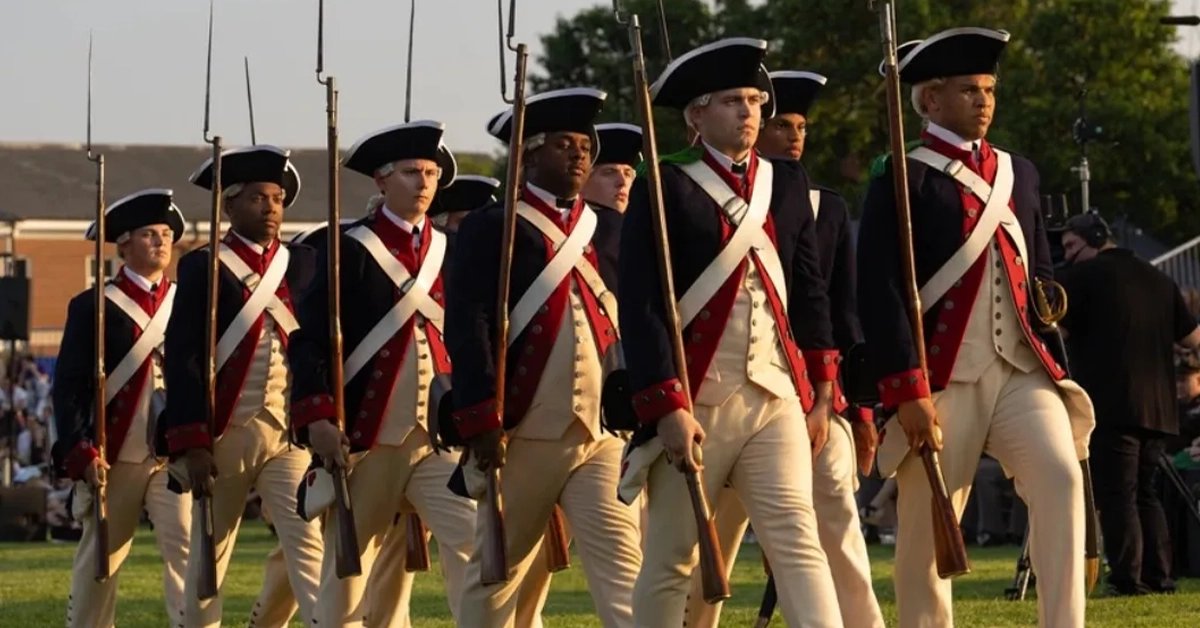
As the war intensified, it became increasingly clear that militias alone could not defeat the British Army. In response, the Continental Congress established the Continental Army in 1775 and appointed George Washington as commander-in-chief. From the beginning, Washington recognized that creating a professional army required more than training and discipline. It required a shared identity, and uniforms played a central role in shaping that transformation.In the early years of the conflict, Continental soldiers still resembled militiamen. Severe shortages of cloth, skilled tailors, and centralized supply systems meant that regulation uniforms were more aspiration than reality. Soldiers wore a mixture of civilian clothing, hunting shirts, and whatever garments could be acquired locally or captured from the enemy. This inconsistency often made it difficult to distinguish American troops from British or Loyalist forces during combat.Despite these challenges, Congress eventually ordered a standardized uniform for the Continental Army. The decision to adopt blue coats was deliberate and symbolic. Blue contrasted sharply with British red and had associations with Whig political movements and European military units sympathetic to republican ideals. It visually separated American soldiers from British authority while signaling legitimacy to foreign powers.The standard Continental uniform consisted of a blue wool coat with white or buff-colored facings, which identified regional units and preserved state identities within the national army. White or buff waistcoats, knee breeches, long stockings, and black shoes with buckles completed the ensemble. In theory, this uniform placed American soldiers on equal visual footing with professional European armies.Headgear also became more standardized. Tricorn hats remained common and were often adorned with cockades. Early in the war, black cockades predominated, but after the alliance with France in 1778, white cockades were added to honor America’s new ally. This subtle but meaningful detail reflected the growing sophistication of the Continental Army and its role in an international conflict.In practice, shortages persisted throughout the war. Many soldiers wore brown, gray, or white coats instead of blue, and captured British uniforms were frequently altered or worn outright. These improvisations reveal the material hardships the Continental Army faced and highlight how the uniform functioned as an evolving ideal rather than a fixed reality.
British Redcoats and Imperial Authority
Opposing the Americans was the British Army, one of the most experienced and professional military forces in the world. British soldiers arrived in North America wearing uniforms that reflected centuries of tradition and a deeply entrenched military culture.The bright red wool coat that earned British soldiers the nickname redcoats was the most distinctive element of their uniform. Red had been associated with the British Army since the seventeenth century and came to symbolize loyalty to the Crown, discipline, and military professionalism. On the battlefield, the bold color made soldiers highly visible, a deliberate choice in an era when maintaining formation was essential.Visibility also mattered in black powder warfare. Smoke from muskets and artillery often obscured vision, and bright red coats helped officers identify their men and maintain control. Red fabric also concealed bloodstains better than lighter colors, which some contemporaries believed helped preserve morale during combat.British uniforms were tightly regulated. Red coats featured contrasting facings in colors that identified specific regiments and reinforced regimental pride. These distinctions connected soldiers to units with long histories and fostered loyalty within the ranks.A British enlisted soldier’s full uniform included a red wool coat, a white waistcoat, white breeches, a linen shirt, white crossbelts for carrying equipment, and a black tricorn hat. Every element emphasized uniformity, hierarchy, and discipline. British soldiers were trained to fight in tight formations, relying on cohesion and coordinated movement rather than individual initiative.While this system proved effective in European warfare, it often struggled against American forces that adapted to local terrain and favored flexibility over rigid order.
Rank, Authority, and Social Order
Uniforms also communicated rank, and this was especially true for officers on both sides of the war. In an era when social hierarchy and visual authority were closely linked, officers’ clothing immediately distinguished them from enlisted men.British officers wore uniforms similar in basic structure to those of enlisted soldiers but made from finer materials and enhanced with elaborate detail. Their coats featured gold or silver lace on cuffs, lapels, and seams. Epaulettes indicated rank, while crimson sashes worn around the waist symbolized command. Officers typically carried swords rather than muskets, reinforcing their leadership role and social status.American officers initially relied on modified civilian clothing to distinguish themselves. As standardization improved, Continental officers adopted blue coats like their men but added visible markers of rank such as colored sashes, epaulettes, decorative buttons, and superior tailoring. George Washington set the example by wearing a blue coat with buff facings, visually establishing authority while aligning himself with republican ideals rather than aristocratic excess.Officer uniforms served a functional battlefield purpose by allowing soldiers to identify leaders amid smoke and confusion. At the same time, the refinement of officers’ dress revealed the persistence of social distinctions, even within a revolution committed to the principle of equality.
Uniforms as History Woven in Cloth
Revolutionary War uniforms were far more than practical garments. They were expressions of identity, ideology, and authority, shaped by the environment, the economy, and belief. The militia’s civilian clothing and hunting shirts embodied local resistance and independence. The blue uniforms of the Continental Army marked the difficult transition from rebellion to nationhood. The red coats of the British Army symbolized imperial power, tradition, and professional warfare.Through these uniforms, the American Revolution becomes visible not merely as a series of battles, but as a cultural transformation. The shift from homespun clothing to standardized blue coats mirrored the emergence of a national identity, while the stark contrast with British red underscored the ideological divide at the heart of the conflict. In the end, the story of Revolutionary War uniforms is the story of a people learning how to see themselves, and be seen by the world, as a nation.
Don’t Miss the Best of We Are The Mighty
• Daniel Morgan’s riflemen were America’s original scout snipers• How Henry Knox became the artillery genius of the Revolutionary War• Naval Combat Demolition Units and the sailors who made D-Day possible
America250
Revolutionary War
Revolutionary War uniforms and the birth of an American army
By Daniel Tobias Flint
Civil War
President Lincoln personally led a recon mission during the Civil War
By Daniel Tobias Flint
History
Marquis de Lafayette: Washington’s indispensable French commander
By Daniel Tobias Flint
Feature
‘Miss Atomic Bomb’ and America’s obsession with the Atomic Age
By Daniel Tobias Flint
Revolutionary War
The original US Navy was an armada of American rebels and privateers
By Daniel Tobias Flint
The post Revolutionary War uniforms and the birth of an American army appeared first on We Are The Mighty.








 New Posts (Home)
 ChatBox
 Popular Posts
  Game Zone
 Top PodCasts