rockintown.com
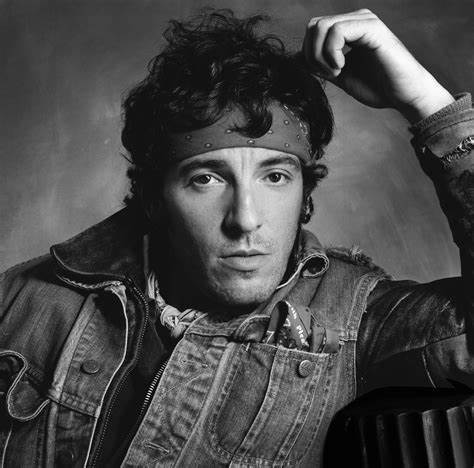
Bruce Springsteen
As a New Jersey teen, Bruce Springsteen got his first guitar and started learning Rock and Blues songs. His sister’s boyfriend was in a group and that gave Springsteen the “in” he needed. From there he traveled through a series of bands before signing what turned out to be a horribly unfair management contract. But that contract, bad as it was, served as Springsteen’s launching pad.The Bruce Springsteen Band formed in ’71 as a ten-piece outfit with horns. After a couple of shows a female back-up singer and some horn players were gone. Fortunately, Clarence Clemons (sax) made the cut. But soon the group was on hiatus.After unsuccessfully wandering around California, Springsteen signed a management contract with Mike Appel’s production company. Even though Appel got Springsteen an audition with legendary producer John Hammond the very next day, the contract proved disastrous. That audition led to an album deal with Columbia Records. Springsteen was to get a paltry $25,000 advance per album. Also, Columbia saw Springsteen as a Folk act.
Having other ideas, he quickly resurrected his backing group naming them the E Street Band. “Greetings From Asbury Park” was the first offering but it failed to resonate with the single “Blinded By The Light” sinking with hardly a trace. “The Wild, The Innocent and The E Street Shuffle,” despite rigorous touring, also stalled.With a career that was building but not breaking out, Springsteen and Rock journalist Jon Landau crossed paths. Eventually, Landau became a friend, confidant and co-producer.,
Landau saw Springsteen at a Cambridge, MA, show and wrote, “I have seen Rock ‘n’ Roll’s future – and its name is Bruce Springsteen.”
The song that caught Landau’s ear was “Born To Run,” which became Springsteen’s signature song.
Many classic albums have an inauspicious beginning and “Born To Run” was one of them.
Born To Run
Guitarist Steven Van Zandt’s involvement had been limited to arranging the horns on “10th Avenue Freeze Out.” “I was just in the studio, hanging around,” said Van Zandt. Springsteen asked what he thought of the album. ‘I think it sucks,’ answered Van Zandt. That might have got him tossed out but Springsteen challenged him to fix it. “So I went and fixed it,” said Van Zandt, who soon became a key member of the E Street Band.
The “Born To Run” album became a huge hit. Of course, it didn’t hurt to have Springsteen’s mug on the covers of both Time and Newsweek in the same week. Some cried hype.Instead of working on a follow-up Springsteen was mired in legal troubles spending most of ’76 and a large chunk of ’77 trying to free himself from Appel’s grip. He was forced to the sidelines until the issue was resolved.
Meanwhile, Manfred Mann’s Earth Band rode to the top of the U.S. charts with a cover of “Blinded By The Light.” The Earth Band also recorded another Springsteen composition, “Spirit In The Night.”Once the management issue was settled, Springsteen was free to continue his career creating ’78’s “Darkness On The Edge Of Town.” He also launched a 109 show U.S. tour covering 86 cities.
Hungry Heart
Double album “The River” rolled out in ’80 (with the classic “Hungry Heart”). The man was certainly prolific with his songs were recorded by Natalie Cole (“Pink Cadillac”), Pointer Sisters (“Fire”), Dave Edmunds (“From Small Things – Big Things One Day Come”) and Gary “U.S.” Bonds (“This Little Girl”).
He followed “The River” with a total change of pace. “Nebraska” was nearly all-acoustic and was recorded on four track equipment.
“Born In The U.S.A.” made Springsteen a superstar. On the liner notes for his “Greatest Hits” collection he mentioned how weird it was to be a pop star (thanks to “Dancing In The Dark”) in his mid-30s. He also claimed he “loved” it.
“Born In The U.S.A.” had a no shortage of great songs. In addition to “Dancing In The Dark,” there was the title track, “Glory Days,” “I’m Goin’ Down” and “Cover Me.” Even the ballads “My Hometown” and “I’m On Fire” showed man at the height of his songwriting and performing powers.
Dancing In The Dark
Glory Days
Both ‘84 presidential candidates tried to acquire “Born In The U.S.A.” as their campaign theme.
Apparently neither Ronald Reagan, Walter Mondale nor their handlers really listened to the song. Instead of being a joyous Beach Boy-type celebration of the good life, “Born In The U.S.A.” charted the dark underbelly of America – the pain, frustration and sense of hopelessness. Springsteen wisely refused overtures from both camps.
Born In The USA
Tunnel Of love
Though a bit subdued, Springsteen’s next effort was the brilliant “Tunnel of Love” album. The main theme was love’s trials and tribulations.
In the early ’90s Springsteen had just about finished his “Human Touch” album when a burst of creativity hit and he wrote and recorded “Lucky Town.” Packaged together, then separately, each sold over a million copies. “Lucky Town” was the harder edged of the two. The introspective “Human Touch” and the rough and tumble “Better Days” were released as singles.
Springsteen continued to record and tour in the ‘90s but spent more time focused on parenthood and the domestic life. But twenty-seven years after hitting the cover of Time, Springsteen made the cover again (a record period between first and second Time cover appearances) on the strength of “The Rising.” Though some songs were completed before 911 (9/11/01), they had the mark of that horrific day and reflected the loss at ground zero when the Trade Center towers came down. Springsteen changed course for his ’05 release “Dust & Devils.” The stripped-down acoustic arrangements left plenty of room for sober lyrics dealing with life’s trepidations. “Magic,” the 11-track ’07 album, was Springsteen’s first with the E Street Band in five years (since ’02’s “The Rising”). “You could say that it’s a little more sonically guitar-driven than any past Bruce album,” said Landau. “Radio Nowhere” won Solo Rock Vocal Performance and Rock Song Grammy Awards.“Working On A Dream,” Springsteen’s 16th studio album was produced by longtime collaborator Brendan O’Brien. The ’08 set was recorded with the E Street Band during downtime on their tour. “All the songs were written quickly (and) we usually used one of our first few takes,” said Springsteen. The album contained “The Last Carnival,” a song that paid tribute to late E Street Band member Danny Federici. “It started out as a way of making sense of his passing,” explained Springsteen. “He was a part of that sound of the boardwalk the band grew up with.”Just days following the album’s debut Springsteen and The E Street Band performed during halftime at Super Bowl XLIII (43) in Tampa. They played “Tenth Avenue Freeze Out,” “Born To Run,” “Working On A Dream” and “Glory Days.”There was more. Springsteen received Best Rock Song award at the 51st Grammy Awards for “Girls In Their Summer Clothes.” But he was initially unaware. “I opened the newspaper on Monday and saw that I had won, and thought, ‘Well, that’s great,'” said The Boss.Springsteen kept his Grammy streak alive when he picked up the Best Solo Rock Performance trophy in ’10 for “Working On A Dream.”.Though the past is the past, the future was about to execrably change. Clemons had been an integral part of the E Street Band since its inception. Springsteen was leaning on Clemons for the “Born To Run” cover. And that seemed symbolic of their relationship – in the studio and especially on stage. So it was hard to comprehend that age and time would conspire to take the “Big Man” down. On June 12, ‘11, Clemons suffered a stroke at his home in Florida. Six days later, he was gone.“(Clarence} loved the saxophone, loved our fans and gave everything he had every night he stepped on stage,” said Springsteen. “His loss is immeasurable and we are honored and thankful to have known him and had the opportunity to stand beside him for nearly forty years. He was my great friend, my partner.”“We will continue to make music and perform,” wrote bandmate Steve Van Zandt on his website. “But it will be very different without him.”Produced by Ron Aniello, “Wrecking Ball” dropped in ’12. The album debuted at #1 in 16 different countries including the U.S. where it sold approximately 196,000 copies in its first week on the way to moving 1.5 million units worldwide to become of the year’s best-selling albums.
The songs on Springsteen’s 17th album had “social overtones” and economic justice themes (that’s no surprise) that were written before Occupy Wall Street movement captured headlines..Two years later, Springsteen returned with “High Hopes,” a collection of covers and originals. It became Springsteen’s eleventh #1 on the U.S. Billboard 200. Opening week sales totaled 99,000 copies.
‘”Western Stars” and “Letter To You,” which arrived in ’19 and ’20, respectively, were critical and commercial success in the United States. “Western Stars,” as the title suggests, evoked the west while “Letter To You” touched on aging and death.
Returning to his roots, Springsteen delivered “Only The Stong Survive,” a collection of R&B and Soul covers. The ’20 set was produced by Aniello who played all the instruments except guitar and piano, which Springsteen handled, with horns by the E. Street Horns.
###
The post Bruce Springsteen appeared first on RockinTown.








 New Posts (Home)
 ChatBox
 Popular Posts
  Game Zone
 Top PodCasts