www.civilwarmonitor.com
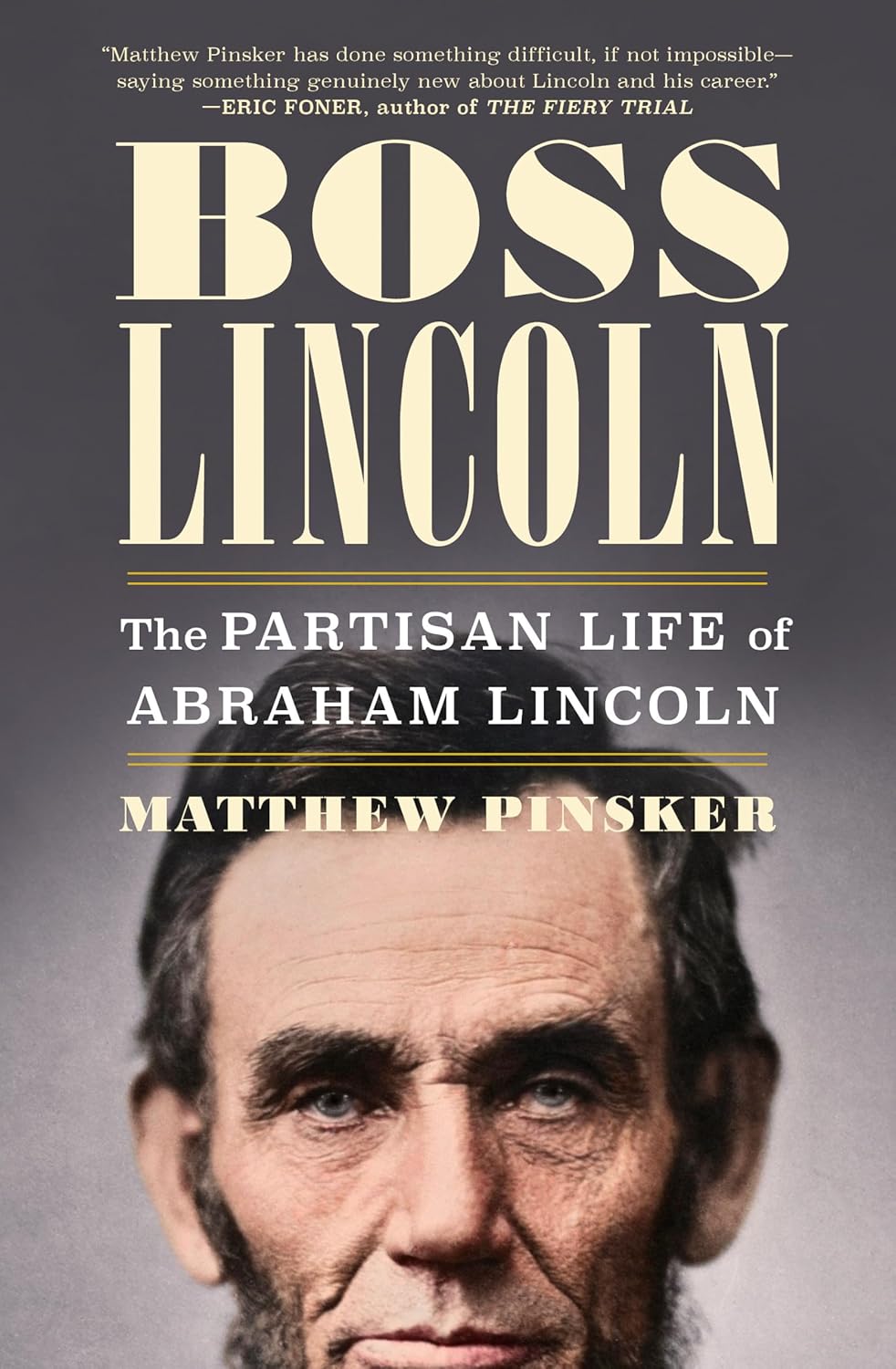
Boss Lincoln (2026)
In this superb, often surprising account by a leading scholar of the Civil War era, Matthew Pinsker presents Abraham Lincoln as a pragmatic and ambitious political animal as he plows his way through the thickets of Illinois politics and into the bruising national arena—and finally the wartime White House. If anyone still thinks of Lincoln as a rube, this deeply researched, crisply written book will dispel that weary stereotype once and for all. Writes Pinsker, “the wartime president was no simple rail-splitter but at times a cold-blooded hatchet man.”
Pinsker, the Pohanka Chair in American Civil War History and director of the House Divided Project at Dickinson College, skillfully reveals the intricate political footwork that led to Lincoln’s rise as a master-strategist, first as a stalwart Whig and then as a Republican, making him one of the canniest political operators in the antebellum United States. Pinsker charts Lincoln’s deft pursuit of “fusion” (the era’s favored term for shaping new alliances from disparate factions), notably during the invention of the Republican party from a congeries of Free Staters, abolitionists, nativists, and anti-slavery Democrats. “To understand Lincoln as a politician,” Pinsker writes, “we must recognize that he was not an office seeker so much as a party builder, and that his peculiar talent for party management was the driving force in his political career.” As Lincoln put it in 1855: “I have no objection to ‘fuse’ with anybody provided I can fuse on ground which I think is right.”
By then, Lincoln was the most indefatigable Republican organizer in the key state of Illinois and in wide demand as a partisan orator. He never shirked confrontation with rivals, enjoyed preparing charts and counting votes, and was a pioneer in the targeted personalization of campaign materials. By 1856, he was already a prospective national candidate, coming in second in the balloting for the vice-presidency on the ticket with Republican presidential nominee John C. Fremont. In 1860, he skillfully outmaneuvered the Republican stalwart William Seward to win the presidential nomination for himself.
Pinsker says that Lincoln’s antebellum partisan experiences prepared him to become an effective wartime president. He details sharply Lincoln’s frustrations with recalcitrant generals, impatient Radicals in Congress, hostile journalists, border-state loyalists, and ambitious rivals—Treasury Secretary Salmon P. Chase in particular—often pushing and cajoling, but never losing sight of his larger goals and only rarely losing his temper. Always cordial, even genial, he nonetheless could, when called for, project great force and authority. Commented the journalist Charles Dana, “There was no flabby philanthropy about Abraham Lincoln.”
Although Lincoln’s personal loathing of slavery was never seriously in question, his arms-length treatment of abolitionists such as Sen. Benjamin Wade (R-OH) and Rep. Thaddeus Stevens (R-PA) has troubled some critics, both in his own day and our own. Pinsker, however, sees Lincoln as always steadily maneuvering toward the antislavery measures he wanted all along. This pragmatic patience was often mistaken for indecision.
Lincoln’s 1864 decision to run for reelection not as a Republican, but as the candidate of the National Union Party has often been dismissed as little more than a temporary expedient to harvest War Democrats’ votes. Pinsker, however, deems it a major strategic shift that embodied his determination reframe the postwar political landscape around emancipation and the eventual incorporation of Black Americans into the political system. To accomplish that goal, Lincoln hoped to inspire “patriotic fusion” across the South, a process he knew would be full of challenges after the war, but which he felt was the best course possible or restoring the shattered nation on a stable basis. “We simply must begin with, and mould from, disorganized and discordant elements,” he reflected. His aim was to unify loyal southern whites with former slaves to build biracial majorities, “and presumably culminate with the birth of multiracial democracy across the nation,” Pinsker writes. He notes that Lincoln rarely even used the label “Republican” after 1862, and never in public statements.
After the 1864 convention, Lincoln and his allies continued to push their supporters toward a broad patriotic front of willing men from any party, but one based on strong measures that included emancipation, Black enlistment, and eventually a constitutional amendment to abolish slavery. “With decisive behind-the-scenes leadership and persuasive public statements, Lincoln had helped the new party develop into a stable and dynamic coalition,” Pinsker writes.
Seen through the fusionist lens, Lincoln’s 1864 dumping of his vice president Hannibal Hamlin, a Maine abolitionist, to make way for Andrew Johnson, a former Tennessee slaveowner—in the view of some, Lincoln’s worst decision as president— was not a misguided blunder, but instead an important step in the effort to cultivate lasting Union support in the South. Lincoln, of course, grossly overestimated the number of Southern Unionists and underestimated the postwar ruthlessness of former Confederates. He didn’t live to see the failure of his strategy in the incompetent hands of the deeply racist Johnson, or the brutal ones of the night-riding Ku Klux Klan.
The Lincoln who emerges from Pinsker’s book is for the most part the morally driven Lincoln we thought we knew, but with added dimension. He is tougher, harder, and less compromising on what really matters to him, as well as a political practitioner of the first rank: in short, a “boss,” though one free of the unsavory connotations that the word usually carries. “Politicians always claim to act on an interest greater than their own ambition,” Pinsker writes. “But in Lincoln’s case, the assertion was true.”
Fergus M. Bordewich’s most recent book is Klan War: Ulysses S. Grant and the Battle to Save Reconstruction.
The post Boss Lincoln (2026) appeared first on Civil War Monitor.








 New Posts (Home)
 ChatBox
 Popular Posts
  Game Zone
 Top PodCasts