www.civilwarmonitor.com
Beyond Shallow Glory
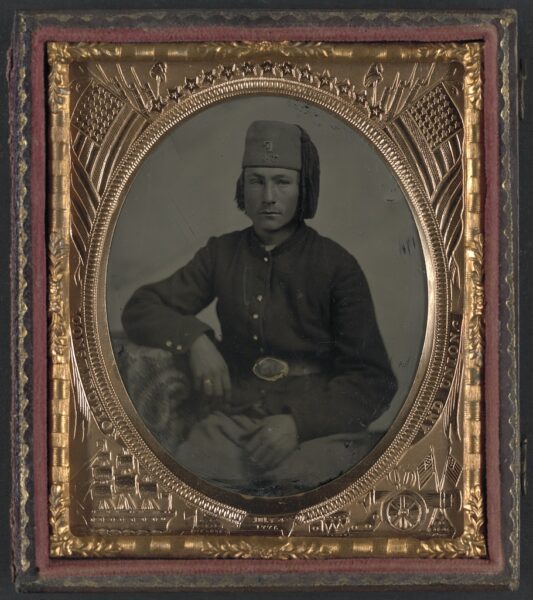
Library of CongressAn unidentified soldier from the 34th Ohio Infantry
On the evening of January 10, 1865, snow battered a small U.S. outpost at Beverly, West Virginia, where the 34th Ohio Infantry was quartered under the command of Lieutenant Colonel Luther Furney. The bitter cold turned out to be the least of the Ohioans’ concerns—as dawn approached a half-starved Confederate force under Major General Thomas L. Rosser ambushed the garrison. It was a risky move given the weather, the Confederates’ 75-mile march from Staunton, Virginia, and their outnumbered force (300 men to the Union’s approximately 1,000). But Rosser’s gamble paid off. The Confederates cut off Furney and his officers from their men, looted the outpost’s supplies, captured the 34th’s regimental colors, and secured almost 600 prisoners.
Some 20th-century histories with a Lost Cause bent celebrate “Rosser’s Raid” as an example of the Confederacy’s bravery and brilliance.1 What these sources fail to acknowledge is that the raid had no lasting results. Furney and several other prisoners escaped even before Rosser made it back to his post; the stolen supplies provided only temporary relief as Union forces isolated and surrounded the remainder of the Confederate armies. Furney’s experience—especially his multiple escapes from imprisonment—reflects on the Confederacy’s inability to establish and maintain territorial control, especially in the war’s final year. All these events were contrary to tales of southern martial success so typically peddled in Lost Cause narratives of the war.2
Luther Furney was born in 1822 in Petersburg, Ohio, during the Jacksonian Era. When the family moved to Kenton, Ohio, his father became a central fixture in the pioneer town, working as a mechanic, gunsmith, grocer, and tavernkeeper. Luther’s father also served as an officer in the 3rd Ohio Militia in the 1830s, including during the Ohio-Michigan War (a mostly bloodless border dispute between the two states from 1835–1836). Luther cleared woods in Kenton to establish an early livelihood and ventured down the Mississippi River to engage in woodcutting for steamships and fishing.3 By the 1840s, he was managing a tavern established by his father and in 1848 married Louisa Souls, with whom he had three children. He also joined the Independent Order of Odd Fellows (IOOF), a fraternal organization based on the values of charity, self-improvement, and neighborly love.4
The day after President Abraham Lincoln’s call for volunteers to defend the Union following the bombardment of Fort Sumter, Furney and fellow Kentonite Asa Carter were recruiting local men for Company D of the 34th Ohio Volunteer Infantry. A county history published in 1910 (with Furney’s input) sheds light on Furney’s early and proactive service in the U.S. military: he was a lifelong Whig and Republican, voting for every Republican presidential candidate from Lincoln to Taft, and he subscribed to the local newspaper, the Kenton Republican. Given his membership in the IOOF and his father’s military service, Furney’s early devotion to the U.S. cause is not surprising.5
Furney and the 34th Ohio assembled at Camp Dennison on September 1, 1861, and subsequently marched to what (in 1863) would become West Virginia. From the outset of Furney’s time in uniform, he encountered the horrors of guerrilla warfare. Less than a month into its service, the 34th engaged with Colonel J.W. Davis, commanding the local Logan County militia, in the Battle of Kanawha Gap, near Chapmanville, Virginia. The Ohioans quickly routed the militia and wounded Davis in a stunning first engagement. From November 1861 through March 1862, Furney’s regiment conducted “guard and scout duty and operate[ed] against guerrillas in Cabell, Putnam, Mason, Wayne and Logan counties.”6
Harper's WeeklyThis Harper’s Weekly illustrations depicts the 34th Ohio advancing on enemy troops during the regiment’s time in western Virginia in 1862.
From May 1862 to May 1864, the 34th Ohio made three attempts to invade the Kanawha River Valley and the Shenandoah Valley so as to disrupt a major Confederate supply line by way of the Virginia and Tennessee Railroad. Furney, who proved adept at ripping up rail lines (a private in the 34th recalled “somebody could get a job of making rails & fence as they are all gone”) led the third attempt from May 1–19, 1864. Along the way, Rebel units and local guerrillas terrorized U.S. soldiers as they marched through the area and at skirmishes at Cloyd’s Mountain, Cove’s Mountain, and New River Bridge. After the clash at New River Bridge, Private James J. Wood of the 34th came across a woman among the dead guerrillas, a discovery that shattered Victorian ideals of women separated from combat and showed how guerrilla warfare blurred societal norms.7
Major General Philip Sheridan’s Shenandoah Valley Campaign from August to October of that year went a step further than targeting the Virginia and Tennessee Railroad. Sheridan sought to both cripple the valley’s agricultural production and drive out Lieutenant General Jubal Early’s Confederate army. The 34th Ohio beat back Early’s forces as part of this offensive before the campaign culminated in the Battle of Cedar Creek on October 19. Exhausted from two months of rapid engagements and retreat, Early was powerless to stop Sheridan’s scorched-earth campaign. Desperate to turn the tide, Early launched a surprise attack at 5 a.m. under the cover of fog on the Union’s extreme left, where Furney was acting as division officer. The attack caught Furney by surprise and led to his capture. But Early could not capitalize on his victory; Furney escaped and returned to his unit within three days while a Union counterattack resulted in Early’s forces being routed and fleeing south. Furney’s easy escape and reentry into U.S. lines underscores the Confederacy’s growing inability to execute its military objectives.8
Following the Battle of Cedar Creek, Furney and the 249 remaining men of the 34th Ohio joined Lieutenant Colonel Robert Youart’s 8th Ohio Cavalry garrison at Beverly, the site of Rosser’s successful raid and Furney’s equally successful escape from enemy hands, his second in three months. Rosser’s raid succeeded because Youart and Furney believed it unlikely there would be an assault in the harsh winter, an attitude born of four long years of war. Lost Cause histories may credit the success of the 75-mile march over treacherous terrain as a mark of military acumen, when in truth it was born of desperation and failed to accomplish much. Rosser shipped most of the captured men to Libby Prison, while Furney was forced from the army the following February for allowing those men to be captured, a dismissal that stained an otherwise respectable military career.9 Exhaustion and hunger—not brilliance or wisdom—better describe the officers on each side of the raid.
Furney’s experience illustrates how romanticized Confederate military actions were often undertaken out of starvation and recklessness, not wisdom, and shows that Confederate forces late in the war often failed to complete basic tasks like securing their prisoners. While Lost Cause histories cherry-pick evidence to cover infected wounds, actual context instills the human ingredient into the past.
Ian Malingowski is a graduate student in the Public History program at Middle Tennessee State University. His research focuses primarily in two directions: East-Central European Diasporas in the Interwar Period and American Civil War memory.
The post Beyond Shallow Glory appeared first on Civil War Monitor.








 New Posts (Home)
 ChatBox
 Popular Posts
  Game Zone
 Top PodCasts