www.militarytimes.com
Gunfight at the Veracruz Custom House led to six Medal of Honor recipients
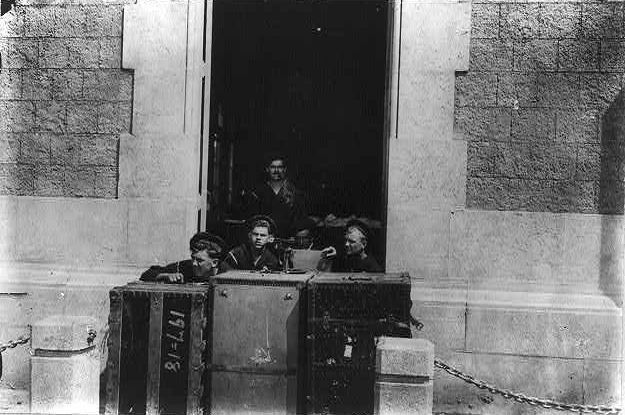
On April 9, 1914, amid the chaos of Mexico’s revolutionary conflicts, nine U.S. Navy seamen had been detained by the dictatorship of Gen. Victoriano Huerta. Although they were released on April 21, the United States learned that the steamship Ypiranga had entered the port of Veracruz with a cargo of German weaponry. In response, the U.S. Navy confiscated Ypiranga and landed an occupation force in Vera Cruz. Although the Americans hoped to avoid bloodshed, the city’s commander, Gen. Gustavo Maass had orders to resist foreign occupation. Consequently, the parties that came ashore on April 21 found themselves in an escalating urban battle. One of the most dramatic events of that first day involved orders from the fleet commander, Rear Adm. Frank Friday Fletcher: “SEIZE CUSTOM HOUSE. DO NOT PERMIT WAR SUPPLIES TO BE DELIVERED TO HUERTA GOVERNMENT OR ANY OTHER PARTY.” When the Americans advanced on the building, they suddenly found themselves pinned down by what an officer on the scene, Ensign George Lowry, described as “murderous rifle and machine gun fire.” Not wishing to risk any more men than he had to, Fletcher called for a handful of volunteers. Five men from the battleship Florida — Harry C. Beasley, George Cregan, Joseph G. Harner and J. F. Schumacher and Joseph Sinnett — alongside Hospital Apprentice 1st Class William Zuiderveld, volunteered.Setting out, Lowry planned to flank the Custom House and attack from the side. Hopes of a surprise assault did not succeed as planned, however. A bullet clipped a button off Lowry’s cap and another creased his right legging. Beasley was slightly wounded and Schumacher was struck in the head. An Aug. 19 after-action report from Adm. Fletcher included a description of what followed:“After the five volunteers from the First Company, Florida Battalion, had advanced with me under heavy fire along the narrow alley between the customhouse and the open warehouse, and Schumacher was shot in the head, I called down the alley for the ambulance party. Zuiderveld, W., Hospital Apprentice First Class, responded quickly and advanced up the alley in a heavy fire to the position occupied by the five volunteers. There kneeling in an exposed position and unaided, he bandaged Schumacher’s head to stop the flow of blood, while a steady fire was being maintained against the Mexicans in the doorway of the Oriente Hotel.”Amid the shooting, one of the Custom House’s most spirited defenders was José Azueta Abad, a 19-year-old Mexican navy lieutenant manning a machine gun and inflicting casualties on the Americans, most likely Schumacher as well. Lowry’s volunteers had their own ace in the hole, however: Boatswain’s Mate 2nd Class Joseph Gabriel Harner who had a reputation as a crack marksman. Engaging Azueta, he severely wounded him at 300 yards. As the Americans closed in and fired into the customhouse, its garrison finally threw out their weapons and surrendered. After the exchange, the Americans found 12 bullet impacts in the vicinity. Sadly, in spite of Corpsman Zuiderveld’s efforts, Schumacher died of his head wound. Nonetheless, Zuiderveld was cited for having “showed extraordinary heroism in the line of his profession.” The Americans occupied Veracruz until Nov. 23, when they withdrew. After hostilities abated, Adm. Fletcher, after learning of Azueta’s valor at the Custom House, sent a message asking to visit him and pay his respects. Azueta’s purported response was: “If the American enters my house, I will either kill him or myself.” Later, when Fletcher offered to put his own surgeon at his disposal, Azueta again declined, insisting on relying on a local surgeon, Dr. Rafael Cuervo Xicoy, who was handicapped by lacking the quality of equipment. Partly due to that, the young officer succumbed to his wounds on May 10. Promoted to captain by the President of the Republic before his death, Azueta has since been honored among Mexico’s heroes of Veracruz.He was not alone. On Jan. 6, 1915, Secretary of the Navy Josephus Daniels came aboard USS Florida in the Brooklyn Navy Yard to award Medals of Honor to Lowry, Beasley, Cregan, Harner, Sinnett and Zuiderveld.Adm. Fletcher also received the Medal of Honor, as did his nephew, Lt. Frank Jack Fletcher. In the inter-war years, Lowry held four destroyer commands. He entered the Reserves in 1927, but in 1940 he returned to regular service and in 1941 he served as operations officer in the Western Sea Frontier, for which he received the Legion of Merit. Lowry retired as a rear admiral in October 1946. He died at Carmel by the Sea, California, on Feb. 5, 1978, aged 91, and was subsequently buried at sea.








 New Posts (Home)
 ChatBox
 Popular Posts
  Game Zone
 Top PodCasts