www.eff.org
The Justice Department Wants To Give Patent Trolls More Power
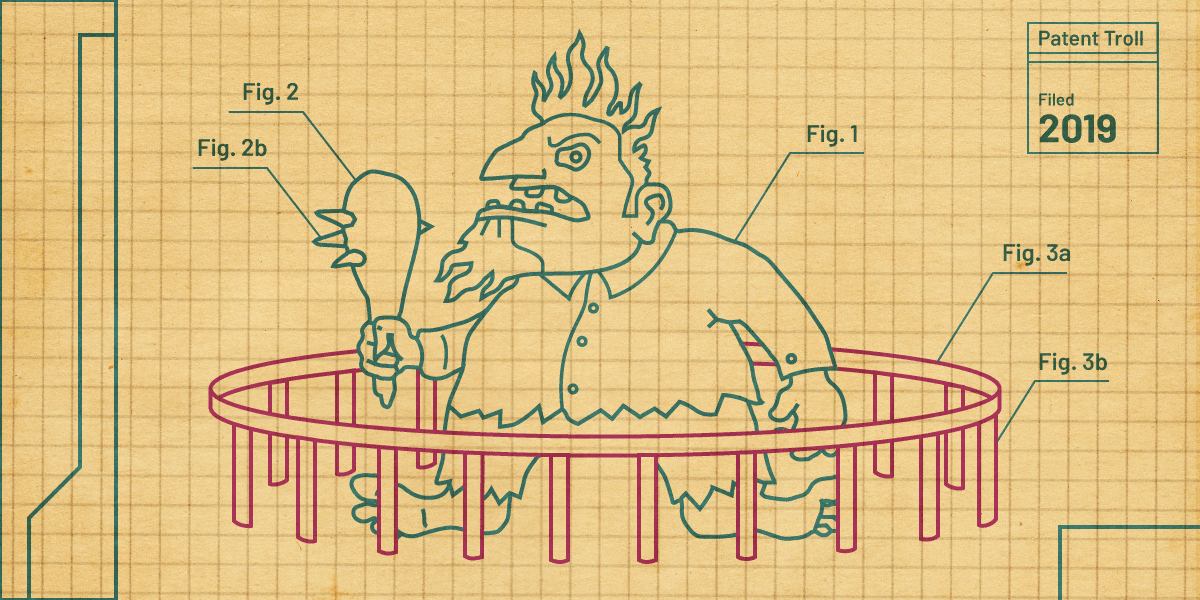
Software patents are mostly vague, hard to define, and widely abused. Most tech patent lawsuits aren’t filed by companies that make real products. They’re filed by patent trolls, companies that acquire patents to extract payments through litigation and legal threats.
A patent on one feature of a smartphone shouldn’t give the patent owner the power to threaten the existence of the entire product line. But that is exactly the leverage patent trolls want—and the current administration is helping them to get it.
In two recent patent cases, Radian Memory Systems v. Samsung and Collision Communications v. Samsung, the Justice Department and the U.S. Patent and Trademark Office have asked courts to make it easier for patent owners to get injunctions. These are judicial orders that can force companies to stop selling products or remove features from them, rather than simply pay monetary damages.
The threat of an injunction can pressure a company to pay far more than what a patent is actually worth. In 2006, NTP Inc., a patent holding company with no products of its own, was able to pressure BlackBerry manufacturer Research in Motion Ltd. to pay a $612 million settlement when it was on the verge of an injunction.
Protection Against Patent Trolls
In May 2006, the Supreme Court rejected the practice of granting permanent injunctions almost automatically after a finding of patent infringement. In eBay v. MercExchange, the high court held that patent owners must satisfy the same tough requirements that plaintiffs in non-patent cases must meet to get a permanent injunction. After eBay, patent owners had to show “irreparable harm,” that they can’t be adequately compensated by money, that the “balance of hardships” favors the plaintiff, and, critically, that an injunction would not harm the “public interest.”
At EFF, we celebrated eBay v. MercExchange as a major win for internet users. More than twenty years ago, we saw that software patents were going to be a disaster—not just for small companies (which they are), but for freedom of expression online. As EFF explained in its brief:
The United States Patent and Trademark Office has issued patents on methods fordownloading video programs, publishing web pages, sending email messages, making internet telephone calls, and even online fundraising methods. Injunctions against uses of these technologies—and many similar technologies—will inevitably affect, and may even chill, free expression on the internet.
The eBay rules make sense because the monopolies provided by patents are only justified when they serve a public purpose: promoting scientific and technological progress. Enforcing patents is not supposed to come at the cost of later innovators, free expression, or people’s access to technology.
Now, two decades after eBay, the government is urging courts to interpret those protections in ways that could give patent owners greater leverage. It’s unusual for the government to intervene in private patent disputes, but the current administration has done so repeatedly—and not on the side of the public.
Patent Licensing Disputes Shouldn't Threaten Entire Product Lines
In June 2025, the Justice Department and Patent Office filed a “statement of interest” in Radian Memory Systems v. Samsung, a dispute over patents involving solid-state drives (SSDs), the storage devices commonly used in modern computers. Radian, a patent assertion company tied to Fortress Investment Group, sought a preliminary injunction that would block sales of Samsung’s products even before a judge or jury had decided whether there was patent infringement.
In its statement, the government argued that even a patent owner whose business depends entirely on patent licensing could suffer irreparable harm, because calculating how much money it should get might be difficult. “In cases of unique assets, courts have commonly found irreparable harm when damages are difficult to calculate,” the DOJ writes in its brief.
But courts regularly resolve disagreements about patent royalty rates, a patent’s contribution, and comparable licenses. The fact that those disagreements exist does not, by itself, establish that monetary damages wouldn’t be enough to compensate the patent owner. If courts adopted the DOJ’s views here, a difficult but ordinary part of patent litigation could become a reason for finding irreparable harm, making it easier for patent owners to seek injunctions that threaten entire product lines. Pure patent-licensing businesses would love that—they would routinely start to ask for injunctions, since eBay’s most important protections would be weakened.
The government also says that “the prospect of an injunction can facilitate negotiation among the parties.” That’s exactly the problem. A company negotiating under threat of shutdown might pay massive sums to patent litigation shops in order to avoid disruption to product lines or customers. The payment is more likely to reflect the value of the threat, rather than the value of a patent. Radian ultimately withdrew its request for a preliminary injunction, but the government's arguments about when injunctions should be available remain concerning.
A Second Attempt To Weaken eBay
Remarkably, the government returned to this argument in February of this year, in a case called Collision Communications v. Samsung, which had already gone to trial. In this case, Collision, a patent-licensing entity that acquired its patents from a defense contractor, was awarded a $445.5 million jury verdict for infringement of four patents, and then sought an injunction.
Even though the jury had awarded Collision $445.5 million in damages, the government still intervened in the case, arguing that patent owners like Collision, which do not make products, should not be denied injunctions because they rely on patent licensing. They also argued that the difficulty of calculating monetary damages can support an injunction.
Although the court agreed that Collision had suffered irreparable harm and that monetary damages would be inadequate, U.S. District Court Judge Rodney Gilstrap rejected Collision’s argument that ongoing patent infringement automatically establishes irreparable harm. He ultimately denied the injunction because Collision didn’t satisfy two other requirements of the eBay test: showing that the balance of hardships favored an injunction and that an injunction would not harm the public interest.
Now Collision has appealed, and the argument is in front of the Federal Circuit, the nation’s top patent court. A brief from the Public Interest Patent Law Institute (PIPLI) explains what is at stake: when a patent owner doesn’t have any products, an injunction can prevent the public from accessing critical technology altogether. Since the patents here involve how mobile phones connect to cellular networks, “the effect on the public goes far beyond what these patents claim as improvements,” PIPLI explains.
The outcome could extend well beyond these two companies. The eBay test requires courts to consider who a permanent injunction would hurt, and who would benefit—including the public. A patent owner’s desire for more negotiating leverage should not override the interests of millions of people who rely on their phones. Yet that’s exactly the kind of leverage the government’s arguments could make it easier for patent owners to obtain, at the expense of the public.
The Government Should Protect the Public, Not Patent Owners
Patent owners can already collect damages and royalties when their patents are infringed. But they should not get a shortcut to shutting down tech products just because calculating damages is hard work.
The Justice Department should defend the eBay safeguard. Instead, this administration is helping patent owners find ways around it. Courts should reject those arguments. We shouldn’t even have to say it, but we do: making patent threats more valuable does not align with the public’s interest.
This post is the second of a three-part series about how the current administration is using its power to give patent holders more power at the public’s expense. The final post will publish next week. See our previous post:
How the USPTO is undermining patent reviews


 New Posts (Home)
 ChatBox
 Popular Posts
 Game Zone
 Top PodCasts