New Posts (Home)
 ChatBox
 Popular Posts
  Game Zone
 Top PodCasts

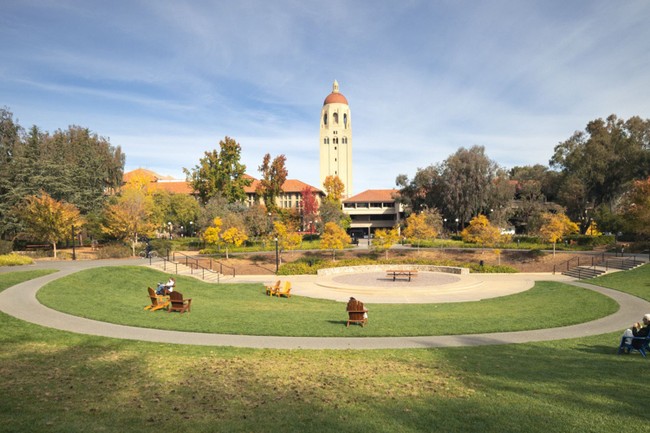
Forty percent of Stanford students are classified as "disabled."
Harvard, which is obviously the home of ableism, only has 20%.
Now you might think that Stanford is filled with one-armed, one-legged, blind, and deaf people, but obviously that isn't the case. Instead, this is a result of a DEI infrastructure and therapy culture.
Advertisement
The full piece by @rosehorowitch https://t.co/DjJfFy6yCi
— Derek Thompson (@DKThomp) December 2, 2025
That, and of course, the perfectly rational impulse of students to follow the incentives. Colleges reward you with perks for being "disabled," so the number of disabled people goes up. It's a version of the moral hazard problem.
dministering an exam used to be straightforward: All a college professor needed was an open room and a stack of blue books. At many American universities, this is no longer true. Professors now struggle to accommodate the many students with an official disability designation, which may entitle them to extra time, a distraction-free environment, or the use of otherwise-prohibited technology. The University of Michigan has two centers where students with disabilities can take exams, but they frequently fill to capacity, leaving professors scrambling to find more desks and proctors. Juan Collar, a physicist at the University of Chicago, told me that so many students now take their exams in the school’s low-distraction testing outposts that they have become more distracting than the main classrooms.
Accommodations in higher education were supposed to help disabled Americans enjoy the same opportunities as everyone else. No one should be kept from taking a class, for example, because they are physically unable to enter the building where it’s taught. Over the past decade and a half, however, the share of students at selective universities who qualify for accommodations—often, extra time on tests—has grown at a breathtaking pace. At the University of Chicago, the number has more than tripled over the past eight years; at UC Berkeley, it has nearly quintupled over the past 15 years.
Advertisement
UC Berkeley hasn't admitted five times as many students who are legitimately disabled; it is just treating five times as many people as if they were because the students have figured out that they can get accommodations that others won't if they claim a disability.
You are kind of a chump if you don't abuse the system. Ask Minnesota Somalis about that one.
The increase is driven by more young people getting diagnosed with conditions such as ADHD, anxiety, and depression, and by universities making the process of getting accommodations easier. The change has occurred disproportionately at the most prestigious and expensive institutions. At Brown and Harvard, more than 20 percent of undergraduates are registered as disabled. At Amherst, that figure is 34 percent. Not all of those students receive accommodations, but researchers told me that most do. The schools that enroll the most academically successful students, in other words, also have the largest share of students with a disability that could prevent them from succeeding academically.
“You hear ‘students with disabilities’ and it’s not kids in wheelchairs,” one professor at a selective university, who requested anonymity because he doesn’t have tenure, told me. “It’s just not. It’s rich kids getting extra time on tests.” Even as poor students with disabilities still struggle to get necessary provisions, elite universities have entered an age of accommodation. Instead of leveling the playing field, the system has put the entire idea of fairness at risk.
The power of being higher up on the intersectional ladder is substantial, and the number of steps on that ladder has proliferated.
Advertisement
It used to be that you had to be female or a racial minority. Then came sexual orientation, and transness, being a Muslim, or being Queer. There are as many variations as pronouns, which proliferate at an astonishing rate, and there are even arguments about who gets closer to the top.
I'm not immersed in that environment, but I can guess. If you a black Muslim Queer who hates Jews and white men and who prefers sex with people pretending to be cows while screaming about Trump being a Hitler figure who uses fossil fuels to burn puppies and force womyn to be pregnant, you likely will get a scholarship to a top school and a pass as you beat up Jews.
Oops. I left off morbidly obese. Being morbidly obese and "neurodivergent" in addition to all the rest will net you a prime spot.
No one is more skeptical of the accommodations system than the academics who study it. Robert Weis, a psychology professor at Denison University, pointed me to a Department of Education study that found that middle and high schoolers with disabilities tend to have below-average reading and math skills. These students are half as likely to enroll in a four-year institution as students without disabilities and twice as likely to attend a two-year or community college. If the rise in accommodations were purely a result of more disabled students making it to college, the increase should be more pronounced at less selective institutions than at so called Ivy Plus schools.
In fact, the opposite appears to be true. According to Weis’s research, only 3 to 4 percent of students at public two-year colleges receive accommodations, a proportion that has stayed relatively stable over the past 10 to 15 years. He and his co-authors found that students with learning disabilities who request accommodations at community colleges “tend to have histories of academic problems beginning in childhood” and evidence of ongoing impairment. At four-year institutions, by contrast, about half of these students “have no record of a diagnosis or disability classification prior to beginning college.”
Advertisement
Well, duh. Students who go to prestigious higher education institutions are the ones most likely to have learned to game the system, so it is no surprise that they continue to do so. And such institutions are the most likely to have curricula specifically designed to teach oppression studies, and to argue for "equity." They train their students to look for every advantage and exploit it.
That's why, when you read about some race or gender hoax at a university, it is almost always a prestigious one. Swastikas, nooses, and racial slurs somehow always pop up at prestigious schools filled with the children of the woke, and far less often elsewhere. It's not because these schools are filled with white supremacists; it's that being a "victim" brings great rewards.
When you reward something, you get more of it.
A parent in Scarsdale, New York, who works in special education told me that it’s become common for parents of honors students to get their kids evaluated so they can have extra time on tests. The process usually starts when kids see that their peers have accommodations— or when they bring home their first B. “It feels in some ways like a badge of honor,” she said. “People are all talking about getting their children evaluated now.” In 2019, a Wall Street Journal analysis found that one in five Scarsdale High School students was considered disabled and eligible for accommodations on college entrance exams—a rate more than seven times higher than the national average.
Several of the college students I spoke with for this story said they knew someone who had obtained a dubious diagnosis. Hailey Strickler, a senior at the University of Richmond, was diagnosed with ADHD and dyslexia when she was 7 years old. She was embarrassed about her disabilities and wary of getting accommodations, until her sophomore year of college. She was speaking with a friend, who didn’t have a disability but had received extra time anyway. “They were like, ‘If I’m doing that, you should definitely have the disability accommodations,’” Strickler told me.
Advertisement
In a way, you have to admire the kids and make fun of the academics who enable all this. The kids are doing what they are rewarded for, and all these academics are wringing their hands because they couldn't predict what any manager at a fast food restaurant could have told them.
So much for the "experts" and "educators." Unable to predict what any ordinary person could in a hot minute.
Of course, the disability advocates love the system and claim it is great. The whole world should be designed to accommodate everybody's quirks rather than toughen people up so they can excel.
Collar, the University of Chicago physics professor, said that part of what his exams are designed to assess is the ability to solve problems in a certain amount of time. But now many of his students are in a separate room, with time and a half or even double the allotted time to complete the test. “I feel for the students who are not taking advantage of this,” he told me. “We have a two-speed student population.”
Most of the disability advocates I spoke with are more troubled by the students who are still not getting the accommodations they need than by the risk of people exploiting the system. They argue that fraud is rare, and stress that some universities maintain stringent documentation requirements. “I would rather open up access to the five kids who need accommodations but can’t afford documentation, and maybe there’s one person who has paid for an evaluation and they really don’t need it,” Emily Tarconish, a special-education teaching-assistant professor at the University of Illinois at Urbana-Champaign, told me. “That’s worth it to me.”
Advertisement
It's the equity mindset, which inevitably leads to the Harrison Bergeron future, where in order to get equity, you have to hobble the excellent to ensure they don't do better than others.
Obviously, keeping somebody out of Stanford because their legs don't work is stupid. Stanford isn't about maximizing your excellence in track and field, and people with paralysis are just as likely to be good at physics or computer programming as somebody who can run a marathon.
But if you can't concentrate, or claim you can't? Perhaps Stanford is not for you, you know.
Just sayin'. I didn't get a spot on Duke's basketball team when I was there, although I tutored Christian Laettner once. He was 18 inches taller than I, so I looked up to him.
There is nothing benign about this trend. "Accommodating" people is only a good thing when the accommodations are irrelevant to the task at hand.
But that doesn't apply here. What we have done is create a system where you are a chump if you are not a scammer. It is a version of the rot that dominates failed third-world cultures, although its expression is quite different.
We are teaching our future elite that the route to success is cheating, and justifying it by claiming to help the disabled.
Ironic, isn't it?
Editor’s Note: Every single day, here at Hot Air, we will stand up and FIGHT, FIGHT, FIGHT against the radical left and deliver the conservative reporting our readers deserve.
Help us continue to point, laugh, and expose the idiocy of progressive elites. Join Hot Air VIP and use promo code FIGHT to get 60% off your membership!