New Posts (Home)
 ChatBox
 Popular Posts
  Game Zone
 Top PodCasts


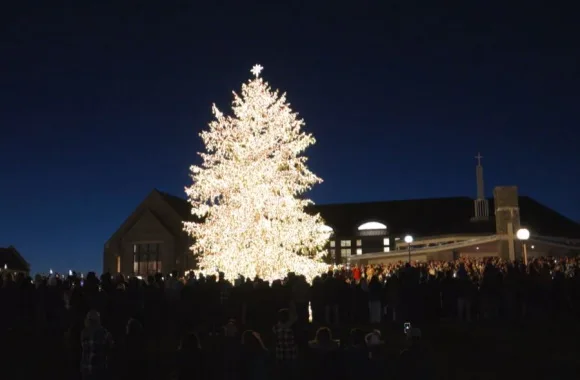
From New York to Alaska, some universities chose to use the neutral holiday tree term rather than Christmas tree, a practice that illustrates a broader secularization trend surrounding the holiday season.
At Marist University in Poughkeepsie, New York, the annual Holiday Tree Lighting took place on Nov. 18. Marist incorporates displays for Hanukkah and Kwanzaa, framing the tree as a unifying symbol for diverse celebrations.
Similarly, Western Oregon University in Monmouth, Ore., hosted its 58th annual Holiday Tree Lighting on Dec. 5. The event centered on a giant sequoia planted in 1887, with activities including a merry market, hot cocoa, a parade featuring local mayors, and photos with Santa. Despite the presence of Santa, the university consistently uses the term holiday tree in official promotions.
Likewise, Idaho State University offered its campus community a Holiday Tree Lighting on Dec. 2 with “hot chocolate, crafts, and visit with Santa indoors.”
The University of Alaska, Fairbanks, touts its holiday tree, located in the campus museum and decorated with polar bears. In a Dec. 2 article on tree selection and maintenance by West Virginia University, it uses the term holiday tree.
Meanwhile, Wright State University hosted a “Holiday Tree and Hot Cocoa” social and William Peace University had a “Holiday Tree Lighting” ceremony.
Media relations officials from the universities did not respond to The College Fix’s request for comment regarding the terminology.
Opting for “holiday” over “Christmas” is nothing new for higher education.
In 2023, an sent to the Wake Forest University campus community announcing its annual Lovefeast, a service to mark Christmas, did not include the actual word “Christmas,” The College Fix reported at the time.
In 2017, University of Minnesota community members were warned against imagery such as Santa, Christmas trees, wrapped gifts and the colors “red and green,” calling them “not appropriate.”
In 2015, the University of Mississippi renamed its annual “A Grand Ole Christmas” tree-lighting ceremony as “Hotty Toddy Holiday,” with an event organizer telling the campus NewsWatch Ole Miss at the time: “Grand Ole Christmas – it connoted too much Christianity on campus and so we wanted to have a more inclusive environment for the holidays this year.”
Although, Ole Miss leader have had a change of heart. This year the university rolled out a 30-foot Christmas tree to the center of the quad — and called it as much in a press release.
Some argue there is nothing wrong with using the term Christmas.
Liberty Counsel, a nonprofit legal group dedicated to defending religious freedom, has frequently challenged restrictions on public expressions of Christianity, including holiday displays. The organization has successfully defended cases involving Christmas trees, nativity scenes, and other Christmas symbols in public spaces.
Last month it launched its 23rd annual Friend or Foe Christmas Campaign, “designed to educate and, when necessary, litigate to ensure religious viewpoints are not censored from Christmas and holiday themes,” the group stated on its website.
In particular, at public schools, students and teachers should feel free to express themselves with Christmas merriment and symbolism, the news release stated.
“Censoring Christmas—whether by avoiding the word entirely, removing religious imagery, or directing employees to use holiday-neutral greetings—tends to polarize public reaction due to several interconnected cultural, emotional, and constitutional reasons,” the group stated.
But proponents of the “holiday tree” label argue it fosters unity in multicultural environments, allowing the tradition to resonate with students celebrating Hanukkah, Kwanzaa, or secular winter festivities.
MORE: What happened to the Christmas tree? Cornell professor makes a case for the evergreen