endoftheamericandream.com
Yes, The Resting Place Of Noah’s Ark Has Been Discovered, And Scientists Are About To Prove It
The remains of Noah’s Ark are contained in the Durupinar formation in the Mountains of Ararat. I have no doubt about this. The boat-shaped Durupinar formation has the exact same dimensions that the Bible says that Noah’s Ark had. Ground-penetrating radar has confirmed that the ship that is buried there has corridors, compartments and three distinct levels. Needless to say, the Bible says that the Ark was built with lower, middle, and upper levels. There are perfect right angles inside the formation that could not have been produced naturally. What I have shared so far is just the tip of the iceberg, because there is so much more evidence. So how did an absolutely enormous three level ship that is roughly the size of a World War I-era aircraft carrier end up so far away from any major body of water in the Mountains of Ararat?
That is a very good question.
If you do not believe in Noah’s Ark, that will be exceedingly difficult for you to explain.
Skeptics are scrambling to come up with some sort of a theory that might work, because for most of them it is unthinkable to concede that the Bible is historically accurate.
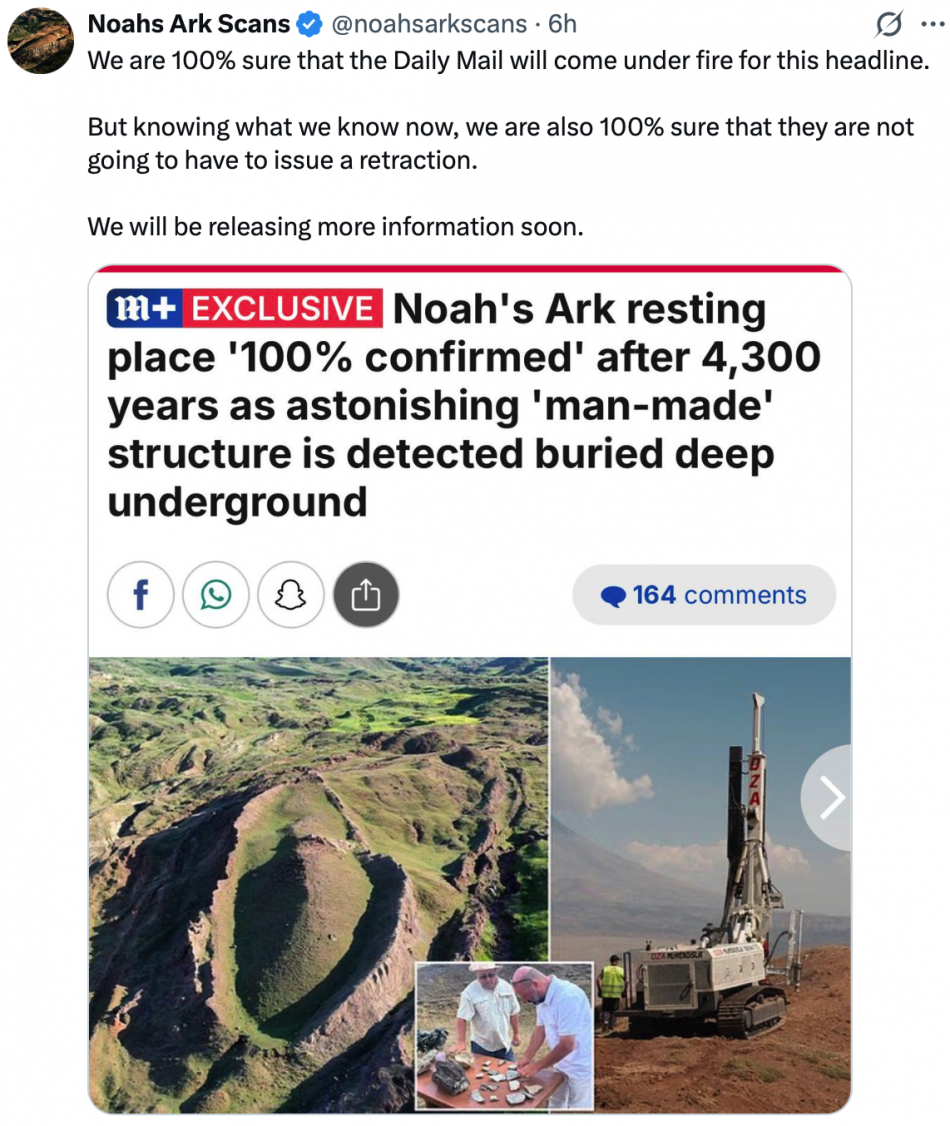
Yesterday, the Daily Mail published an article that claimed that the resting place of Noah’s Ark has been 100 percent confirmed.
In response, one of the organizations that is involved with the scientific work that is going on at the Durupinar formation stated that “knowing what we know now, we are also 100% sure that they are not going to have to issue a retraction”…
So how can they be so confident?
An international team of researchers, geologists and archaeologists has been conducting an unprecedented scientific investigation of the Durupinar formation, and they are extremely excited about what they have found so far…
For centuries, travelers passed through these mountains.
With Mount Ararat rising behind the Durupınar formation, this region became an ancient crossroads between east and west, a route later traveled by merchants, pilgrims and travelers along the Silk Road.
And according to ancient traditions, some of those pilgrims came here because they believed the Ark had come to rest in these mountains.
There are even accounts of travelers taking pieces of wood from the Ark as sacred relics, pieces that were later preserved in churches and monasteries.
Today, the story is being investigated in a very different way.
Instead of simply collecting relics, our team is collecting data.
Radar. Core drilling. Soil samples. Geological analysis.
Generations of people have come looking for Noah’s Ark.
Now we’re using modern science to investigate what remains beneath the surface.
For years, researchers were prevented from doing this sort of work by Turkish authorities.
But now permission has been granted, and the team is being led by a couple of prominent Turkish professors…
The 2026 field program is led by Turkish Professor of Archaeology Prof. Dr. Cenker Atila of Sivas Cumhuriyet University and supported by Prof. Dr. Ahmet Şengönül, Rector of Sivas Cumhuriyet University with Noah’s Ark Scan’s Andrew Jones serving as Vice President of the Noah’s Ark Research Project. This Scientific Expedition is being conducted with official authorization from relevant Turkish government agencies. The Durupınar formation is a 157-meter (515-foot) boat-shaped feature first identified in 1959 by Turkish Army Capt. İlhan Durupınar.
This is a really big deal.
Never before have researchers been allowed to drill deep into the Durupinar formation to collect core samples.
According to Andrew Jones, at one point they were forced to stop drilling because they “struck a layer so hard that the drill bit broke”…
“For the first time in history, we are performing an extensive, permitted deep core drilling survey inside and outside the Durupınar Noah’s Ark site, recovering samples from depths of up to 18 meters, nearly 60 feet. We have so far recovered layers of rich organic material that we believe could be the decayed top tier remains of the Ark. We are encountering multiple cavities, including one filled with mud and water. No bedrock or solid limestone has so far been identified in the holes drilled inside the formation. These current findings challenge claims that this is simply a natural shape made of limestone or bedrock.
“In one of the holes drilled inside the boat, approximately 4–5 meters below the surface, The drilling system had already penetrated the overlying material, but at this layer, the operation stopped as we struck a layer so hard that the drill bit broke. Petrified or highly mineralized wood are both a possibility we want to investigate through third party lab testing.”
Petrified wood can be much harder than limestone.
I have an old friend that has actually been to the Durupinar formation.
He has personally confirmed to me that there is petrified wood at the site.
The good news is that the drill bit has been repaired and so the core drilling will be able to continue…
In addition to the core drilling that is being done, the team also intends to insert an underground exploration drone into “voids, tunnels, and corridors previously mapped by ground-penetrating radar”…
Second, researchers plan to insert the custom-built GOPHER underground exploration drone into voids, tunnels, and corridors previously mapped by ground-penetrating radar, electrical resistivity tomography, and related surveys. GOPHER, named for the “gopher wood” of Genesis, is equipped with a high-resolution camera, designed to enter narrow borehole access points without opening large excavation trenches.
That drone should be able to give us a tremendous amount of information.
In fact, I believe that what that drone reveals will shock the entire world.
Prior to all of this, months of important work has been going on at the Durupinar formation…
The drilling campaign follows months of baseline work at the site, including precision GPS mapping, three-dimensional digital modeling, soil sampling inside and outside the outline, and high-resolution subsurface imaging. Earlier scans identified linear features, right-angle intersections, layered anomalies, and elongated voids interpreted by the team as possible corridors and chamber-like spaces. U.S. Defense Scientist Dr. Khrosrow Bakthar, recently deployed BaktharRadar at the site and provided the core drilling coordinates to the Noah’s Ark 2026 expedition team. Dr. Bakthar’s preliminary report found no bedrock at the site, more details of the prestigious scientist’s report are expected to be released by Noah’s Ark Scans later this week.
To me, what the ground-penetrating radar has been discovering is particularly exciting…
The team has also found pottery near the Durupinar formation “that predates the flood”, and we are being told there are lots of seashells in the area that haven’t even fossilized yet.
That seems rather odd considering the fact that the closest major body of water is about 150 miles away.
So how did all of those seashells get there?
Of course all of the evidence that is being collected is simply confirmation of what locals in the area have known for thousands of years.
In fact, residents of that region have always been very proud of the fact that the resting place of Noah’s Ark is there.
And all the way back in the first century, Josephus identified that location as the resting place of Noah’s Ark.
So it isn’t as if we have suddenly discovered something new.
I suppose it would be much more accurate to say that we have rediscovered what others have known all along.
Noah’s Ark really does exist, and it is still sitting there in the Mountains of Ararat where it has always been since the days of the Flood.
Michael’s new book entitled “10 Prophetic Events That Are Coming Next” is available in paperback and for the Kindle on Amazon.com, and you can subscribe to his Substack newsletter at michaeltsnyder.substack.com.
About the Author: Michael Snyder’s new book entitled “10 Prophetic Events That Are Coming Next” is available in paperback and for the Kindle on Amazon.com. He has also written nine other books that are available on Amazon.com including “Chaos”, “End Times”, “7 Year Apocalypse”, “Lost Prophecies Of The Future Of America”, “The Beginning Of The End”, and “Living A Life That Really Matters”. When you purchase any of Michael’s books you help to support the work that he is doing. You can also get his articles by email as soon as he publishes them by subscribing to his Substack newsletter. Michael has published thousands of articles on The Economic Collapse Blog, End Of The American Dream and The Most Important News, and he always freely and happily allows others to republish those articles on their own websites. These are such troubled times, and people need hope. John 3:16 tells us about the hope that God has given us through Jesus Christ: “For God so loved the world, that he gave his only begotten Son, that whosoever believeth in him should not perish, but have everlasting life.” If you have not already done so, we strongly urge you to invite Jesus Christ to be your Lord and Savior today.
The post Yes, The Resting Place Of Noah’s Ark Has Been Discovered, And Scientists Are About To Prove It appeared first on End Of The American Dream.
 New Posts (Home)
 ChatBox
 Popular Posts
  Game Zone
 Top PodCasts