www.historyhit.com
Italy’s Hidden Hellenic Heart: Paestum and the Art of Ancient Greece
When you picture the greatest temples of the ancient world, your mind likely jumps to the Parthenon in Athens. But presenter Tristan Hughes argues that one of the best-preserved, most stunning structures on Earth isn’t in Greece at all – it’s in Italy, at the site of Paestum.
Founded by Greek colonists 2,500 years ago, Paestum is a living testament to a vibrant, untold chapter of the ancient Mediterranean. Originally named Poseidonia, after the Greek god of the sea, the city was one of over 50 Greek settlements established along the Italian coastline – a region that became known as Magna Grecia (‘Greater Greece’). The settlers brought their rich culture, thriving on the fertile agricultural soils and lucrative trade routes, leaving an indelible mark in southern Italy well before the rise of Rome.
In History Hit’s new documentary, Paestum: A Tale of Three Cities, Tristan explores the magnificent ruins, revealing how three incredible civilisations – the Greeks, the native Italian Lucanians, and the mighty Romans – collided in this single, extraordinary location.
Sign up to watch
Here, we focus on the city’s foundational Greek age, deciphering the art and architecture the Greeks left behind.
The colossal temples: a pinnacle of Greek grandeur
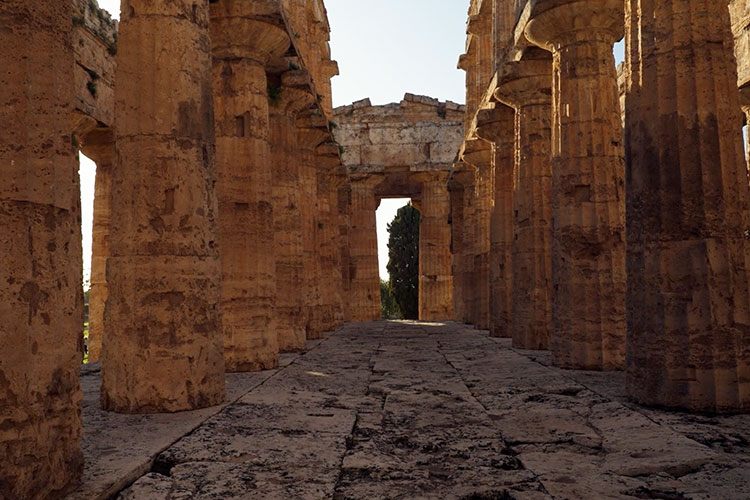
Paestum boasts three of the best-preserved, colossal ancient Greek temples in the world, monuments that rival anything found in Greece itself. Tristan focuses on the Temple of Neptune, which he rates as one of the best-preserved ancient Greek temples in the world. Standing over 10 metres tall and built decades before the famous Parthenon, it is the pinnacle of the Greek Doric style, instantly commanding awe with its long, fluted columns.
Inside the Temple of Neptune, Paestum, Southern Italy.
This documentary takes you inside the temple’s sacred heart and challenges assumptions about its dedication. While early archaeologists assumed the most monumental temple belonged to Poseidon, Director Dr Tiziana D’Angelo explains that evidence now points towards the goddess Hera or perhaps Apollo.
The temples also reveal a surprising truth of ancient ritual: most of the sacred ceremonies took place outside by the altar, rather than within the god’s house.
Paestum, Southern ItalyImage Credit: History Hit
The treasure of the Tomb of the Diver
The artistic legacy of Greek Paestum is revealed in one of its greatest treasures: the Tomb of the Diver. Discovered in 1968, this is one of the only surviving examples of a complete Greek wall painting from the early 5th century BC anywhere in the world.
In the documentary, Tristan and Tiziana discuss the symbolic meaning of this breathtaking fresco, which contains a central figure, diving into water – is it a metaphor for the passage from life to the afterlife, or a realistic scene of daily life? The other frescoes depict scenes of classical Greek life, including symposiums (Greek drinking parties) – scenes instantly recognisable to Greeks across the Mediterranean. This astonishing find proves that the Greek cultural zenith was not confined to Athens, but flourished with equal brilliance here in Southern Italy.
The Tomb of the Diver, Paestum, Southern ItalyImage Credit: History Hit
The collision of cultures
The documentary continues its journey by exploring the subsequent periods that defined the city, showcasing dramatic shifts in power and culture:
The Lucanians – warriors and cultural fusion: Two centuries after its foundation, native Italian tribes, the Lucanians, took over the city. While some bitter Greek sources labeled them “barbarians,” you’ll see the reality was far more complex: far from destroying Greek culture, the Lucanians deeply admired it. They transformed the city’s art to feature vivid scenes of warriors and military prowess, creating a profound cultural fusion that incorporated Greek styles.
The Roman conquest: Control shifted again in 275 BC. The Lucanians – having unwisely allied with the Greek warlord Pyrrhus against Rome – lost their protector and the city was conquered. The Romans were swift to establish authority, building the Forum as a new political and urban centre. Yet, while replacing many Greek structures, the Romans allowed the magnificent temples to stand, underscoring their enduring respect for Paestum’s Greek origins and ensuring the city’s foundational culture survived.
Tristan and Dr Tiziana D’Angelo stand beside a Lucanian artwork depicting chariot racing.Image Credit: History Hit
As Tristan points out, Paestum fundamentally challenges the perception that ancient Italy was exclusively Roman, demonstrating instead that Rome existed alongside a vast array of extraordinary civilizations. As the site epitomises the dramatic collision of Greek, Lucanian, and Roman cultures, it reveals the rich, often overshadowed, histories of people who left behind some of the most beautiful wonders of the ancient world.
Join Tristan Hughes as he explores these layers of history, uncovering how three civilisations converged at this single, extraordinary site. Watch Paestum: A Tale of Three Cities to discover the art, politics, and power of the Mediterranean’s hidden gem.
Sign up to watch








 New Posts (Home)
 ChatBox
 Popular Posts
  Game Zone
 Top PodCasts