www.theamericanconservative.com
The Double Significance of the Fall of Pokrovsk
Foreign Affairs
The Double Significance of the Fall of Pokrovsk
The Russians call Pokrovsk Krasnoarmeysk. Perhaps we should get used to calling it that, too.
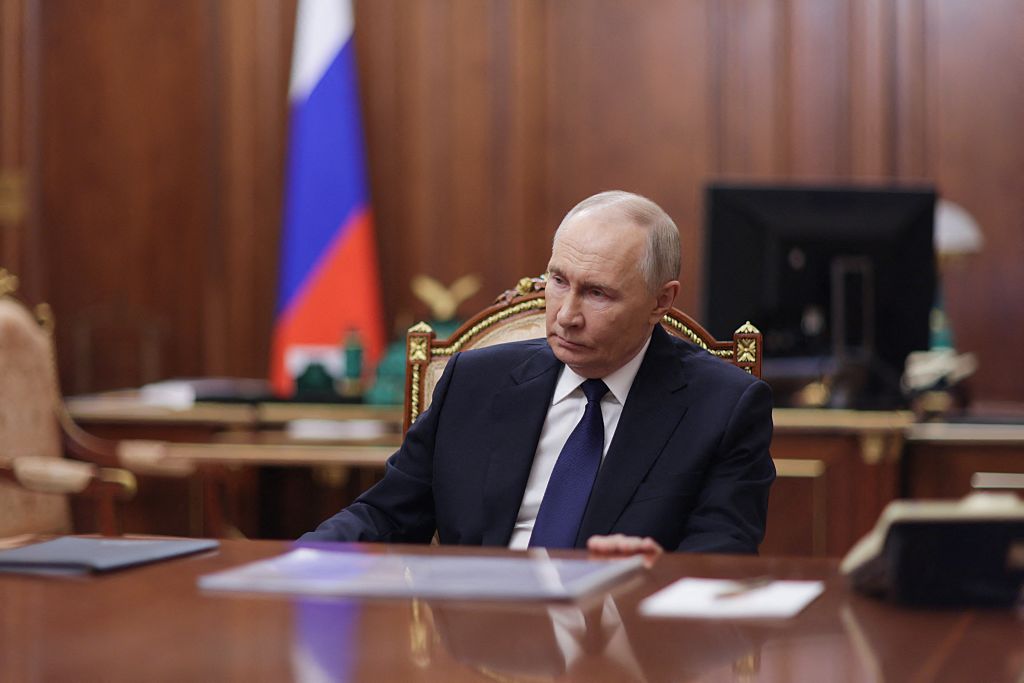
(Photo by Alexey NIKOLSKY / POOL / AFP via Getty Images)
On December 1, Russia’s President Vladimir Putin travelled to a battlefield command post to receive a briefing from his chief of staff, General Valery Gerasimov. It was good news for Putin. Gerasimov told Putin that Pokrovsk had been liberated: it had fallen to the Russian armed forces.
As part of a desperate push to justify the continued flow of billions of dollars of arms from Europe by selling the hope that the war is not yet lost, Ukraine has denied the claim, claiming instead that it is just “propaganda” to influence negotiations that does “not correspond to reality.” But the reality is that, if Pokrovsk has not fallen, it has 95 percent fallen and will be completely in Russian hands any day.
Prior to the fall of Pokrovsk, all sides agreed that it was a key logistical hub; subsequent to its fall, Ukraine and its European partners have downplayed its significance, claiming the victory to be more of a Russian morale and propaganda victory than a strategic one. The consistently quoted talking point is that at Russia’s rate of advance over the last nearly four years, it would take “at least another year” to capture the rest of Donetsk.
But the calculation is sophistry that deliberately ignores the nature of Russia’s attritional strategy. The nearly four years of war has not been a war to advance rapidly across territory. It has been a war to attrit Ukraine’s weapons and troops until they are stretched so thin that they collapse under the force of the still-growing Russian force. To claim that, at the current rate, it will take another year for the Ukrainian front to collapse is like claiming that, if it took 100 years for a brick wall to disintegrate by 80 percent, it will, at the current rate, take 25 more years for it to fall. In reality it might crumble at any minute.
The fall of Pokrovsk is important for two reasons: on the battlefield and at the negotiating table. On the battlefield, the loss of the key logistical hub would threaten the Ukrainian armed forces’ ability to supply their troops in the Donbas with weapons and food. It would also leave other key Ukrainian cities facing encirclement and Russia with miles of undefended field as they continue their advance west.
The day after being briefed that Pokrovsk had fallen, Putin was asked by the media why this achievement was so important. He answered that Pokrovsk “has indeed been given special importance both by the Ukrainian side and by the Russian Armed Forces” because it is “a major infrastructure site that is part of the network of regional transport links.”
“Most importantly,” he said, “it is a good bridgehead for accomplishing all the objectives set at the beginning of the special military operation. That is, from here, from this bridgehead, this sector, the Russian army is well positioned to advance in any direction the General Staff deems most appropriate.”
On December 4, Putin said of the parts of Donbas that Russia does not yet control, “Either we will liberate those territories though military force, or Ukrainian forces will withdraw and stop fighting there.”
Putin insisted that the dire situation in Donbas never had to come to this point. “We told Ukraine from the start: ‘The people don’t want to stay with you, they took part in referendums [in 2022], voted for their independence; pull back your troops, and there will be no fighting’. But they chose to fight.”
But it has come to this. And the shift on the battlefield has led to a crucial shift at the negotiating table.
Much of the fate of the current peace negotiations has come down to a single point. Point 21 of the 28-point peace plan states that “Ukrainian forces will withdraw from the part of Donetsk Oblast that they currently control” and “Crimea, Luhansk and Donetsk will be recognised as de facto Russian, including by the United States.” Russia insists on this point, and Ukraine has refused to agree.
Point 7 is, perhaps, equally divisive. It states that “Ukraine agrees to enshrine in its constitution that it will not join NATO, and NATO agrees to include in its statutes a provision that Ukraine will not be admitted in the future.” This is the key point for Russia, and Ukraine has again refused to agree.
But half of the decision regarding point 7 is not really in Ukraine’s power. Ukraine can choose to reject the demand to enshrine neutrality in its constitution. But it is up to NATO what is included in its statutes. Despite the constant insistence by Western officials and media that it is Ukraine’s right to choose to join NATO, it is not true that any country has the right to join NATO; nor is NATO obliged to accept anyone who wishes to join. Membership has to be at the invitation of NATO, and NATO members have to agree unanimously. And NATO is under no obligation to extend an invitation to a solicitous country. NATO only says that it “may then be invited to participate,” and that there is no guarantee. Even Ukraine’s European “partners” have cynically suggested that, perhaps, Ukraine could keep the pursuit of NATO membership in their constitution while NATO agrees never to grant it.
So peace may hang on the seemingly intractable demand that Ukraine cede the approximately 14 percent of Donetsk that it still controls.
At the end of November, U.S. President Donald Trump pointed out the obvious: “Look, the way it’s going, if you look, it’s just moving in one direction. So eventually, that’s land that over the next couple of months might be gotten by Russia anyway. So do you want to fight and lose another 50,000–60,000 people, or do you want to do something now?”
The strategically crucial fall of Pokrovsk has forced this crucial shift at the negotiating table. With the failure of the Minsk Agreements and the military and cultural threat to the ethnic Russian citizens of Donbas, Russia was determined to protect those citizens, if not by the autonomy promised by the Minsk Agreement, then by annexation. Along with legal guarantees that Ukraine would never be a NATO member, this was one of the key root causes of the war that Russia insisted would be addressed either at the negotiating table or on the battlefield.
The fall of Pokrovsk will bring the military accomplishment of this Russian goal to reality, whether it takes weeks or months or a year. During that time, thousands more Ukrainians will die. To ask them to die for the very same outcome that can be achieved at the negotiating table now with no more death is morally horrible.
The significance of the fall of Pokrovsk is that the shift on the battlefield has forced a shift at the negotiating table. Europe must provide a way for Ukraine and its president to accept the terms that reality has dictated—and stop pushing for a war that it knows will change nothing but the body count.
The post The Double Significance of the Fall of Pokrovsk appeared first on The American Conservative.








 New Posts (Home)
 ChatBox
 Popular Posts
  Game Zone
 Top PodCasts