www.thegospelcoalition.org
Rediscover the Book That Launched the Modern Missions Movement
William Carey was born August 17, 1761, in Paulerspury, England, a small village in Northamptonshire. Even today, little more than a thousand people live in the village. But it was into this tiny hamlet that Carey was born—the man who would help launch the modern missionary movement and the man who exhorted his fellow Christians with the now famous words “Expect great things from God; attempt great things for God.”
For much of his life, it didn’t seem that Carey was destined for great things. His father was a weaver, and Carey’s first job was in shoemaking. Carey wasn’t rich. He didn’t have formal schooling past age 12. He didn’t come from a well-connected or well-known family. As an adult, he was only 5’4” (unusually short even for his day) and bald. He didn’t look the part of a man who would change the world.
At 18, he left the Anglican fold and became a Baptist. Not long after, in 1781, he married Dorothy “Dolly” Plackett. By the next year, Carey began preaching every other week, splitting his time as a cobbler and as a pastor. In 1785, he was turned down for ordination, but the church allowed him to continue preaching on a trial basis as he honed his skills. It took him two more years to be ordained. In 1789, he assumed the pastorate at a Baptist church in Leicester.
Burdened for the Lost
Carey was a Calvinist. He believed in unconditional election and in the need for the sovereign grace of God if sinners were to be converted. Carey also possessed an indefatigable zeal for the unconverted. He couldn’t understand why the church’s attitude toward the heathen was so passive.
In 1786, he began publicly advocating for a missionary society. When Carey proposed the idea at a gathering of his Particular (i.e., Calvinistic) Baptist colleagues, one minister is reported to have said, “Young man, sit down. You are an enthusiast. When God pleases to convert the heathen, he’ll do it without consulting you or me.” Carey was living among hyper-Calvinists.
Carey was a Calvinist. He also possessed indefatigable zeal for the unconverted.
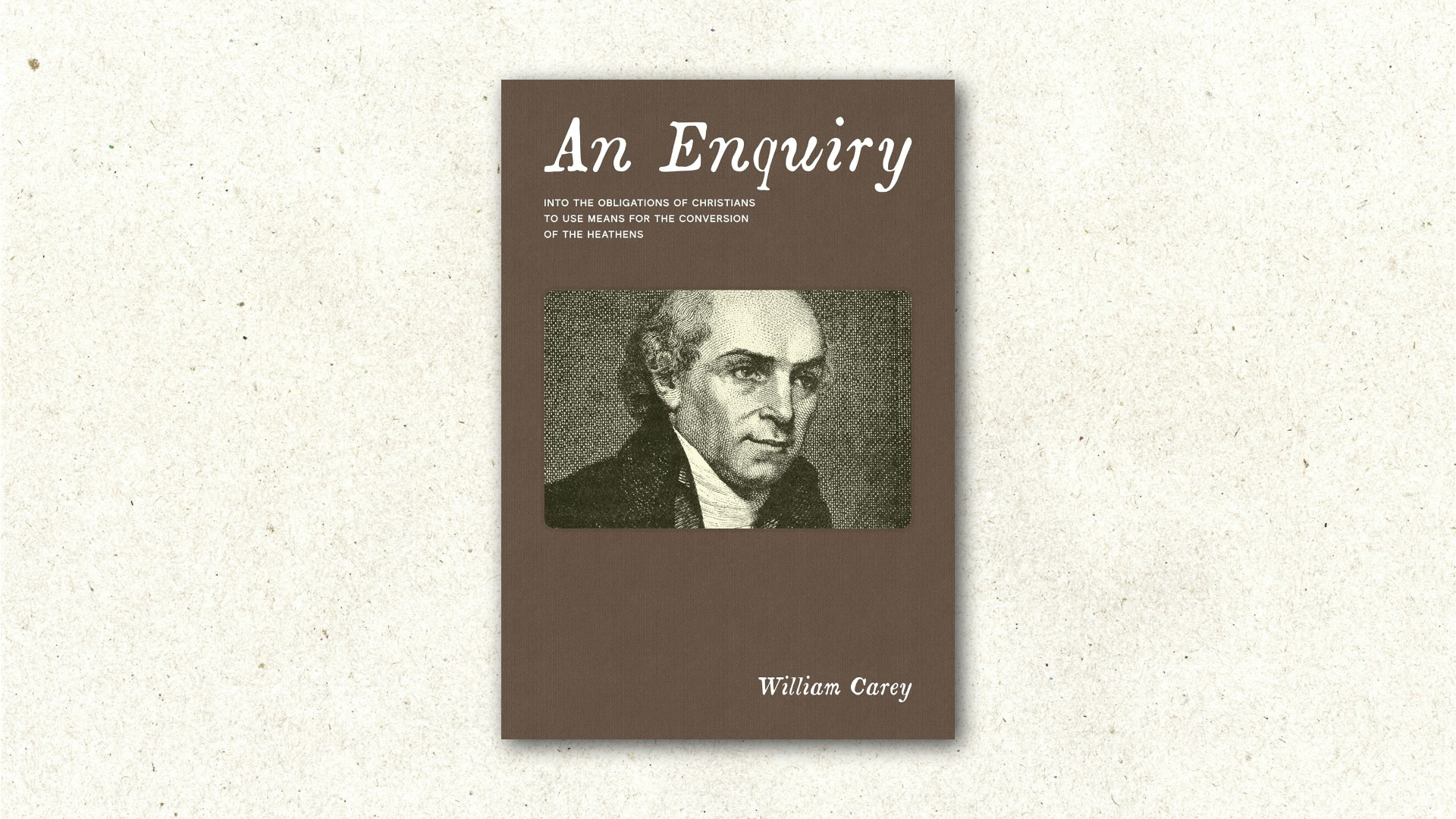
The rebuke prompted Carey to study the matter more closely and put his thoughts on paper. The result was a modestly sized book published first in 1792 and republished in this volume. Though the book was relatively small, the title was not: An Enquiry into the obligations of Christians to use means for the conversion of the heathens. In which the religious state of the different nations of the world, the success of former undertakings, and the practicability of further undertakings, are considered, by William Carey. Most modern readers know it simply as An Enquiry.
There’s nothing fancy about Carey’s book. It has pages of tables about the size of various nations, how many people live there, and what religion they practice. What made the tract influential wasn’t the data but the basic message: We’re commanded to go into all the world and preach the gospel. The whole world hasn’t heard the gospel. So why isn’t anyone going?
Continuing Commission
Carey’s central theological argument was that the Great Commission is still binding. True, there may be some sense in which the gospel went out into all the world during the time of the apostles (Rom. 10:18; Col. 1:23), but the gospel’s expansive success in the first century doesn’t render the Great Commission null and void.
Carey insisted the Great Commission was still the church’s commission. If teaching all nations was restricted to a certain era, Carey reasoned, then so was baptizing (yet the church still baptizes). If the Great Commission is no longer operative, then all those who had gone to the heathen before did so without warrant. If the commands of Matthew 28 were limited to apostles, then why did Jesus promise to be with them to the end of the age?
Particularly compelling is Carey’s response to the familiar retort—common in his day and in ours—that we can fulfill the call of “missions” by simply attending to the spiritual needs in our own neighborhoods. On this point, it’s worth quoting Carey at length:
It has been objected that there are multitudes in our own nation, and within our immediate spheres of action, who are as ignorant as the South Sea savages, and that therefore we have work enough at home without going into other countries. That there are thousands in our own land as far from God as possible, I readily grant, and that this ought to excite us to ten-fold diligence in our work and in attempts to spread divine knowledge amongst them is a certain fact; but that it ought to supersede all attempts to spread the gospel in foreign parts seems to want proof. Our own countrymen have the means of grace and may attend on the word preached if they choose it. They have the means of knowing the truth, and faithful ministers are placed in almost every part of the land, whose spheres of action might be much extended if their congregations were but more hearty and active in the cause. But with them the case is widely different, who have no Bible, no written language (which many of them have not), no ministers, no good civil government, nor any of those advantages which we have. Pity, therefore, humanity, and much more Christianity, call loudly for every possible exertion to introduce the gospel amongst them.
Carey’s reply anticipates the now familiar distinction between the “reached” and the “unreached.” By all means, Carey says, we ought to labor hard in our own lands. But if our neighbors—in “Christian” lands—need our help, how much more do those people around the world with no or little access to the Bible, to the church, or even to the blessings of civilization need gospel workers among them.
One-Way Ticket to India
By the end of 1792, the Baptist Missionary Society was formed. In June of the next year, Carey and his family left for India as the society’s first missionaries. On November 11, 1793, Carey landed on India’s east coast in Calcutta. Carey spent 41 years in India and never returned to England.
The British colonial government in India wasn’t welcoming of missionaries, and the powerful East India Company looked down on their arrival even more. While in British-controlled cities like Calcutta, Carey was constantly in danger of hostility or deportation.
Carey’s central theological argument was that the Great Commission is still binding.
By 1800, he’d moved 16 miles north to the Danish colony of Serampore. There, he joined two other English missionaries, Joshua Marshman and William Ward. Together, Carey, Marshman, and Ward became the famous Serampore Trio. Before long, Carey baptized his first Indian convert, Krishna Chandra Pal.
The work of the Serampore Trio was multifaceted. They started educational institutions—boarding schools at first (for both boys and girls, in separate schools), then Serampore College in 1819. The college, which opened with 37 students (19 Christians and 18 non-Christians), offered instruction in Sanskrit, Arabic, and English. In 1826, Marshman met with the King of Denmark and secured a royal charter for the college, making it the first degree-granting institution in Asia.
The Trio also worked to abolish the practice of sati, whereby widows were expected to burn themselves to death on their husband’s funeral pyre. Crucially, over many years, they labored extensively in Bible translation, completing six translations of the whole Bible, along with 23 New Testaments and portions of the Bible in 10 other languages. Carey himself translated the Bible into Bengali, Sanskrit, and Marathi.
Lasting Influence
Most importantly, Carey was a church planter. Although he saw only a few converts in his lifetime, he was able to establish an indigenous church. Even though this work was small, Carey’s influence was great. His contribution was to thrust the English-speaking world into the work of global missions. One missiologist has estimated that from Carey’s time to the 1960s, four out of every five Protestant missionaries came from the English-speaking world.
For good reason, then, Carey has been hailed as the father of the modern missions movement. This is certainly true for English-speaking Protestants. From Henry Martyn in India, to Robert Morrison in Canton Province, to Hudson Taylor in inland China, to Adoniram Judson in Burma, to Samuel Zwemer in Arabia and Egypt, dozens and hundreds (if not thousands) of missionaries have been inspired by Carey to “expect great things from God” and “attempt great things for God.” This fact alone makes Carey worth remembering and his missionary tract worth reading.
Given Carey’s heroic efforts for the spread of the gospel, it’s fitting that his epitaph highlights God’s grace for sinners. His tombstone reads, “William Carey, D.D.; Born: 17 August 1761; Died: 9 June 1834; A wretched poor and helpless worm on thy kind arms I fall.”








 New Posts (Home)
 ChatBox
 Popular Posts
  Game Zone
 Top PodCasts