www.upworthy.com
'Cultural Tutor' explores when and how we stopped trying to make ordinary things beautiful
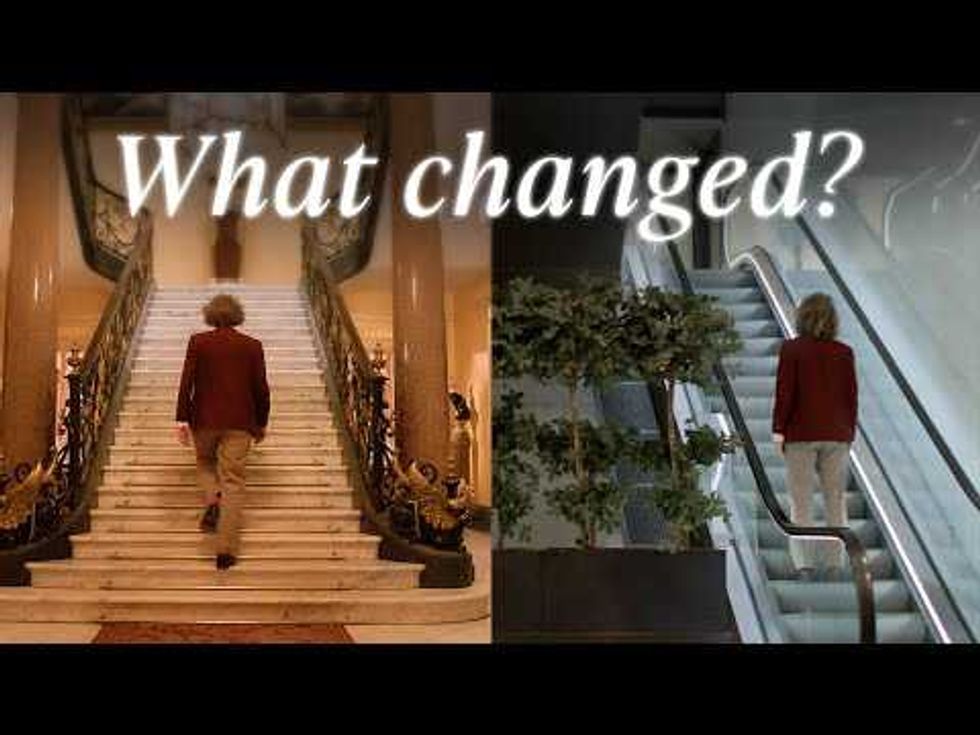
If you step into almost any building built before World War II, you'll see all manner of artistic detail, from the flowery ornateness of the Victorian era to the geometric glamour of the Art Deco years. Globally, we see centuries of architecture that prioritized beauty, from colorful mosaics and intricately painted ceilings to striking colonnades and arches.Now, we have stark, generic buildings that altogether lack architectural detail. The design of everyday things has become almost purely utilitarian, and while we've seen a revival of affinity for the sleek, mid-century modern aesthetic, most modern design is unarguably rather…boring. And that, Sheehan Quirke argues, says something about us as a society. - YouTube youtu.be Quirke, the self-described "Cultural Tutor" who has gained a huge following on social media, says the problem isn't so much that our man-made surroundings have become less beautiful, but that they have become less interesting. "Modern design has become boring, but it doesn't have to be this way," he shares on YouTube. "The word 'beautiful' is overused. We don't need 'beautiful' lamps, bus stops, and water fountains — we just need lamps, bus stops, and water fountains that are interesting, that actually mean something. At the very least, we need the details of our cities and homes to be not boring."Showing an example of two lampposts in his video, Quirke points out that a modern lamppost "does its job, but not much else." An old, ornate lamppost "does its job, and a little bit more." The details in its design add charm to the space it inhabits. "But these two lampposts don't just look different," he says. "They represent fundamentally different worldviews. If you want to understand any society, don't look at what it says about itself. Look at what it creates."
— (@)
Quirke points out that the fancy lamppost was the height of new technology when it was built. In the modern world, we don't associate ornate decoration with the latest innovations, but in the past, people did. He also points out that even a purely functional building, part of London's sewage infrastructure built in the 1800s, was "designed with the same ornamental exuberance as any church or palace."Indeed, it is stunning, even though it didn't have to be. So why was it?"Well, people worked here," he says. "And why shouldn't people who work in sewers also have a beautiful place of work? That is how the Victorians thought. But there's more. There was also a sense of pride, a belief that what they'd done here was worthwhile, that it meant something. And the result, over a century later, is that this place, a sewage facility, is now a museum, a tourist destination. If you want to know what any society really believes in, just look at how they design their sewers." The Crossness Pumping Station, built in 1865, helped divert sewage away from the River Thames in London.Christine Matthews / Crossness Pumping Station, Belvedere, Kent / CC BY-SA 2.0 (Wikimedia Commons) Quirke points out that we've become a society that values convenience above all else. We design things for maximum convenience, and the result is that ordinary objects are ugly and boring. Of course, it cost more to make ordinary things beautiful, but it's not like it couldn't be done. We just prioritize making higher profits over making things pretty. Does that really matter? Quirke thinks so. "The aesthetics of architecture and urban design aren't just a bonus; they totally change how we think, feel, and behave," Quirke asserts. "Boring environments make us more stressed and less productive; they erode our sense of community; they make us sadder, less trusting, and lonelier. A boring world is one where we spend even more time online and where our addictions are even harder to battle."
— (@)
"Modern design tells the truth very loudly: that we are technologically superior and very efficient but also a little bit boring and unimaginative," Quirke says. "And it says that we no longer believe in the idea of ordinary beauty or in the idea of a public that deserves ordinary beauty."However, he says, it doesn't have to be that way. Those ornate lampposts could easily be mass-produced (and indeed, they were at the time they were made). We just have to choose, as a society, to care about what things look like and to recognize that beauty actually matters. That's the lesson we can learn from the past: "even ordinary, useful things can also be beautiful" if we choose them to be. You can follow Sheehan Quirke, The Cultural Tutor, on X and on YouTube.








 New Posts (Home)
 ChatBox
 Popular Posts
  Game Zone
 Top PodCasts