www.thegospelcoalition.org
7 Novels to Help You Think About Technology
Most of my reading is nonfiction. That habit is driven, in part, by necessity. As an elder who teaches Sunday school in the local church, I’m often deep into commentaries and monographs that help me explain the text better. As an editor at The Gospel Coalition, I try to read many of the books we review and some we don’t. Nonfiction also helps satiate my curiosity about how the world works, so deep dives into engineering, politics, and history are always intriguing for me.
Yet sometimes fiction is more helpful in gaining an understanding of complex philosophical ideas. I still point people toward the Calvin and Hobbes comics by Bill Watterson to better understand postmodernism; sometimes it takes a boy and his stuffed tiger to reveal the absurdity of concepts that adults try to explain with a straight face. That’s what C. S. Lewis is talking about in his essay “Bluspels and Flalansferes,” where he writes, “For me, reason is the natural organ of truth; but imagination is the organ of meaning.” Fiction shapes our imagination to give us metaphors that help make abstract ideas more concrete.
In 2025, many of the contributors to Scrolling Ourselves to Death: Reclaiming Life in a Digital Age offered recommendations of nonfiction books to help Christians understand their relationship with technology. Those books offer helpful diagnoses of contemporary trends. Yet these seven novels may more powerfully shape our imaginations and deepen our thinking about the nature of humanity and the purpose of technology. It should come as no surprise that most are dystopian novels intended as warnings.
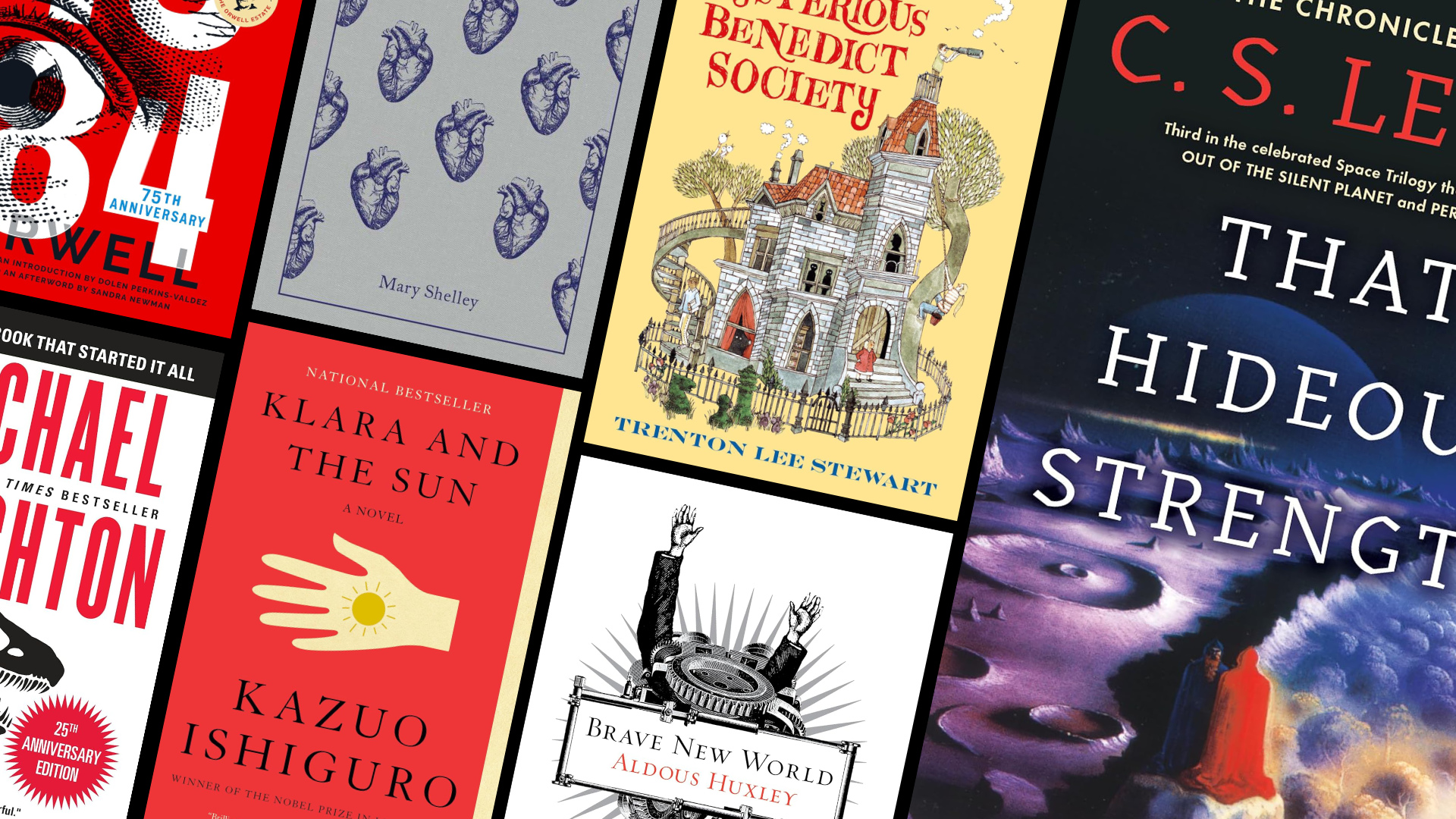
1. C. S. Lewis, That Hideous Strength (Scribner) (Amazon)
A few years ago, I would’ve said that Lewis’s Space Trilogy was significantly underrated, but there’s been a great deal more interest in and adulation for the series recently. Though it’ll probably never hit the same heights as The Chronicles of Narnia, the Space Trilogy’s theological and social commentary points people toward the objective truth of the Christian worldview. In a 2023 interview, historian Molly Worthen highlighted this sci-fi trilogy as part of her conversion narrative.
The final volume of Lewis’s trilogy, That Hideous Strength, is the fictional parallel of Lewis’s essay “The Inner Ring” and his lectures on education in The Abolition of Man. Lewis dramatizes the consequences of raising “men without chests,” helping readers to see what happens when bare, materialistic science pushes out matters of theological significance.
As we see theories about AI being related to some sort of demonic force, it’s interesting to see how Lewis depicts the way supernaturalism often hides behind the curtain of scientific naturalism. We could all stand to read more Lewis, and That Hideous Strength has much to say about our culture’s relationship with technology.
2. Kazuo Ishiguro, Klara and the Sun (Vintage) (Amazon)
This novel by Nobel Prize winner Kazuo Ishiguro was released in 2021. It likely would have hit the bestseller list because of his reputation, but it deserves a wide audience because it’s a good story told well. The book looks ahead to a future when genetic alteration of children is normal and robots function as “embodied” AI companions for children. It’s a future that seems exponentially nearer with every passing month. I’m not surprised that the film adaptation, expected to release in 2026, is being described as dystopian science fiction.
It’s impossible to summarize the book without giving away too much of the plot. The story is told from the perspective of Klara, an AI robot companion. As the novel unfolds, we experience Klara’s growing sentience and deepening personality as she gets to know her owner, Josie. Meanwhile, Josie’s mother has a heartbreaking plan that looms like a thundercloud over the narrative. Though the story unfolds slowly at first, Klara and the Sun is hard to put down because it forces readers to ask hard questions.
3. Trenton Lee Stewart, The Mysterious Benedict Society (Little, Brown Books for Young Readers) (Amazon)
When The Mysterious Benedict Society was published in 2008, we hadn’t yet experienced the full anxiety-inducing weight of ubiquitous smartphones. Nevertheless, Stewart highlights the threat to everyone’s mental health: The Emergency. This children’s book tracks the exploits of four genius kids as they halt a plan to take over the world.
Apropos for our media-saturated culture, the proposed world conquest isn’t through military might; it’s to be accomplished by inducing anxiety that drives people to surrender power to a supposedly benevolent, bureaucratic dictator.
There’s a lot to like about Stewart’s entire series. The story is witty, the content is clean, and there’s a clear sense of good and evil. Also, somewhat uncommon among children’s books, there are trustworthy adults who aren’t just bumbling foils for the competent young adventurers.
Yet, without being preachy, the message is also clear that electronic media is especially powerful for shaping people’s hearts and minds, often in ways we don’t recognize. This novel is a good way to introduce a discussion with kids about the subtle effects of media.
4. George Orwell, 1984 (Berkley) (Amazon)
Reading Orwell’s classic dystopia is a rite of passage for many high schoolers. The screen-saturated surveillance society has only become more real since the book was published in 1949, mostly due to our voluntary participation in our own electronic monitoring.
When Neil Postman published Amusing Ourselves to Death in 1985, he argued that Western culture had become more like Huxley’s Brave New World than Orwell’s 1984. Sometimes it seems to me that we’ve simply picked the worst of both worlds and tried to mash them together.
It’s tempting to focus on the state-centric aspect of the surveillance and propaganda in 1984. That can make us feel as if America, with free-speech rights, is somehow safe. Yet we continue to see attempts at speech control and historical revisionism in our free society that sometimes rival the coercive oppression in Orwell’s novel. When we put his fiction in conversation with Kai Strittmatter’s description of the modern Chinese surveillance state in We Have Been Harmonized, it should cause us to reevaluate how willingly we’re moving toward an entirely digital culture.
5. Aldous Huxley, Brave New World (Harper Perennial) (Amazon)
Between psychedelic drug usage, the development of artificial wombs, and genetic engineering of human embryos, Huxley’s dystopia seems more real every month. When we adopt new technologies, we often only think of their positive effects. Cars allow us to see family more often; cell phones save lives in emergencies; artificial wombs could save premature babies. But negative effects often go along with those technologies. For example, as Huxley shows, divorcing sex from reproduction and gestation from parenting contributes to a society where people don’t particularly matter.
As it becomes easier to separate the genetic origin of a child from the intimacy of gestation, Brave New World should push us to ask what we’ll lose when our offspring are made instead of begotten. Huxley’s fiction can prompt readers to return to Scripture to think about what it means to be human and how that should shape our reproductive choices.
6. Mary Shelley, Frankenstein (Penguin Classics) (Amazon)
The story of Victor Frankenstein and his monster has been adapted hundreds of times since it was published in 1818. For many people, the mention of the novel conjures an image of Boris Karloff from the 1931 film adaptation. More literary-minded individuals are likely to think about her influence on the gothic novel, the fact that Shelley had to publish the volume psuedonymously due to her gender, or her relationship with English Romantic poet Percy Shelley.
Yet one of the most important aspects of Frankenstein is found in the subtitle: The Modern Prometheus. In Greek mythology, Prometheus created humanity and gave them fire, thus enabling technological progress. The story raises important questions about what it means to be a human made in God’s image and the undesirable, and often unanticipated, consequences of technology.
7. Michael Crichton, Jurassic Park (Ballantine) (Amazon)
Don’t let the fact that Crichton’s novel spawned a movie franchise keep you from appreciating the cultural significance of Jurassic Park. The commentary in the novel is much more thought-provoking than the movies. Unlike the sequel, The Lost World, this 1990 thriller is much more than a page turner; it’s an illustration of human hubris toward technology and life.
When mountaineer George Mallory was asked why he wanted to climb Mount Everest, he purportedly replied, “Because it’s there.” His body was found in 1999, with evidence that he never made it to the top. Our culture’s approach to technology is often similar: We adopt new technologies and apply them to new tasks because the possibility exists.
The chaos that ensues in Jurassic Park on Isla Nublar because of John Hammond’s attempt to genetically engineer and contain dinosaurs is a powerful image of the way our culture often approaches technological innovations. In the real world, however, the John Hammonds rarely get eaten by their own creations. The monsters more often devour the innocent people who just came to be entertained.








 New Posts (Home)
 ChatBox
 Popular Posts
  Game Zone
 Top PodCasts