www.theamericanconservative.com
Partitioning Iran Would Backfire Spectacularly
Foreign Affairs
Partitioning Iran Would Backfire Spectacularly
Don’t believe the neocons’ latest fantasy.
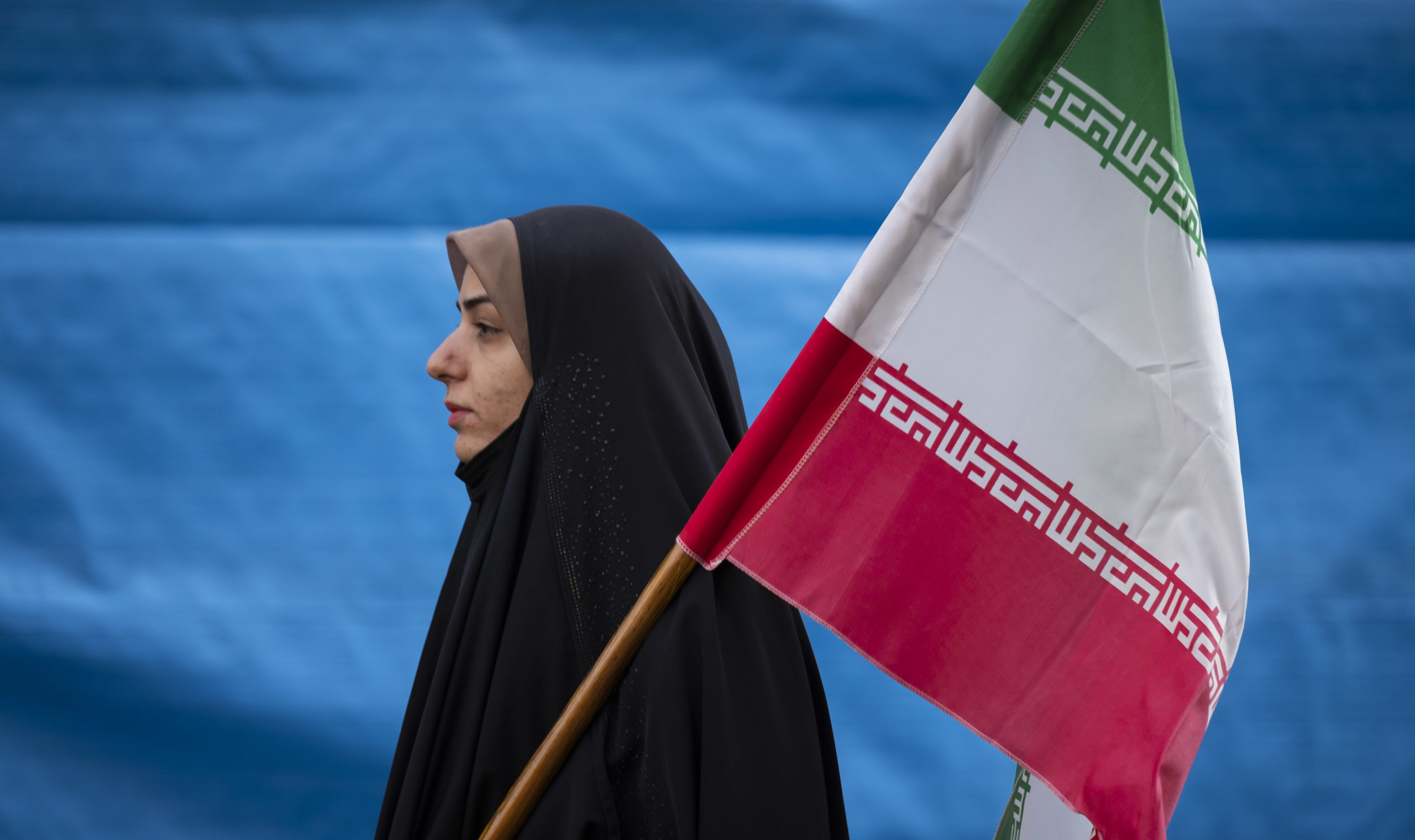
A veiled Iranian woman carrying an Iran flag while attending a gathering out of the former U.S. embassy in Tehran to mark the anniversary of the seizure of the U.S. embassy, also known as the student’s day or national day against global arrogance, November 4, 2022. (Photo by Morteza Nikoubazl/NurPhoto via Getty Images)
Following the Islamic Republic’s brutal crackdown on protests this past week, an air of inevitability continues to surround the possibility of American military intervention. But what would such an intervention look like?
Voices in U.S. and Israeli media are once again floating the idea of breaking Iran apart along ethnic lines. A recent Wall Street Journal opinion piece argues that a “fractured Iran” could frustrate Russia and China, reduce threats to Israel, and benefit Turkey by creating a larger Azerbaijani state—while downplaying the risks of state collapse.
The Jerusalem Post, apparently disillusioned with the dimming chances that Reza Pahlavi, the exiled son of the deposed Shah of Iran, will bring down “the mullahs,” has reverted to openly advocating for the country’s dismemberment.
This is dangerous nonsense, and America First advocates of realism and restraint in U.S. foreign policy must unambiguously reject it. It is also déjà vu, reminiscent of the political atmosphere that preceded the Iraq debacle—and it promises an even more catastrophic failure in a country four times the size of Iraq.
In the wake of the 2003 invasion, some neoconservatives and liberal interventionists—including then-senator Joe Biden—pushed a “soft partition” plan to divide Iraq into three autonomous ethno-sectarian zones: Kurdish, Shia, and Sunni. Sold as a pragmatic way to manage the nation’s diverse make-up, this idea ignored Iraq’s deeply intertwined communities and national identity.
The result of American intervention in the country was not stability but a cascading disaster which exacerbated sectarian divisions, fueled terrorism, empowered genocidal extremists like ISIS, and turned the nation into a proxy battlefield where Iran gained the upper hand. Trillions of dollars and thousands of American lives later, the region is still reeling from that reckless adventure.
Ethnic fragmentation, or balkanization, is not a new idea. It has long circulated in certain Israeli strategic circles: The 1982 Oded Yinon Plan highlighted Israel’s Arab neighbors’ ethno-confessional diversity as a vulnerability to be exploited. All adjacent Arab states—including Egypt, with which Israel had concluded a peace agreement in 1979—had to be dismembered. The influential neoconservative historian Bernard Lewis applied the same template to Iran.
Yet this view fundamentally misunderstands Iran. It is not an artificial, multiethnic construct held together only by an authoritarian power. Proponents fixate on diversity—Azeris (Iran’s largest minority, comprising an estimated 15–23 million), Kurds, Baloch, Arabs—while ignoring the powerful, unifying force of Iranian nationalism, the product of a millennia-old Persianate civilization and 20th century nation-building.
Modern Iranians, regardless of ethnicity, share a profound connection to their land and history. While ethnic grievances exist, often exacerbated by government repression—under monarchical and, later, Islamic regimes—the protests that have shaken the country have overwhelmingly demanded universal rights, dignity, and an end to theocracy, not secession. To reduce Iran’s complex national story to a map of ethnic enclaves is an intellectual failure.There is no American interest in Iran’s disintegration at all. U.S. priorities in Iran are to ensure it doesn’t acquire a nuclear bomb or disrupt the global oil supplies and, ideally, to see it tone down and ultimately eschew the “Death to America” rhetoric.
Trump’s strike on Iranian nuclear facilities during the 12-day war last June halted uranium enrichment. Restrainers were right to oppose that strike, preferring a deal that seemed to be achievable until Israel launched a surprise offensive. But Trump, to his credit, refused then to be drawn into a prolonged war with Iran, and it’s a fact that he set back Tehran’s nuclear program.
A policy of partition, however, would catastrophically undermine that achievement. The collapse or fragmentation of the state would create a security vacuum, which armed and dangerous men would inevitably fill. Moreover, a besieged rump regime would have every incentive to clandestinely pursue a nuclear deterrent. The know-how remains, despite the bombing, and the motive would be overwhelming. That would draw the U.S. into another endless war.
As for the “Death to America” chants, the looming succession in Tehran could open the way for a less ideologically rigid leadership more amenable to finding a modus vivendi with Washington. Even the current Supreme Leader Ali Khamenei occasionally displays a pragmatic streak, like when he allowed the 2015 Iran nuclear deal to be negotiated and signed. The interests of the U.S. would be served far better by exercising strategic patience to see what kind of leadership emerges once Khamenei exits the scene. The U.S. can afford to wait: There is no security threat posed by Iran that demands a swift, drastic action.
By contrast, forced partition would accelerate the very threats it’s meant to neutralize. Far from “taking Iran off the geopolitical chessboard”, as the Journal’s op-ed argues, it would set that board on fire. American policymakers should acknowledge a broad regional consensus against Iran’s fragmentation that also includes their allies and partners in the region. They would work to bolster a rump Tehran to prevent total collapse.
Turkey, for whom Kurdish separatism is an existential threat, would be a natural ally of Tehran in crushing any new Kurdish project on its border. Pakistan, battling its own Baloch insurgency, would cooperate closely with Tehran to prevent contagion. This regional counter-alignment means Iran, though weakened, wouldn’t be isolated, since powerful neighbors, including the Gulf Arab monarchies, would be interested in preserving the status quo ante.
A conservative administration that prioritizes the protection of Christians worldwide, as the Trump White House does, must consider the catastrophic humanitarian consequences of such a scheme. We need only look again to the grim precedent in Iraq, where the Christian community was decimated from over 1.5 million before the 2003 invasion to fewer than 200,000 today due to the chaos of war and the rise of ISIS.
In Iran, a violent breakup would place ancient indigenous Christian communities—Armenians and Assyrians, who number around 250,000 and have some constitutional protections under the current system—in extreme peril. It would inevitably inflame the Azerbaijani nationalism that the Journal and neoconservative DC think tanks like Foundation for Defense of Democracies and Hudson Institute recklessly cheer.
As we saw in the neighboring Republic of Azerbaijan, such irredentist fervor leads directly to the ethnic cleansing of Armenians and the obliteration of their millennia-old Christian heritage. To advocate for policies that could subject Iran’s Christians to a similar fate is not statecraft; it is a profound moral and strategic error.
The hard-earned Iraq experience demands that we oppose the siren song of partition and chaos in another Middle Eastern country. America’s security interests in Iran are narrow and well-defined. They most certainly do not include a violent redrawing of that faraway nation’s map.
The post Partitioning Iran Would Backfire Spectacularly appeared first on The American Conservative.








 New Posts (Home)
 ChatBox
 Popular Posts
  Game Zone
 Top PodCasts