www.dailysignal.com
Pro-Life Movement Gains Traction With Young Adults, Polls Show
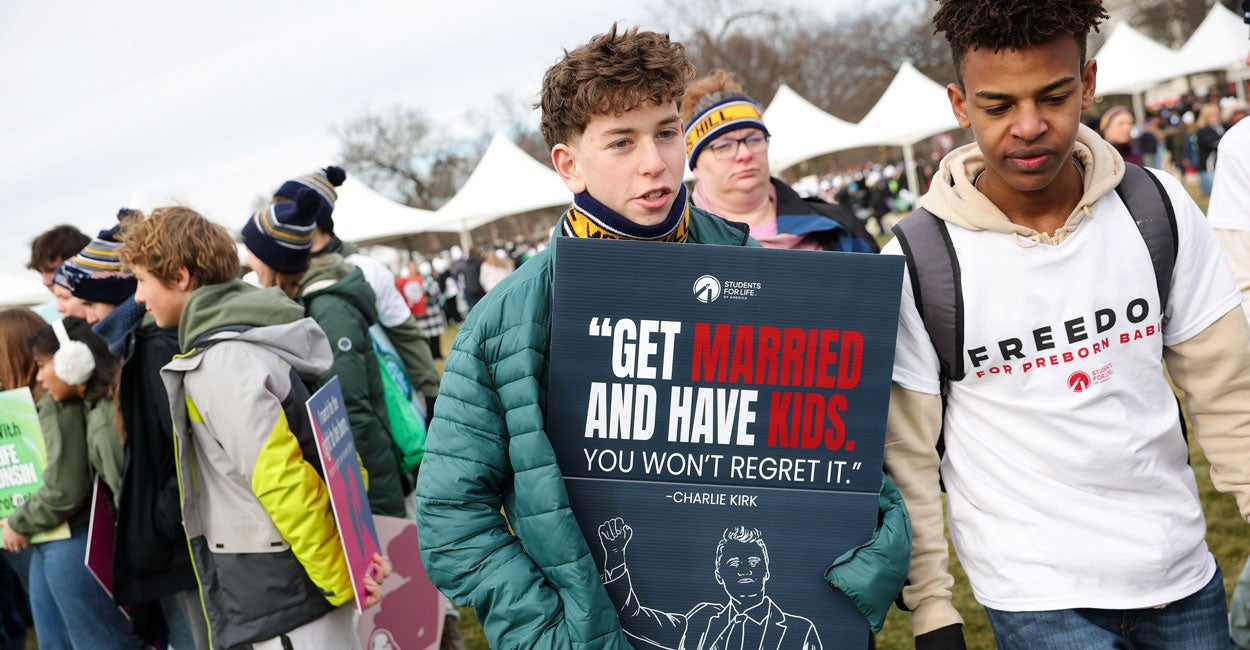
Recent polling suggests a notable shift in how younger Americans view abortion, with signs that the pro-life movement is gaining ground among adults ages 18 to 29.
Multiple surveys show an increase in the share of young adults identifying as “pro-life,” while support for unrestricted abortion access has declined in recent years.
According to data from Gallup and others, the percentage of young adults calling themselves pro-life climbed to about 37% in 2025, an increase of about 8 to 11 percentage points compared to polls from 2022 and 2023.
Over the same period, the percentage of young adults who say abortion should be legal in all circumstances has declined sharply, falling by roughly 10 to 14 percentage points, according to Gallup data.
Generational Divide
These findings come amid broader national polling showing a persistent generational divide on abortion policy.
A separate Pew Research Center survey from 2024 found that adults under 30 are more likely than older Americans to say abortion should be legal “in all or most cases,” but that support has fallen from earlier years.
One of the most striking shifts comes from young men. In summer 2025, an IPSOS poll in Great Britain found that 46% of men ages 16 to 34support the legal abortion— a rate 25 points lower than the average population.
Why Are Views Shifting?
Abortion today is more accessible due to the proliferation of prescription drugs Mifepristone and Misoprostol. Since the 2022 Supreme Court decision overturning Roe v. Wade, abortions have steadily increased in the United States.
So what’s causing young people to back away?
Analysts and movement leaders attribute the shift among young people to a variety of factors, including pro-life campaigning on college campuses, increased engagement with religious communities, and sustained debate over abortion policy since the Dobbs v. Jackson Women’s Health Organization decision. Younger men’s views in particular have become more favorable to pro-life messaging, contributing to the overall change in self-identification among Millennials and Gen Z.
Some observers point to cultural and technological changes as key drivers of the shift.
Advances in ultrasound and fetal imaging—widely shared on social media platforms popular with Gen Z—have made prenatal development more visible to young people than ever before. Short-form videos and graphics showing infant growth shape younger Americans’ views of pregnancy and human development in ways that to earlier generations didn’t experience.
Changing Landscape
Another factor is the changing political and social landscape following the Supreme Court’s Dobbs decision.
With abortion policy now largely determined at the state level, younger Americans are encountering the issue in more concrete and local terms—through ballot initiatives, campus activism, and legislation—rather than as an abstract national debate. This has fueled increased engagement from both sides, including more visible and organized pro-life outreach aimed at young voters.
Together, these trends indicate that the evolving views of young Americans are being shaped less by traditional party affiliation and more by cultural exposure, digital media, and localized political experiences—factors that may continue to influence how the abortion debate unfolds in the years to come.
While abortion remains a deeply contested and polarized issue nationally, the emerging data on young adults suggests that the pro-life movement is resonating with a notable portion of the next generation of voters—potentially reshaping the long-term trajectory of this debate.
The post Pro-Life Movement Gains Traction With Young Adults, Polls Show appeared first on The Daily Signal.








 New Posts (Home)
 ChatBox
 Popular Posts
  Game Zone
 Top PodCasts