www.dailysignal.com
The Man Who Showed That Faith and Reason Align
Many people believe that faith and reason are incompatible. Faith is for those who blindly trust what their religion tells them or what they feel is true. Reason is what we have proof for; it’s for the logical ones, and faith is for the childish and weak.
This is an over-characterization, but there is truth to the generalization. The truth here lies in the fact that this mindset is prevalent, but not that it is valid.
Every year, the Catholic Church celebrates the feast day of St. Thomas Aquinas (1225-1274) on Jan. 28.
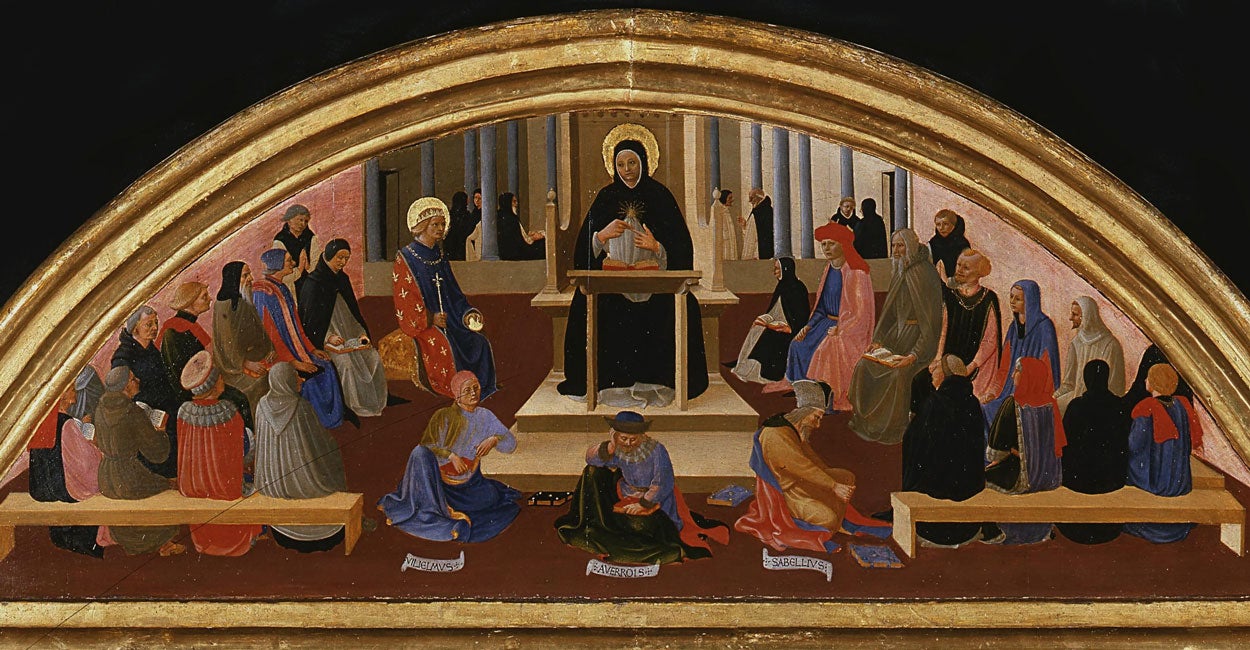
Over the course of his lifetime, Aquinas wrote over 8 million words. He was a Dominican priest who spent hours each day in prayer and study. His life was devoted to God and to writing about the truth. Aquinas was groundbreaking in many ways because he was able to show the validity of church doctrine through the use of reason.
Pope St. John Paul II wrote in his masterful encyclical, “Fides et Ratio (Faith and Reason),” that faith and reason are “like two wings on which the human spirit rises to the contemplation of truth.” The pope, who was trained in the theology and philosophy of Aquinas, noted that the human person needs both faith and reason in order to be truly human and to come to the fullness of the truth.
Reason is seen in the writings of Aquinas in a multitude of ways.
First, his core belief is that the intellect is made for the truth and the will is made for the good.
Even without mentioning God, we can come to see that this is the case. When I come to know something as true, my intellect rests in the fact that it now knows. When my choices align with goodness, my conscience is at ease, and when I act selfishly, my conscience nags at me to ask for forgiveness.
This is all rooted in the proper understanding of truth. Truth is the conformity between the mind and reality.
When a thought or proposition that I claim is in alignment with what actually is true, then my claim itself is also true. Therefore, if a religious claim was to defy logic or be the contradictory stance found in known scientific fact, then the religious belief would have to be wrong.
Otherwise, the principle of noncontradiction would be invalid. This principle holds that two opposing claims cannot both be true at the same time. This is why the atheist and the believer cannot be correct. God is either real or not real.
Rooted in the thought of Aristotle, Aquinas explained that the existence of God can be demonstrated through simply investigating the world around us, as explained in Aquinas’ famous “Five Ways.”
As explained, Acquinas’ findings align with what modern science has concluded about the universe. All material things have cause. The universe is a material thing. Therefore, the universe must have a cause outside of itself otherwise nothing would exist. In other words, infinite regress is not possible to explain the cause of the universe. The first three ways of Aquinas (motion, causality, contingency) hinge on this understanding.
The fourth way is called the gradation of perfection. Without knowing and there being a perfect being, there can be no way to grade something as more or less perfect than another thing. God is not just the best or most-good or most-perfect being. God is being itself. His nature is existence.
Finally, the fifth way is called unintelligent beings acting towards an intelligent end. Simply put: How does grass know how to grow? It cannot think. Grass cannot choose. However, when sunlight, warmth and water are present, it simply grows—every time. The fifth way argues that the fact that nonrational beings act in rational and predictable ways proves that there was an Intelligence that ordered it that way.
Christianity is unique because it is rooted both in history events and in a relentless reliance on reason.
The Christian claim is that Jesus is God, made flesh. The God who is perfection. The God who is goodness and love itself became one of us so that we can know Him and be with Him forever.
The life and writings of Aquinas place an exclamation point on this, pushing all of us today to deeply investigate the claims of our faith, so that we can know that it is true and why it is both reasonable and faith-filled.
We publish a variety of perspectives. Nothing written here is to be construed as representing the views of The Daily Signal.
The post The Man Who Showed That Faith and Reason Align appeared first on The Daily Signal.








 New Posts (Home)
 ChatBox
 Popular Posts
  Game Zone
 Top PodCasts