allthatsinteresting.com
Archaeologists In Spain Believe They’ve Uncovered The First-Ever Remains Of The Elephants That Hannibal Used Against The Romans
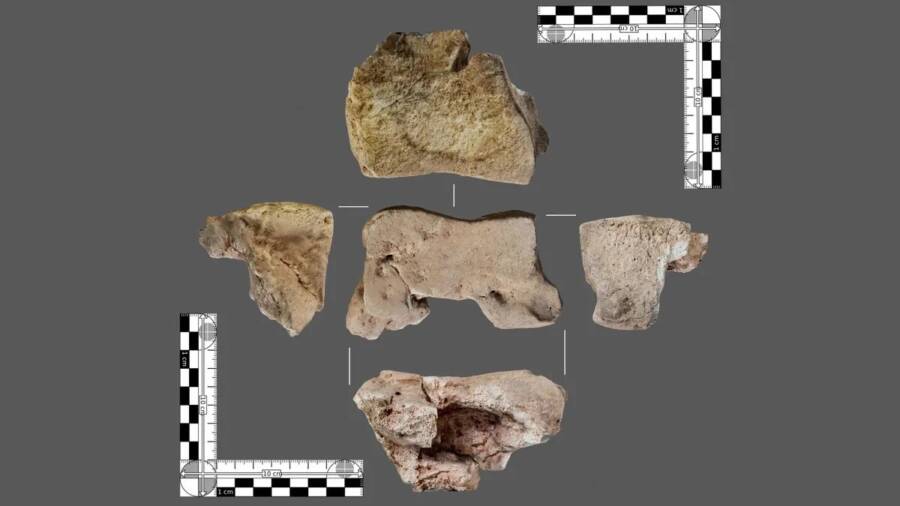
Agustín López and Rafael MartínezThe small bone found in Spain came from the ankle on the right foreleg of an elephant, though researchers aren’t sure which species.
“Elephants, when tamed, are employed in war,” the Roman writer Pliny wrote in the first century C.E. “They tread under foot whole companies, and crush the men in their armour.”
Now, a rare bone that likely came from of one of these war elephants has been found in Spain.
The bone, only the size of a baseball, appears to belong to an elephant who marched near Córdoba, Spain, some 2,200 years ago. Researchers believe that the elephant was one of the creatures brought to the European continent by the Carthaginian general Hannibal Barca during the Punic Wars, before he famously took them over the Alps and into Italy.
The Ancient Bone Found In Spain That May Have Come From One Of Hannibal’s Famous Elephants
Agustín López and Rafael MartínezThe elephant bone was found during excavations in Spain, at the site of an ancient fortified village.
According to a new study published in the Journal of Archaeological Science: Reports, the bone was a mystery when it was first unearthed in 2020 near Córdoba, as it didn’t appear to match any native species. Ultimately, researchers realized that the bone was an elephant’s right carpal bone.
So where did the elephant come from?
Researchers believe that the elephant may have been one of the animals brought to Europe by the Carthaginian general Hannibal. The bone is roughly 2,200 years old, which suggests that the elephant died during the Second Punic War (218 B.C.E to 201 B.C.E.) which was fought between Rome and Carthage. It was also found at the site of an ancient fortified Iberian village known as an oppida, and the discovery of 12 spherical stones, likely ammunition for Carthaginian catapults, further suggests that a battle took place in the area.
Agustín López and Rafael MartínezTwelve spherical stones at the site are likely ammunition for Carthaginian catapults — and evidence of a battle between the Romans and the Carthaginians.
The elephant seemingly died during the battle, and its right carpal bone either survived because it was buried under a piece of collapsed wall, or because it had been taken as a war trophy. The sample is so small that the species of elephant is difficult to determine, though researchers think it’s possibly a species of extinct elephant that Hannibal and the Carthaginians used in their wars against the Romans and others.
War Elephants In The Ancient World
Long before Hannibal brought war elephants to Europe, the animals were used in other, even more ancient conflicts. They were seemingly first deployed in combat during the Battle of Gaugamela in 330 B.C.E. between Alexander the Great and Persian King Darius III, and again a few years later, when Alexander faced off against King Porus in India. The Romans first encountered elephants between 280 and 275 B.C.E., when the Greek King Pyrrhus (from whom we get the phrase “Pyrrhic victory”) used the animals against Rome.
War elephants were both powerful work animals and psychological weapons meant to strike fear into the hearts of opponents. And the Carthaginians eventually began to use elephants in battle as well.
Hannibal is best known for crossing the Alps with 37 elephants to invade Rome, but the elephant bone from Spain is not from that campaign. The researchers wrote, “Carthaginian forces frequently deployed elephants during the Punic Wars, particularly in the second, which was fought primarily in Iberia, southern Gaul, the Maghreb, and the Italian Peninsula.”
Public DomainA depiction of war elephants in the Battle of Zama (202 B.C.E.), the final, decisive battle of the Second Punic War, in which Rome triumphed.
Despite the terror that the animals caused, however, Carthage was ultimately defeated by Rome in the Second Punic War. Roughly a century later, Carthage collapsed during the Third Punic War.
But Carthage’s elephants have never been forgotten. That said, little archaeological evidence of these fabled creatures has been unearthed, which makes the discovery of the elephant bone in Spain especially astounding.
Somehow preserved over the centuries, it’s a relic from a time when the Iberian peninsula thundered with the roar of war elephants and catapults, as Carthage and Rome battled for control over the Mediterranean.
After reading about the elephant bone found in Spain that may have belonged to a Carthaginian war elephant during the Second Punic War, learn about how Rome, though triumphant over Carthage, eventually fell. Then, go inside the catacombs of Rome that snake beneath the city to this day.
The post Archaeologists In Spain Believe They’ve Uncovered The First-Ever Remains Of The Elephants That Hannibal Used Against The Romans appeared first on All That's Interesting.








 New Posts (Home)
 ChatBox
 Popular Posts
  Game Zone
 Top PodCasts