www.thecollector.com
9 Times Rome Was Sacked and Somehow Still Survived
From ancient times to the modern era, Rome has played a pivotal part in European history, shaping society and politics for millennia. However, history has not always been kind to Rome. It is known as the “Eternal City” for good reason. It has survived the onslaughts and ravages of passing eras with all their violence and unrest.
From Gauls, to Goths, Arabs, and the Holy Roman Empire, Rome reluctantly hosted invading armies, and fell numerous times in the process.
Here are 9 times Rome was sacked.
1. The First Sack of Rome by the Gauls in 390 BCE
The figurehead of Brennus from the 19th-century battleship of the same name, named after the leader of the Senones who defeated the Romans in 390 BCE. Source: Musée National de la Marine/Wikimedia Commons
With accounts from many ancient historians such as Polybius, Livy, Diodorus Siculus, Plutarch, and Strabo, the first sack of Rome is widely attested. However, these accounts were written long after the events, and the details are challenged by many modern historians.
Nevertheless, the sack came after the Battle of the Allia in 390 BCE, although the exact year is in question. 390 BCE is the traditional year, but Polybius derived the year as 387 BCE, while Tacitus gives the date of July 18. Either way, a Gallic tribe called the Senones, led by Brennus, invaded Italy and won a major victory 10 miles north of Rome, routing the Roman army defending the city. The Gauls then marched into Rome and laid siege to the Roman citadel on the Capitoline Hill.
After seven months, the defenders, gripped by famine, surrendered and agreed to pay a ransom for their city. The nature of this, too, is contested in the histories. Polybius states that the Gauls lifted the siege as a result of their homelands being invaded by the Veneti, while Livy states that the Gauls were suffering from the plague, forcing them to abandon their efforts.
Modern analysis shows a lack of evidence for any major destruction of Rome, and if the records are to be believed, the first sack of Rome caused little damage relative to later events.
2. The Visigoths in 410 CE
Alaric entering Athens by Allan Stewart. Source: Britannica/Wikimedia Commons
The ignominy of the first sack of Rome was all but forgotten so many centuries later when the city again suffered defeat at the hands of barbarians from the north. The catalyst for the sack of Rome in 410 CE was resentment by the Visigoths toward the Romans. The Visigoth leader, Alaric, served at the Battle of Frigidus in 394, in which Gothic foederati (barbarian soldiers in service to Rome) were used in a callous tactic to overwhelm the enemy, resulting in massive Gothic casualties. He was refused the rewards he was promised, and spent the next few years negotiating vigorously to get recognition for his people, including sacking Athens.
In 402, Alaric invaded Italy, but was turned back after being defeated by the Romans under the command of Flavius Stilicho at the Battle of Pollentia. In 408, however, Alaric and his warriors were back in Italy. He laid siege to Rome and demanded ransom, but Emperor Honorius refused. On August 24, 410, an unknown person or persons opened the gates to the city. Alaric and his forces entered and looted the imperial holdings. Throughout the three-day occupation, Alaric’s forces were relatively respectful of Roman citizenry, and only a few public buildings were targeted. After the sacking of Rome, Alaric marched south to continue his campaign, but he died of an illness soon after.
3. The Vandals in 455 CE
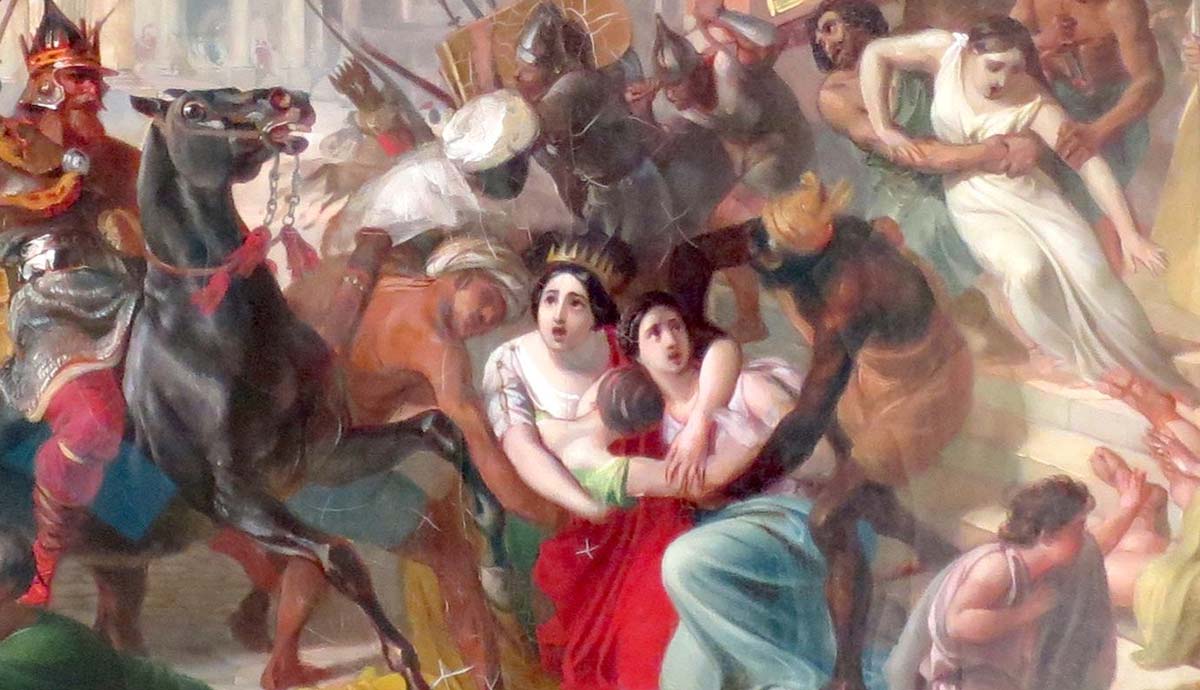
Genseric’s Invasion of Rome by Karl Bryullov. Source: Tretyakov Gallery/Wikimedia Commons
The third sack of Rome came in 455 CE with the Vandals under the leadership of their king, Gaiseric. At this time, the Vandals controlled a kingdom in North Africa over areas that were previously part of the Roman Empire. Peace between the two states was hammered out and included a marriage between Gaiseric and a daughter of Emperor Valentinian III.
Valentinian, however, was succeeded by Petronius Maximus, who married his son to Valentinian’s daughter, in breach of the truce with the Vandals. Gaiseric took his revenge by marching on a poorly defended Rome and spent two weeks looting the city.
Destruction was widespread; however, Pope Leo I intervened and negotiated with the Vandals, thus sparing Rome from being razed. Nevertheless, the Vandals took valuables and slaves before moving on to Campania. They failed to take Neapolis and afterwards, returned to Africa.
4. Ricimer in 472 CE
Ricimer, who led the troops who sacked Rome in 472 CE. Source: Austrian National Library/Wikimedia Commons
The fourth sack of Rome came in 472 CE at the hands of a Germanic Roman general named Ricimer during a civil war in which Ricimer attempted to control Rome by installing puppet emperors. He established Anthemius as emperor, but the two later came to blows. Ricimer commanded Germanic troops, primarily foederati, who laid siege to Rome, although at this time, the capital of the Roman Empire had been moved to Ravenna. Of note was the support of another Germanic warrior named Odoacer, who played a pivotal role in the end of the Roman Empire in 476.
Rather than attributing the sack of Rome to the foederati, or an ethnic group, Ricimer’s sack was a result of a struggle between political rivals rather than tensions between ethnic or cultural groups. This is not to say, however, that there weren’t significant ethnic and cultural tensions at work.
The siege was a brutal affair, with those in Rome suffering starvation and destabilization, while Ricimer managed to fend off a relief army from Gaul. After five months, Rome fell, and Ricimer marched into the city. Anthemius was executed. Ricimer did not live long enough to enjoy the fruits of his victory. He died from a disease just over a month later.
Romulus Augustulus surrenders the crown to Odoacer. Source: Cyclopedia of Universal History Volume 11 by John Clark Ridpath/Wikimedia Commons
In popular imagination, the fall of Rome is associated with a violent sack in 476, but this was not the case. The final blow that led to a symbolic end of the Western Roman Empire came in 476 due to resentment over the ill-treatment of foederati. Despite their service to Rome, promises to Germanic troops went unfulfilled, and revolt erupted as the foederati leader, Odoacer, sought justice. His forces proclaimed him king on August 23, 476, and five days later, they arrested and executed Orestes, who ruled Rome on behalf of his young son, Romulus Augustulus, whom he had personally installed as emperor after deposing Emperor Nepos in 475.
5. The Ostrogoths in 546 CE
Portrait of Totila by Francesco Salviati, 1549. Source: Wikimedia Commons
The end of the Roman Empire did not mark the end of Rome as a target for marauding armies. In fact, Rome has been sacked more times in the years since! During the Gothic War (535 to 554 CE), the Ostrogothic Kingdom and the Byzantine Empire were the main belligerents. After the fall of Rome at the end of the fifth century CE, the peninsula eventually came under the control of the Ostrogothic Kingdom, and in the next century, the Byzantines set about regaining the territory that was lost when Rome fell.
In the early stages of the war, they saw great success, but were later beset by plague and led by incompetent generals, allowing the Ostrogoths to gain the upper hand, who maneuvered to retake the Italian Peninsula. From March to December of 546, under the leadership of King Totila, the Ostrogoths besieged and finally took Rome. The city was plundered, and much of its defensive walls were dismantled.
6. The Ostrogoths (Again) in 550 CE
Mosaic of Byzantine General Belisarius. Source: Wikimedia Commons
After Totila and his army left Rome, the Byzantines under the leadership of John, a general appointed by Belisarius, occupied the city. They rebuilt much of the defenses and prepared for Totila’s return. From June 549 to February 550, the city suffered yet another siege. Belisarius had returned to Constantinople and was then ordered back to Italy, but his army was beset by recruitment issues, and he struggled against Totila’s forces. Belisarius, however, did not command Rome’s defense.
Totila was victorious and took what they could from Rome. This time, he ordered the male inhabitants massacred, and those attempting to flee were caught in prepared ambushes along the roads leading away from the city. The severity of these actions, however, is still a point of historical debate. Two years later, a Byzantine army resoundingly defeated the Ostrogoths at Taginae, where Totila was killed by a Gepid lancer.
7. The Arabs in 846 CE
Saracen Army on the March with Musicians and Standard-bearers, by Gustave Léon Schlumberger, 1844-1929. Source: Wikimedia Commons
In the decades before 846 CE, Arabs (differing sources claim they were Saracens or Moors) had struck at Sicily, launching a major campaign of conquest, and had remained a dangerous presence in the Mediterranean. Despite the threat, Siconulf of Salerno and Radelchis I of Benevento engaged in hostilities with each other, with both hiring Arab mercenaries who had left their main army looking for fortune.
Taking advantage of the chaotic situation, the Arabs gathered a force and raided Rome in 846. The Roman militia retreated behind the Aurelian Walls, but these defensive positions did not protect the entirety of the city. Of major consequence was St. Peter’s Basilica, which lay outside the walls and was filled with riches. The Arabs plundered the outskirts of the city and the holy shrines before receding from the city.
An army headed from Spoleto, and commanded by Lombard Duke Guy, attacked the Arabs as they struggled to transport their slaves and booty. Many made it to their ships only to be caught in a fierce storm.
In the aftermath, Pope Leo IV ordered a new ring of defenses to be built around the city. This was, however, not the last time Rome would be sacked.
8. The Normans in 1084
Re-enactors dressed as Norman knights. Source: English Heritage
After years of distrust and conflict between Henry IV of the Holy Roman Empire and the papacy, the situation escalated to breaking point when Henry IV was excommunicated for a second time by Pope Gregory VII. A number of bishops sympathetic to Henry’s cause convened and deposed the pope, after which they elected an antipope, Clement III.
Gregory VII, however, had opportunities for revenge. He requested assistance from the Norman Duke of Apulia and Calabria, Robert Guiscard. With a large army of hired mercenaries, which included Muslims as well as Christians, he marched into Rome. Incensed by a Roman rebellion against Guiscard and the pope, Guiscard’s troops went on a rampage. Everything they found, they sacked and destroyed.
Such was the devastation that two decades later, Ildebrand of Tours described Rome as “a desert strewn with ruins.”
9. Mutinous Troops of the Holy Roman Empire in 1527
Landsknechts Break Into Parmigianino’s Studio (1854), by Amanzio Cattaneo. Source: National Gallery of Parma/Wikimedia Commons
Charles V of the Holy Roman Empire captured Rome on May 6, 1527, during the War of the League of Cognac. He ordered his troops to threaten military action in order to force Pope Clement VII to come to terms. Much of the army, however, had gone unpaid and decided to take things further. Disobeying their orders, around 20,000 soldiers, most of whom were Landsknechts, stormed the city and easily overcame the scarce defense.
The sack was utterly devastating. Contemporary Florentine goldsmith Benvenuto Cellini referred to the events as an “unbelievable spectacle and conflagration.” For over a month, the city was plundered. People were murdered, palaces and holy places were looted, and cardinals were held to ransom. Such was the impact that civic and cultural life was halted for a year as the city struggled to recover from such humiliating barbarism. For many historians, it marked the end of the high point of the Renaissance.
Detail of The Sack of Rome in 1527. Source: Wellcome Collection/Wikimedia Commons
Rome’s history of being sacked generally conjures up images of ancient events. However, history shows that Rome was sacked intermittently, even over a thousand years after the Fall of the Western Roman Empire. And as history has repeatedly shown to be an unpredictable beast, it leaves one wondering if Rome could still be sacked in the future!








 New Posts (Home)
 ChatBox
 Popular Posts
  Game Zone
 Top PodCasts