www.wearethemighty.com
This metal manufacturing jobs program wants to fill 122,000 openings
You may know absolutely nothing about metal manufacturing, working in a foundry, or what a forging shop does, but if you enjoy the benefits of tools, cars, buildings, and everything else that makes modern life possible, you should know there’s a huge problem hiding in plain sight. The work is high-skill, the tech is getting more complex, and the workforce pipeline is not exactly overflowing.The solution might be a perfect fit for separating veterans who are looking for different ways to serve their country, for those willing to do whatever it takes to avoid office work, or for those looking for a career that’s likely safe from AI for the foreseeable future.Also Read: The best online colleges for veterans in 2026METAL, short for Metallurgical Engineering Trades Apprenticeship & Learning, is built to fix that with a pretty straightforward idea: make the on-ramp into metal manufacturing jobs like casting and forging easier, cheaper, and a lot more hands-on.The program is led by IACMI (the Institute for Advanced Composites Manufacturing Innovation) and backed by the Industrial Base Analysis and Sustainment program, with an explicit focus on building the talent base that keeps the U.S. defense industrial supply chain functioning.METAL’s training model is intentionally stacked. It starts with free, self-paced online courses that don’t assume you already speak “metallurgy,” then moves candidates into short, intensive in-person bootcamps hosted on college campuses.From there, the program plugs into apprenticeships and internships so the learning doesn’t stop at the quiz screen. It very quickly turns into time on equipment, under real supervision, doing real work.The online side is the front door into the program. METAL markets it as no-cost, self-paced training, and it’s not a single monolithic course, it’s a menu. Level one is the “start here” option, clocking in at about 8.5 hours and covering the basics: metalcasting processes, metallurgy and heat treatment, nonferrous alloys, irons and steels, casting design and modeling, additive manufacturing for casting, forging and rolling fundamentals, melting, post-processing, mechanical properties and testing, plus a careers module.Finish it, and you earn a digital credential.
Then there are the specialty tracks that aim at where modern shops are headed, not where they were 20 years ago. Digital Technologies for Casting runs through six modules (think Industry 4.0, data analytics, immersive technologies, robotics, and automation) with the pitch that you’ll be ready to apply it hands-on in a bootcamp after you complete the course.
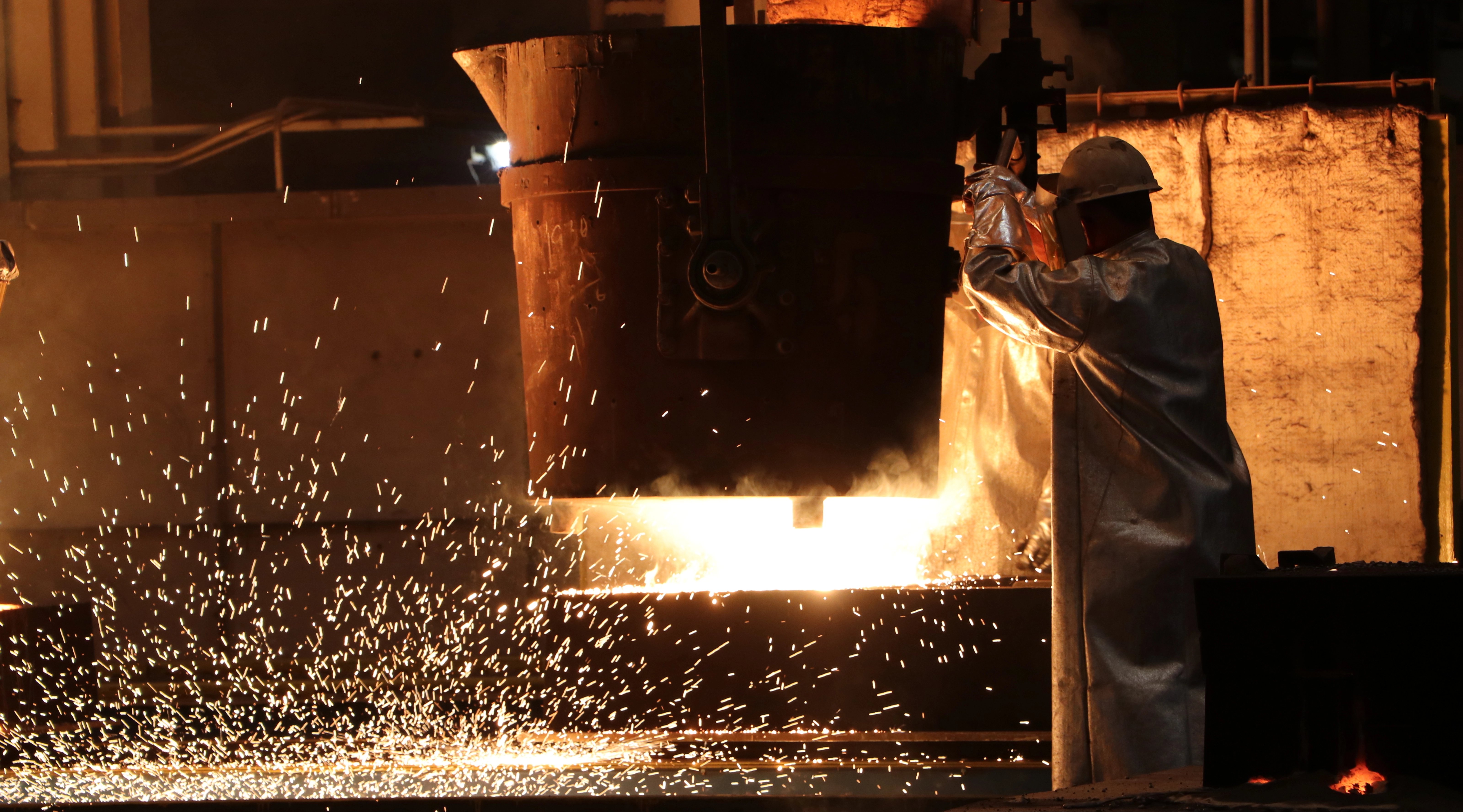
Rock Island Arsenal-Joint Manufacturing and Technology Center artisans pour molten metal into ceramic shell molds. (U.S. Army/Haley Smith)
For forging, METAL offers an advanced online curriculum developed with the HAMMER Engineering Research Center, structured into 15 modules (approximately 10 hours). It leans into the blend employers keep asking for. These are things like materials science plus practical process knowledge, and then the digital layer, simulation software, FEM applications, and what “Industry 4.0” actually means for forging operations. The course also comes with recorded lectures, quizzes, slide decks, and curated readings and videos.
Sand Science fills a gap that a lot of people only discover after they’ve already made a mess in a mold line. It’s split into two parts, fundamentals and advanced practices, and focuses on green sand and resin-bonded systems, plus how to improve them when quality, scrap, and repeatability start fighting you. Like the other tracks, it’s built to end with a digital badge and a pathway into an in-person bootcamp.
The in-person component is where METAL gets blunt about its priorities: these are one-week bootcamps, held on university campuses, designed to immerse participants in casting and forging, with guidance from industry and faculty experts.The idea isn’t to replace a degree or years on the job; it’s to compress a lot of exposure, coaching, and confidence into a short window so people can see the work up close and decide whether they want in.
On the employer side, METAL also positions itself as an apprenticeship builder. Companies can tap the program for consulting support, customizable apprenticeship templates, connections to funding resources, help tailoring training to their equipment and processes, and access to the same online modules as “related instruction” alongside on-the-job training.METAL’s apprenticeship effort includes a partnership with Jobs for the Future, and it emphasizes the standard apprenticeship mechanics: earn while you learn, raises tied to skill gains, and a credential at completion through the U.S. Department of Labor.
What makes METAL a little different (and a little more ambitious) is that it doesn’t pretend the pipeline starts at your high school graduation or ETS day. It also runs K-12 workshops meant to spark interest early, including mini foundry-style activities where students cast small objects using low-temperature alloys and explore forging concepts through hands-on materials work. It’s outreach, but with dirty hands and a keepsake at the end.Zoom out, and the program is basically trying to industrialize workforce development the same way manufacturing industrializes production. It seeks to standardize what can be standardized, scale what can be replicated, and build local hubs that don’t require everyone to relocate.METAL’s current hubs are in Pennsylvania and Tennessee, with more planned, and frames the overall goal as a national training network that sustains the base metals workforce through 2050.There’s no secret to why the urgency to create a pipeline of skilled metal workers exists. There’s a casting-and-forging workforce shortage directly tied to defense supply-chain stability, and by 2028, the industry will need an additional 122,000 skilled professionals across trades, engineering, and other critical roles. In other words, this isn’t a “nice-to-have” program. It’s a response to a labor problem that’s already here.
To register for the online training course or find a bootcamp near you, visit the METAL for America website.
Don’t Miss the Best of We Are The Mighty
• The grunt’s 250-year quest for a weapon that actually works• Veterans suffering from Gulf War Illness won a 30-year war for recognition• The Army’s new neural limb lets soldiers ‘feel’ again
Transition
Military News
This metal manufacturing jobs program wants to fill 122,000 openings
By Blake Stilwell
Education
The best online colleges for veterans in 2026, according to US News and World Report
By Gina Napoletano
Military Life
Everything veterans need to know about negotiating their first civilian salary offer
By Gina Napoletano
Resources
5 Nonprofits that help you build a future in your post-military career
By Adam Gramegna
Military News
Lowe’s launches a Skilled Trades Academy for no-cost job training and placement
By Blake Stilwell
The post This metal manufacturing jobs program wants to fill 122,000 openings appeared first on We Are The Mighty.








 New Posts (Home)
 ChatBox
 Popular Posts
  Game Zone
 Top PodCasts