www.scotusblog.com
Which of Trump’s Supreme Court nominees is the “weakest link”?
Empirical SCOTUS is a recurring series by Adam Feldman that looks at Supreme Court data, primarily in the form of opinions and oral arguments, to provide insights into the justices’ decision making and what we can expect from the court in the future.
It’s no secret that all three of President Donald Trump’s Supreme Court nominees – consisting of Justices Neil Gorsuch, Brett Kavanaugh, and Amy Coney Barrett – are judicial conservatives. This does not mean, of course, that all three vote for a conservative outcome in each case before them. Indeed, for much of the last decade, certain Supreme Court commentary has revolved around which of these conservative justices has been most likely to side with the court’s liberal bloc (consisting of Justices Sonia Sotomayor, Elena Kagan, Ketanji Brown Jackson, and formerly Justice Stephen Breyer) in a given case. Each term seems to produce a new candidate, often prompted by a single, high-profile decision that defies ideological expectations.
Gorsuch’s authorship of Bostock v. Clayton County remains perhaps the most prominent example. The 2020 decision extending anti-discrimination protections to gay and transgender employees cemented Gorsuch’s reputation as a justice willing to part ways with conservative orthodoxy. More recently, Kavanaugh and Barrett have drawn similar attention after joining liberal justices in closely divided cases involving voting rights, immigration, administrative law, and economic regulations.
Anecdote, however, is a poor substitute for systematic analysis. This article takes a data-driven approach to the question. Using Supreme Court voting information collected by the Supreme Court Database from the 2020-21 term onward – when Gorsuch, Kavanaugh, and Barrett all began serving together – it examines who really is the “weakest link” among Trump’s Supreme Court nominees.
Same-side voting
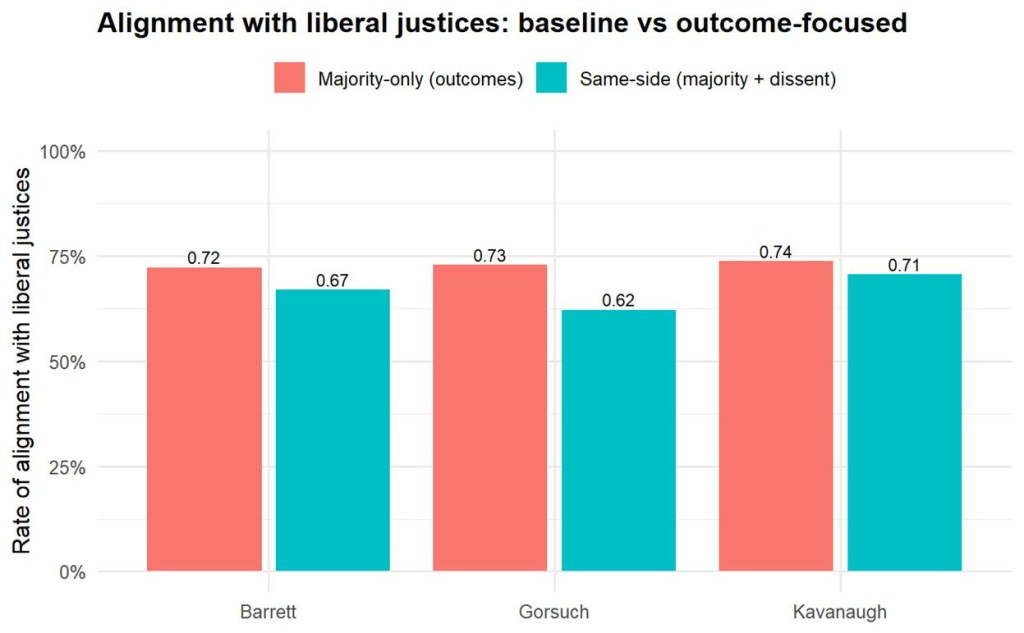
The most intuitive way to measure ideological alignment is to ask how often a justice votes on the same side as the liberal justices, regardless of whether that vote is in the majority or dissent. This produces the following results (in blue):
This metric suggests that Kavanaugh is the conservative justice most frequently aligned with liberals, while Gorsuch is the least. But this measure has an important limitation: it treats dissent alignment and majority alignment as equivalent. In other words, a justice who regularly joins liberal dissents – no matter how futile – will appear more aligned under this metric than a justice who joins liberals only when they win (that is, when it really mattered).
Shifting the focus to outcomes
Given this, it makes some sense to shift our focus to outcomes, or where the conservative justice voted with liberals in the majority (represented by the red bar). To put it simply: when this justice is on the winning side, how often are liberals on that side as well? This majority-only metric removes dissenting behavior from the analysis and thus asks not whether a justice sympathizes with liberal positions, but whether they participate in winning coalitions that liberals actually join.
Under this measure, the differences among the three justices narrows considerably:
Kavanaugh did so approximately 74% of the time
Gorsuch did so approximately 73% of the time
Barrett did so approximately 72% of the time
All three conservative justices frequently sit in broad majorities that include liberals. But Kavanaugh is again in the lead, remaining slightly more likely than his colleagues to do so. And this also foreshadows a recurring theme: Gorsuch’s reputation as a crossover justice is driven less by outcome coalitions and more by his frequency of joining the liberal bloc in losing cases.
Close cases: where alignment matters most
Broad majorities tell only part of the story. In 9-0 or 8-1 decisions, ideological alignment often reflects consensus rather than genuine coalition-building. Rather, the cases that most shape perceptions of who is the “swing justice” are close decisions – especially 5-4 and 6-3 splits. Looking at these yielded the following:
Across all 5–4 cases:
Gorsuch joined the liberal bloc approximately 44% of the time
Kavanaugh joined the liberal bloc approximately 37% of the time
Barrett joined the liberal bloc approximately 21% of the time
Interestingly, across all 6–3 cases, this pattern reversed itself:
Barrett joined the liberal bloc approximately 32% of the time
Kavanaugh joined the liberal bloc approximately 31% of the time
Gorsuch joined the liberal bloc approximately 14% of the time
These figures explain why Gorsuch often appears as the most liberal-aligned justice in the closest cases. But they still mask a crucial distinction: whether the liberals are winning or losing those cases.
Wins versus losses
The next move was to separate 5-4 cases into two categories: those in which the liberal justices were in the majority, and those in which the liberal justices dissented along with one of the Trump appointees.
When liberals win 5-4
In 5-4 cases where a liberal justice was in the majority, they necessarily did so with the help of at least two conservative justices. These cases are the strongest evidence of a justice functioning as an outcome-determinative swing vote.
In this subset:
Kavanaugh joined the liberal majority in 52% of the cases
Gorsuch joined the liberal majority in 43% of the cases
Barrett joined the liberal majority in 22% of the cases
This pattern is striking but the results are clear: When liberals win narrowly, Kavanaugh is the conservative justice most likely to be part of the winning coalition.
When liberals lose 5-4
In contrast, when liberals lost 5-4, the question becomes which conservative justices were willing to join the liberal dissent.
Here the ranking flips:
Gorsuch joined the liberal dissent in 40% of the cases
Barrett joined the liberal dissent in 20% of the cases
Kavanaugh joined the liberal dissent in 7% of the cases
This, again, is the source of Gorsuch’s distinctive profile. He is far more likely than his conservative colleagues to side with liberals in close losses – even when doing so has no effect on the outcome.
Why salient cases skew our perceptions
High-profile decisions can obscure these broader patterns. Bostock v. Clayton County remains the paradigmatic example. The decision, authored by Gorsuch and joined by the liberal justices (and Chief Justice John Roberts), looms large in the public imagination and continues to shape perceptions of Gorsuch’s jurisprudence.
But Bostock predates Barrett’s tenure and, based on the data above, has proven atypical of Gorsuch’s role in the post-2020 court. In the Barrett era, Kavanaugh has joined liberal majorities in a larger number of closely divided cases.
What actually distinguishes Gorsuch is not the frequency with which he joins liberals in outcomes, but the frequency with which he joins them in dissent. Kavanaugh is most closely associated with liberal outcomes and Gorsuch is most closely associated with liberal dissents. The disagreement over the court’s “weakest link,” in other words, turns not on degree but on which kind of alignment one chooses to prioritize.
The bottom line
Taken together, the composite indices clarify a common source of confusion in Supreme Court commentary, especially regarding Gorsuch. Unlike what occurred in Bostock, Gorsuch is the conservative justice most likely to side with liberals in close dissents. Indeed, he has done so in such areas as tribal law (e.g., Arizona v. Navajo Nation and Oklahoma v. Castro-Huerta) and certain criminal cases (such as in Pulsifer v. United States and Diaz v. United States (although note that the liberal bloc itself was split in these cases)), in which he has more of a tendency to part ways with his conservative colleagues.
It is Kavanaugh who is the conservative justice most likely to side with liberals in outcomes. This is perhaps not surprising: He is the Trump-appointed justice most frequently in the majority. His liberal-majority votes in close cases are perhaps best explained less by a single subject area (as in the case of Gorsuch) than by a repeatable posture, as he appears most likely to cross over when the liberal position can be framed as institutionally stabilizing and incremental – preserving existing decision rules, cabining remedies, or avoiding structural leaps.
Barrett falls between the two. Her rate in the majority by term is a touch lower than Kavanaugh’s but has been greater than Gorsuch’s. Her cross-ideological alignments are (somewhat like Kavanaugh) often about favoring restraint, in interpreting doctrinal or interpretive moves she views as too aggressive relative to existing law.
But to return to where we began: which justice appears most “liberal-aligned” depends on whether one values dissent as much as outcomes. If one values dissent, it is Gorsuch. If one values outcome, it is Kavanaugh. This makes understanding the “weakest link” of Trump’s Supreme Court appointees more complex – but also more accurate.
The post Which of Trump’s Supreme Court nominees is the “weakest link”? appeared first on SCOTUSblog.








 New Posts (Home)
 ChatBox
 Popular Posts
  Game Zone
 Top PodCasts