www.bikernet.com
ABATE OF FLORIDA FREEDOM RIDE
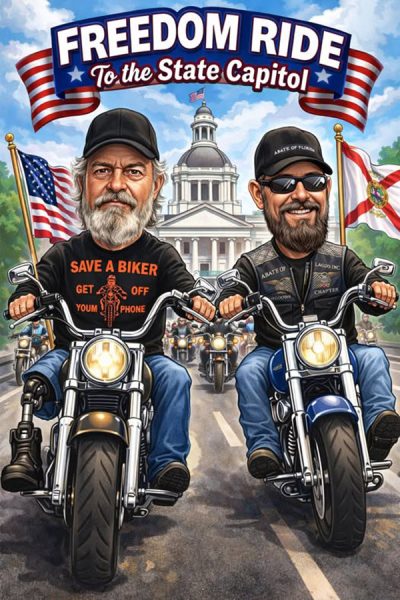
ABATE OF FLORIDA 29th ANNUAL FREEDOM RIDE TO THE FLORIDA STATE CAPITOL
ABATE (A BROTHERHOODD AGAINST TOTALITARIAN ENACTMENTS ) has come a long way since it was started by Easyriders in 1971 and it continues to grow and protect the rights of motorcycle riders around the country. The way that is done is to get people involved. There are numerous ways to do that, and, in most cases, it starts with joining a motorcycle rights organization. Contact your legislators and other elected officials and letting them know what changes you want made and why.
In my opinion the most effective way to get their attention is to bring people to their office in the Capitol.Groups left from different locations and the one I was in had a Tallahassee Police Escort who did a. excellent job
When we arrived at the capitol ABATE of Florida had already set up a welcome tent and podium for speakers.
The President of ABATE of Florida led the pledge of allegiance and addressed those present about meeting their legislators.
Elisabeth Fetterhoff of the FWD Consulting Firm the lobbyist for ABATE of Florida spoke to the group about how the bills were doing and points to bring up to legislators for those doing so.The handouts of legislation I and others discussed with our legislators are.HB 1241 & SB 1152
ABATE Support for Hands-Free Driving Bills (HB 1241 & SB 1152)
What the Bills Do (in plain language):
HB 1241 would prohibit a driver from operating a vehicle while holding or physically supporting a wireless communications device (like a phone), except for brief activation/deactivation. Sustained use must be via hands-free accessories.
The Senate bill SB 1152 mirrors the House bill with similar language, definitions, and provisions to make Florida a hands-free state.
Why ABATE Supports This Legislation
1. Reduces Distracted Driving Risk Motorcycle riders are particularly vulnerable around drivers who take eyes off the road. Hands-free laws target the manual and visual distractions that lead to crashes.
2. Addresses a Known Safety Gap Current Florida law bans texting while driving, but does not clearly prohibit holding a device for other uses (navigation, scrolling, etc.) — making enforcement difficult. HB 1241/SB 1152 close that gap.
3. Easier Enforcement Means Safer Roads By making the rule simply about holding the device, law enforcement can more reliably uphold the law, promoting consistent deterrence of dangerous behavior that disproportionately affects motorcyclists.
4. Consistent with Trends in Other States Over 30 states have adopted hands-free driving laws. Advocates (like Hands-Free Florida) point to these as a model for reducing distracted driving across all road users.
5. Clear Legislative Intent to Improve Safety for all Road Users The bills explicitly aim to improve safety for vehicle operators, passengers, bicyclists, pedestrians, and other road users — which aligns with ABATE’s mission of promoting rider safety without unnecessary burden.
There were a lot of different clubs present
Opposition to HB 429 & SB 536
(Criminal Gang Membership Expansion Bills)
ABATE’s Position
ABATE of Florida opposes HB 429 and SB 536 because these bills expand the definition of “criminal gang membership” in a way that is overly broad, subjective, and vulnerable to misuse, posing serious risks to lawful motorcycle riders, clubs, and other constitutionally protected associations.
1. Overly Broad & Subjective Criteria
The bills allow appearance, associations, language, symbols, and social media activity to be used as indicators of gang membership.
These factors are inherently subjective and depend heavily on interpretation rather than clear criminal conduct.
Law-abiding citizens should not be at risk of enhanced penalties based on lifestyle, clothing, or group affiliation.
2. Guilt by Association
The bills weaken the long-standing principle that people are judged by their actions, not who they know or ride with.
Merely associating with others who may later be accused of wrongdoing could expose innocent individuals to gang designation or sentencing enhancements.
This creates a dangerous precedent of punishing association rather than criminal behavior.
3. Chilling Effect on Constitutional Rights
Freedom of association and expression are core constitutional protections.
These bills risk discouraging lawful citizens from:
Joining motorcycle clubs
Attending events or charity rides
Expressing themselves online or in public
Floridians should not have to choose between their rights and avoiding suspicion.
4. Disproportionate Impact on Motorcycle Clubs
Motorcycle clubs—especially traditional MCs—often have:
Patches, colors, insignia
Defined hierarchies and terminology
Strong group identity and camaraderie
These cultural elements could be mischaracterized under the expanded criteria, despite no criminal intent or activity.
5. Existing Laws Are Already Sufficient
Florida already has robust criminal statutes to prosecute:
Organized crime
Conspiracy
Racketeering
Violent offenses
Expanding definitions is unnecessary and risks net-widening rather than improving public safety.
6. Risk of Uneven or Discriminatory Enforcement
Broad discretion increases the likelihood of inconsistent enforcement across jurisdictions.
What one agency views as harmless association, another may view as “gang-related.”
Laws should be clear, objective, and uniformly applied, not dependent on individual interpretation.
ABATE’s Recommendation
ABATE urges lawmakers to:
Reject HB 429 and SB 536 as written
Preserve clear, conduct-based standards for criminal liability
Protect the rights of law-abiding motorcyclists and civic organizations
Focus enforcement on actual criminal acts, not perceived identity or association
Steve Kliemisch ABATE VP and Rogue discussing how good things were going.
There is some concern about Electric Bicycles because of unclear past legislation about of road and rode motorcycles.
HB 243 (Electric Bicycles / Motorized Vehicle Definitions)
Position: WATCH WITH CONCERN
SUMMARY
HB 243 is presented as an electric bicycle safety and classification bill. While it does not directly regulate motorcycles, it creates definition, licensing, and reporting precedents that could later be expanded to include motorcycles and other motorized two-wheel vehicles. ABATE of Florida urges lawmakers to consider long-term impacts on rider rights, enforcement, and data accuracy.
KEY CONCERNS
1. Definition Expansion (“Definition Creep”)
HB 243 revises statutory definitions for electric and motorized two-wheel vehicles.
History shows that once definitions are broadened, future legislation often folds motorcycles into those frameworks.ABATE is concerned about blurred lines between: electric bicycleselectric motorcyclesscooters and mopedstraditional motorcycles
ABATE Position: Motorcycles must remain clearly and distinctly defined in statute.
2. Licensing & Endorsement Precedent
HB 243 introduces or reinforces licensing concepts tied to vehicle classes.
This sets a precedent that can later justify: additional endorsements
IF YOU LIVE IN FLORIDA PLEASE CONTACT YOUR ELECTED OFFICIALS ABOUT THIS AND ANY OTHER ISSUES YOU ARE CONCERNED ABOUT.
https://www.abatefloridainc.com
The post ABATE OF FLORIDA FREEDOM RIDE appeared first on Bikernet.com - Online Biker Magazine.








 New Posts (Home)
 ChatBox
 Popular Posts
  Game Zone
 Top PodCasts