www.washingtonexaminer.com
Sports to play big role in Trump’s celebration of country this year
President Donald Trump has long understood the power of sports as a unifying force, a platform for patriotism, and a stage for bold leadership. One year after his triumphant return to the White House, the president’s engagement with athletics continues to evolve.
Over the past 12 months, Trump has championed causes close to his heart, such as pushing for the reinstatement of baseball legend Pete Rose into Hall of Fame eligibility, a move that materialized after his direct involvement with MLB Commissioner Rob Manfred. He also advocated tirelessly for Roger Clemens’ Hall of Fame candidacy and made headlines by attending high-profile events, including the Ryder Cup at Bethpage Black in September, where he rallied American golfers amid enthusiastic crowds, and the College Football Playoff National Championship in January.
These moments captured the president’s enduring affinity for competition, but they merely set the stage for what’s next. As America gears up for its 250th anniversary, the president’s vision is turning forward by channeling sports to preserve traditions, drive infrastructure, promote health, offer redemption, and showcase our nation on the world stage.
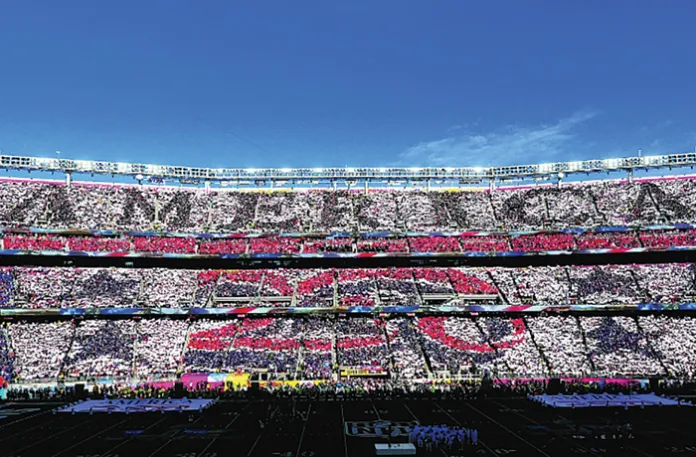
Fans use placards to display ‘America 250’ prior to the start of Super Bowl 60 on Feb. 8 in Santa Clara, California. (Thearon W. Henderson/Getty Images)
Trump’s appearances at major events further amplified his sportsman-in-chief persona. At the Ryder Cup, held at the famed Bethpage Black course on Long Island, he arrived via helicopter, mingling with players like Bryson DeChambeau and Keegan Bradley. The crowd’s chants of “USA! USA!” echoed as the president waved from the first tee, injecting a dose of national pride into the biennial showdown against Europe. Just months later, at the CFP National Championship in Miami, Trump sat in a luxury suite with Secretary of State Marco Rubio and family. The game, pitting the undefeated Indiana Hoosiers against the resilient Miami Hurricanes, drew record viewership.
These retrospective highlights pale in comparison to the ambitious agenda ahead. Trump’s administration is prioritizing initiatives that embed sports into national policy, from protecting historic rivalries to hosting unprecedented spectacles. This forward momentum aligns with the semiquincentennial celebrations, which will position sports as a cornerstone of cultural renewal. By focusing on preservation, innovation, and inclusivity, Trump aims to leave an indelible mark on how sports intersect with governance, the economy, and society.
Safeguarding a sacred rivalry: The Army-Navy Game
Few events embody American grit and patriotism like the annual Army-Navy football game, a tradition dating back to 1890. President Trump, who has attended the matchup multiple times, including performing the coin toss in December 2025, recognizes its unique place in the national calendar. Facing encroachment from an expanding CFP and postseason games that dilute viewership, Trump in January announced plans to sign an executive order mandating an exclusive four-hour broadcast window for the game on the second Saturday in December. “The Army-Navy Game is one of our Greatest American Traditions — Unmatched Patriotism, Courage, and Honor!” he declared on Truth Social, emphasizing that no other contests could overlap with it.
This executive action stems from concerns that the game’s stand-alone status was eroding amid the CFP’s potential expansion to 16 teams, which could result in scheduling play-in games on the same day. Trump’s order aims to restore the rivalry’s prominence and ensure that it remains a focal point for families, veterans, and fans nationwide. Lawmakers from both parties have echoed support for this initiative. Shielding the broadcast from competition could boost ratings for CBS, which holds rights through 2038, while also honoring the service academies’ cadets and midshipmen.
The order’s implications extend beyond television schedules. It signals a broader commitment to preserving military traditions in an era of commercialized sports. Historically, the game has served as a neutral ground where rivalries transcend politics; Republican and Democratic presidents alike, from Theodore Roosevelt to John F. Kennedy, have attended the game. Trump’s intervention draws on this legacy, positioning him as the game’s defender against CFP scheduling mayhem.
Implementation will involve coordination between the White House, the Department of Defense, and the NCAA. The exclusive window ensures the game’s 3 p.m. EST kickoff remains uninterrupted, allowing for full pre-game ceremonies, including the famed march-ons. For veterans’ groups, this move reinforces the event’s symbolic importance and reminds Americans of service members’ sacrifices. As preparations unfold, the order positions the president as a guardian of timeless rituals, preventing commercial pressures from overshadowing this battlefield of rivals who unite as “America’s unstoppable patriots.” Looking ahead, Trump has hinted at similar protections for other service academy games, potentially expanding the policy to include Air Force matchups.
Rebuilding the capital’s gridiron glory: DC stadium saga
Washington, D.C., once home to the landmark RFK Stadium, is poised for a sports renaissance under Trump’s watchful eye. The Washington Commanders’ $3.7-3.8 billion dome stadium project, approved by the D.C. Council in September 2025, will rise on the old RFK site, marking the team’s return to the capital by 2030. Trump, ever the dealmaker, has injected himself into the process, advocating for a name that honors his legacy while pushing for classical architectural elements that align with the city’s neoclassical aesthetic.
Allies like National Capital Planning Commission Chairman Will Scharf have urged designs incorporating columns and grand facades, evoking the grandeur of landmarks like the U.S. Capitol. Trump even threatened to derail the deal over the team’s name, insisting on a return to “Redskins” before backing off amid negotiations. With $2.7 billion from private owners and $1 billion in public funds, the 65,000-seat venue promises mixed-use development, retail, and entertainment. Renderings released in January 2026 show a modern yet timeless structure that blends cutting-edge amenities with historical nods.
The project’s journey reflects Trump’s real estate roots and his vision for urban revitalization. RFK Stadium had fallen into disrepair, symbolizing neglect in the nation’s capital. Trump’s administration facilitated federal land transfer legislation in 2024, paving the way for redevelopment. His involvement extends to aesthetic oversight, insisting on “beautiful” designs that complement D.C.’s monumental style and drawing on his previous executive order on federal architecture, which favored classical motifs.
Economically, the stadium is projected to generate billions in revenue by creating jobs and boosting tourism. Community advocates highlight promises of affordable housing and green spaces in the surrounding development. The team, led by owner Josh Harris, has been navigating back-channel communications with the White House to balance its commercial interests with the president’s preferences.
As construction timelines advance, the stadium saga embodies Trump’s blend of showmanship and policy. It promises to transform the Anacostia Riverfront into a vibrant hub hosting NFL games, concerts, and potentially international events. For Trump, this is the kind of infrastructure project upon which he’s built his career, a symbol of American excellence, and a demonstration that we are still capable of turning a defunct site into a beacon of pride.
A cage match for the ages: UFC at the White House
Are you ready to ruuuuumble?! Well, by this summer, you’d better be! Because our nation will be celebrating its semiquincentennial — a word none of us knew before this year — the president is planning to mark the occasion with unprecedented flair: a UFC event on the White House South Lawn. And while the fighting will be taking place on the South Lawn, RFK Jr. will be holding a pushup contest in the Oval Office. (Okay, I made the last part up, but you never know, it could happen.)
Scheduled for June 14 — which coincides with Flag Day and the president’s 80th birthday — this historic card will be the first professional sporting event at 1600 Pennsylvania Avenue (assuming we’re not counting Nixon’s bowling). UFC CEO Dana White, a longtime Trump ally, confirmed the “done” deal after Oval Office meetings, promising a “one-of-one event” that could shatter viewership records, at least until WrestleMania 43 takes over the West Wing in 2027. (Hey, you never know!)
Part of the broader America 250 festivities — which include a Great American State Fair and Patriot Games — the idea originated from Trump’s longstanding ties to mixed martial arts, which date back to the sport’s nascent days. White credits Trump with legitimizing UFC, and this event reciprocates that support while aligning with the president’s emphasis on strength and resilience. Logistically, transforming the South Lawn into a fight venue involves Secret Service coordination, temporary seating for thousands, and enhanced security measures.
Culturally, the UFC card fuses combat sports with national pride in ways that should appeal to Trump’s base while also attracting global audiences. It symbolizes America’s fighting spirit, especially poignant as we approach our 250th anniversary, recalling how we fought to win our freedom from Great Britain. So, even though the Founding Fathers probably never exactly envisioned fighting at the White House, it’s not an entirely inappropriate way to commemorate America’s 250th, if you think about it. But hey, at least we’re not bringing dueling back. (Sorry, Alexander Hamilton. Though you do have a New Jersey Turnpike rest stop named after you, so there’s that.)
Reviving a fitness revolution: The presidential test returns
In a nod to MAHA and the aforementioned pushup king RFK Jr., Trump in July signed an executive order to reestablish the Presidential Fitness Test.
“This was a wonderful tradition, and we’re bringing it back,” he proclaimed at the signing, flanked by athletes like DeChambeau, the golfer. Administered through the revamped President’s Council on Sports, Fitness, and Nutrition, the test will assess students’ push-ups, sit-ups, running, and flexibility, awarding badges for excellence.
Aimed at combating childhood obesity and promoting active lifestyles, the program draws support from organizations like the American College of Sports Medicine. States like Mississippi and Oklahoma have already adopted it for the 2026-27 school year. Trump envisions updates for modern needs, incorporating technology like fitness trackers and partnering with schools and pros to inspire youth.
The test’s revival harkens to its origins under President Dwight Eisenhower, who in the 1950s wanted to address youth fitness amid Cold War concerns. Expanded by Lyndon B. Johnson in 1966, it became a rite of passage for many young Americans. The Obama administration phased it out in 2012, shifting to a less competitive model, a change which has been rightly critiqued as giving in to the temptations of softness and sloth.
Under Health and Human Services Secretary Robert F. Kennedy Jr., the program integrates nutrition education and mental health components, aligning with “Make America Healthy Again” initiatives. Schools receive grants for equipment, and top performers may earn White House recognition. (An invitation to square off against Kennedy in the Oval Office pushup contest hasn’t yet been mentioned as one of the possible ways these top performers will be recognized, but, once again, you never know…)
Kicking off global glory: The 2026 FIFA World Cup
Culminating Trump’s sports agenda is the 2026 FIFA World Cup, which will be hosted predominantly by the U.S., with some matches occurring in Canada and Mexico. Coinciding with our 250th birthday, the president established a White House task force — chaired by himself and involving cabinet heavyweights — to oversee preparations.
Trump has vowed to ensure the event’s safety, threatening to relocate games from “unsafe” cities and imposing visa fees while navigating foreign policy tensions. The State Department’s “Sports Diplomacy Playbook” is leveraging the event for economic gains and cultural exchange. As kickoff approaches on June 11, Trump’s hands-on approach promises the “best World Cup ever,” blending soccer’s global appeal with patriotic fervor.
The tournament’s scale is unprecedented: 48 teams, 16 host cities from Atlanta to Seattle, 6 million expected visitors, and $5 billion in anticipated economic impact. Trump’s task force will coordinate the tournament’s security, infrastructure, and diplomacy, as well as address challenges such as travel bans on certain nations. Venues like MetLife Stadium will feature fan zones with patriotic themes that tie into America 250 events.
BILLY BOB’S BOOMTOWN
Ultimately, the World Cup could position Trump as a global statesman through sports — a leader who could use this global stage to foster unity amid an increasingly divided nation. If everything goes smoothly, a successful U.S. World Cup could redefine mega-events in the country by blending competition with national celebration. And if Trump’s other ambitious sports initiatives succeed, these measures could, collectively, create a blueprint for national renewal.
From protecting hallowed games to hosting epic bouts, Trump’s sports goals show how athletic competition can be woven into the fabric of American identity, giving patriots and sports fans alike something to cheer about as our nation nears its big 2-5-0.
Daniel Ross Goodman is a Washington Examiner contributing writer and the Allen and Joan Bildner Visiting Scholar at Rutgers University. Find him on X @DanRossGoodman.








 New Posts (Home)
 ChatBox
 Popular Posts
  Game Zone
 Top PodCasts