www.wearethemighty.com
Operation Highjump was one of the military’s coldest missions to date
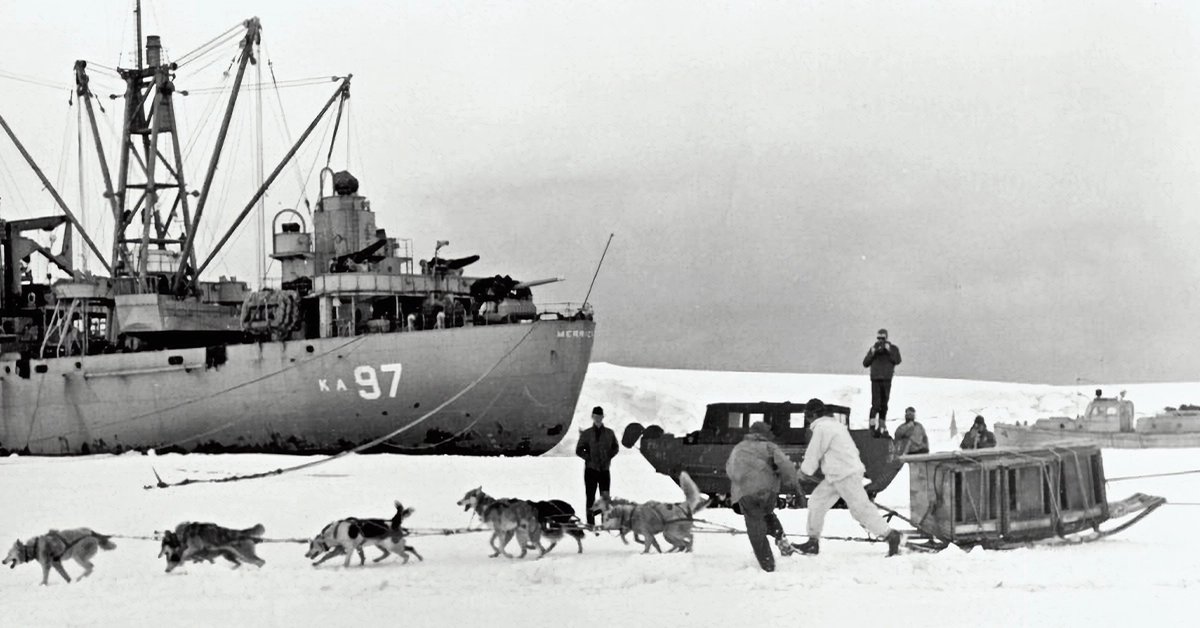
With polar temperatures dipping into the Southern U.S. every winter, many Americans are finding a newfound respect for their usual temperate climate. Even for the briefest of moments, negative temperatures and high winds prove to be an unwanted combination. But when it comes to working in the actual Arctic (not just a place that feels like the Arctic), there’s no such thing as warming up. Soldiers train for years to adapt to the harsh conditions of working in blizzards and dangerous cold. Such was the case in 1946 and 1947, when Task Force 68 of the U.S. Navy planned and built the Antarctic research base Little America IV, the latest in a series of research bases on the continent. Also Read: Why getting the Antarctica Service Medal is so difficultHighjump was not just a science field trip with uniforms. The Navy went in with explicit objectives: train personnel and test equipment in frigid zones, determine whether bases could be established, maintained, and supplied, and develop techniques for building and operating air bases on ice. It also wanted expand its hydrographic, geographic, geological, meteorological, and communications knowledge. The mission carried a blunt political objective as well: consolidating and extending U.S. sovereignty over the largest practicable area of Antarctica.
The Coast Guard icebreaker Northwind completed the first rescue mission involving a submarine, USS Sennet, during Operation Highjump. (National Archives)
Antarctica’s real menace was not just the temperature. It was heavy pack ice, fog, and whiteout conditions that could freeze anything (including a schedule) in place, ground aircraft for days, and threaten to trap ships if the sea locked up early. Everything had to move fast because once the Ross Sea started to close, no amount of confidence or horsepower was going to negotiate with the ice.
What the United States Navy Antarctic Developments Program (Operation Highjump’s official name) lacked in timeline, it made up for in force. The mission included 4,700 men, 13 ships, and 33 aircraft. Rear Admirals Richard E. Byrd and Richard H. Cruzen led the largest Antarctic expedition in history. It was also one of the coldest missions in the history of the U.S. military. Reports listed ships as giant icicles with frozen decks. Ice also had to be broken and cleared for ships, with the Coast Guard assisting in the effort. Task Force 68 was organized for coverage, not comfort. The Central Group served as the command center and fought its way toward the Ross Ice Shelf to build and supply Little America IV, operating around the USS Mount Olympus and supported by icebreakers such as the USCGC Northwind and the USS Burton Island. The Eastern and Western groups worked the Antarctic perimeter with seaplane tenders, destroyers, and tankers, launching patrol aircraft to photograph and chart a coastline that was still incomplete or wrong. A separate carrier element built around the USS Philippine Sea helped move ski-equipped R4D transports into position, while a base group handled construction, air operations, and contingency planning ashore.
Sikorsky R-4 helicopter landing on icebreaker USCGC Northwind during Operation Highjump. (National Archives)
To the public, the operation was called a training exercise. But the real goal was to train for extreme cold conditions while extending American sovereignty over the most desired part of the continent (sound familiar?). Before the Cold War, the Arctic was seen as a strategic advantage, and research was the first step toward landing forces there.That Arctic advantage was not abstract. In the early nuclear era, planners fixated on polar routes because the shortest paths between North America and Eurasia ran over the top of the world. Highjump’s Antarctic work was a brutal proving ground for navigation, communications, logistics, and airfield construction techniques that could translate to other high-latitude operating areas, including places like interior Greenland.
In addition, Operation Highjump was to establish a full logistics chain, including ships, shore forces, and aircraft—all on the Ross Ice Shelf, where highs sit around 25 degrees Fahrenheit with frequent fog, heavy snows, and unpredictable winds. In the process, the United States requested detailed scientific data that could be used for later objectives, such as claiming territory, siting buildings, and more. Little America IV was not a flag in the snow. Crews selected a site, marked supply routes from ship to camp, and built a temporary settlement on shelf ice designed to function like a small, isolated air station. The setup included large tents, Quonset huts for communications and aviation maintenance, and prefabricated living quarters. Just as important, planners prepared a fallback option: an emergency winter camp concept built around the older Little America III site, stocked with supplies in case rescue operations required a party to remain behind longer than intended.
(National Archives)
Most ships sailed from U.S. ports on Dec. 2, 1946, then converged south in staggered waves. By mid-January, the Central Group was forced into the hardest work: unloading tractors, bulldozers, and tracked vehicles; bridging pressure ridges; hauling cargo across uneven shelf ice; and grooming an airstrip to support sustained flight operations. The perimeter groups had their own clock, too, squeezing in reconnaissance whenever weather and sea state opened a brief window, because a few days of fog could wipe out an entire week of planning.
Within two weeks, an aircraft was in the air gathering key information. Planes were launched for reconnaissance missions, but they soon learned that the extreme weather made it difficult to fly. Oil had to be heated, planes switched between tires and skis, and special fuel had to be used, which held a lower freezing point. The aircraft mix was built for improvisation. Seaplane tenders operated flying boats for long patrols and coastal photography, while ski-and-wheel R4D transports were used to push reconnaissance deeper inland once Little America IV could support them. Early helicopters, including the HO3S-1 and smaller HNS-1 types, handled scouting, short-haul transport, and utility missions that fixed-wing aircraft could not safely execute without a runway and good visibility. However, even the helicopters still required key preparations, such as ensuring that rotors didn’t freeze or accumulate ice. A full hour was needed to warm fuel and prep rotors before takeoff. At least one helicopter crashed during the mission after its rotor blades became coated with ice. The operation also learned, the hard way, that Antarctica punishes mistakes fast. Another helicopter was lost in strong winds during takeoff, and a sailor was killed during unloading operations while crews were preparing equipment to build and maintain the airstrip. On Dec. 30, 1946, a plane crashed in a blizzard, killing three sailors. The pilot attempted to rise above the storm but encountered whiteout conditions that made visibility impossible. Six additional members aboard the plane survived and were rescued 13 days later.
On the brighter side, much data was collected. From 28 photographic flights, more than 70,000 pictures were taken. More than 1.5 million square miles were mapped and photographed in aerial detail. In addition, a site for Little America IV was chosen, with supplies unloaded near the Bay of Whales.The photo haul was the headline, but it was not the whole point. Those images were meant to become usable planning material, supporting navigation, future site selection, and any later decision to build larger, more durable facilities on the ice. Crews also collected scientific and environmental information when conditions allowed, pairing the spectacle of mass aviation in Antarctica with the slower, less glamorous work of making the continent legible.
Highjump also became a media product and a precedent. Navy cameras documented base life, ship operations, and polar flying, footage that later fed “The Secret Land,” a feature-length documentary that won the Academy Award for best documentary feature. In the longer run, the expedition helped set the stage for expanded U.S. Antarctic activity during the International Geophysical Year of 1957-58 and the Operation Deep Freeze era, which pushed Antarctica toward international scientific cooperation and the Antarctic Treaty, signed Dec. 1, 1959, and in force June 23, 1961.
Although a permanent American base was never realized, the Navy deemed the operation a success. But others weren’t as excited about the outcome. Operation Highjump came to an abrupt end in February 1947 when U.S. troops abruptly departed, citing early winter weather. Conspiracy theories, however, surrounded the mission and its “true” purpose, fueled by attending sailors who said they were given little information and weren’t given an intended goal. Some chalked it up to poor communication, and others said the mission was a cover-up for seeking out Nazi bases, looking for aliens, or proving the location of “the ice wall,” a distant boundary theorized by flat-earthers.
Don’t Miss the Best of We Are The Mighty
• The U.S. Navy unloaded on the Iranians in the most explosive surface battle since World War II• The Navy is bringing back battleships with the Trump-class USS Defiant• How cribbage became the card game that rules the Navy’s Submarine Force
Navy
History
Operation Highjump was one of the military’s coldest missions to date
By Bethaney Phillips
Movies
Here’s the Tom Cruise classic ‘Top Gun’ in under 3 minutes
By August Dannehl
Medal of Honor
He fought seven MiGs and kept it secret—70 years later, he’s getting the Medal of Honor
By Miguel Ortiz
Feature
These are the Navy’s rules for being buried at sea
By Blake Stilwell
Resources
Everything you need to know about military ranks and what they mean
By Jessica Evans
The post Operation Highjump was one of the military’s coldest missions to date appeared first on We Are The Mighty.








 New Posts (Home)
 ChatBox
 Popular Posts
  Game Zone
 Top PodCasts