www.civilwarmonitor.com
Introducing Fugitive Federals
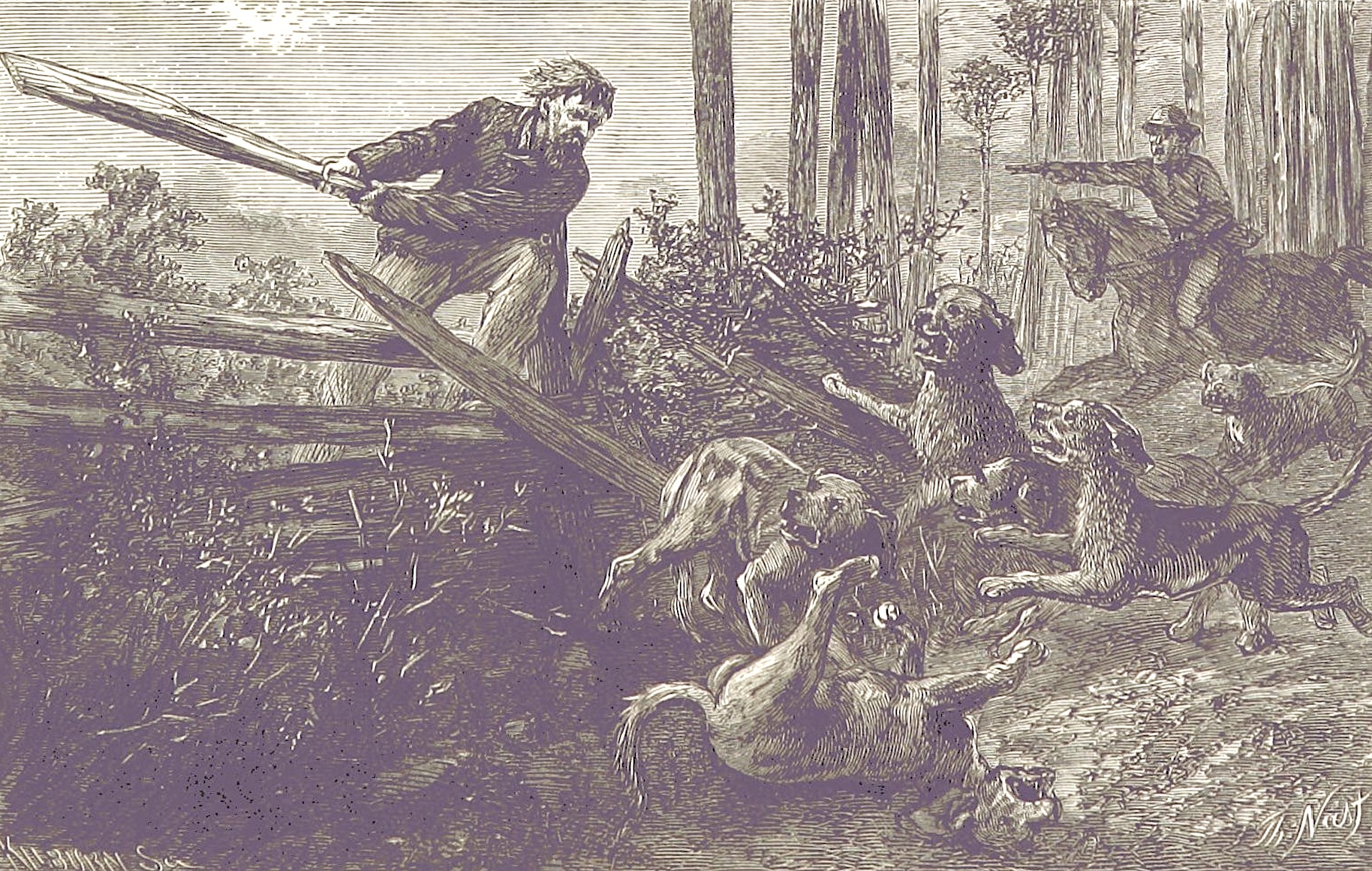
The Soldier's Story of His Captivity at Andersonville (1867)An escaped Union POW is depicted being tracked down by dogs in a postwar illustration.
In the winter of 1864 and 1865, more than 3,000 Union prisoners of war escaped the clutches of the Confederacy and swarmed the southern countryside “like the locusts of Egypt.”1 Their routes to freedom (or, more often, recapture) played out like a harrowing version of J.R.R. Tolkien’s Fellowship of the Ring: bloodhounds trained for generations to track and attack escaped slaves dogged the men’s trails; the frozen earth and air numbed their appendages; the swamps and mountains obstructed their paths with rocks and briars that cut them and teemed their wounds with vermin that sickened them; starvation sapped their energy every moment; and every human encounter could in an instant extend their flight or turn deadly. Every decision they made—where to go, who to ask for cover, or to guide them or feed them—carried the risk of violence or reimprisonment. After months, if not years, of literally rotting in the South’s most notorious POW camps—places like Andersonville, Salisbury Prison, and Libby Prison—how did these desperate men make such perilous journeys?
Lorien Foote, professor of history at Texas A&M, wrote the award-winning monograph, The Yankee Plague: Escaped Union Prisoners and the Collapse of the Confederacy (UNC Press, 2016), to answer that question in the larger context of the Civil War. Foote dug through the written records left behind by POWs, their aiders and abettors, and their predators—thousands of diaries, memoirs, letters, biographical sketches, newspaper articles, military orders and correspondence, and provost marshal records. Foote concluded that apart from the escaped POWs’ exceptional sense of duty, bravery, and will to survive, the men had a lot of help. Southern whites, particularly white women, sabotaged the Confederate government by harboring them. Enslaved people sheltered and expertly guided them through the southern landscape’s hidden networks to Union lines, unhinging the men’s common understanding of racial superiority in the process. Lastly, the escapees’ obstacles crumbled alongside the Confederacy’s ability to govern and protect its territory. Foote’s analysis of the territory POWs traveled also broadened the known extent of the Confederacy’s internal collapse at the end of the war and unveiled yet another pivotal role of black Americans in the Confederacy’s demise.
Foote created a database with the names of more than 3,000 escaped POWs, but The Yankee Plague relied on primary source evidence gathered for 50 of them. There remained thousands of individual stories still to be told and collected. If that most-challenging task could become a reality, new topics and interpretations might—most certainly would—emerge. To continue the research, Foote combined her scholarship with the undergraduate classroom. In 2018, she partnered with Andrew Fialka, associate professor of history at Middle Tennessee State University, to design and teach a Historical Research Methods course using a digitized version of the POW dataset as its centerpiece. A required course for most universities’ history majors, methods classes teach aspiring historians the discipline’s professional standards: how to understand scholarly debates in secondary sources, how to find primary sources in archives, how to analyze evidence from multiple and conflicting points of view, and how to craft original analyses through persuasive writing.
What sets Foote’s and Fialka’s classes apart is the students’ opportunity to publish their research on a project website and to use their research to test Foote’s conclusions with hundreds of additional case studies. The process of testing historical knowledge typically takes decades: masters and doctoral students produce theses and dissertations that use new sources in different geographies and time periods to challenge or corroborate established conclusions (this, after years of one-on-one graduate-level instruction). Foote and Fialka have expedited the process for training ethical researchers and generating trustworthy historical knowledge by creating and maintaining a project website, making teaching materials publicly available, and testing the course at doctoral-granting universities classified R1 and R2 for their “high research activity.”
The goals of this digital column are to maximize the project’s educational potential and to share its stories with Civil War Monitor readers. Foote and Fialka encourage educators reading this to use the Historical Research Methods syllabus and course materials at their own institutions. They are more than willing to appear for question-and-answer sessions in classrooms via Teams or Zoom. Additionally, they would like to extend the opportunity for exceptional students to publish their research on our project website—and here, in this their column.
For Monitor readers, they hope to offer miraculous stories about the Civil War’s participants.
Ultimately, we believe this bridge between academic scholarship, public history, and college classrooms everywhere can help us all understand more clearly how and why the Confederacy collapsed.
—Lorien Foote and Andrew Fialka
The post Introducing Fugitive Federals appeared first on Civil War Monitor.








 New Posts (Home)
 ChatBox
 Popular Posts
  Game Zone
 Top PodCasts