www.dailysignal.com
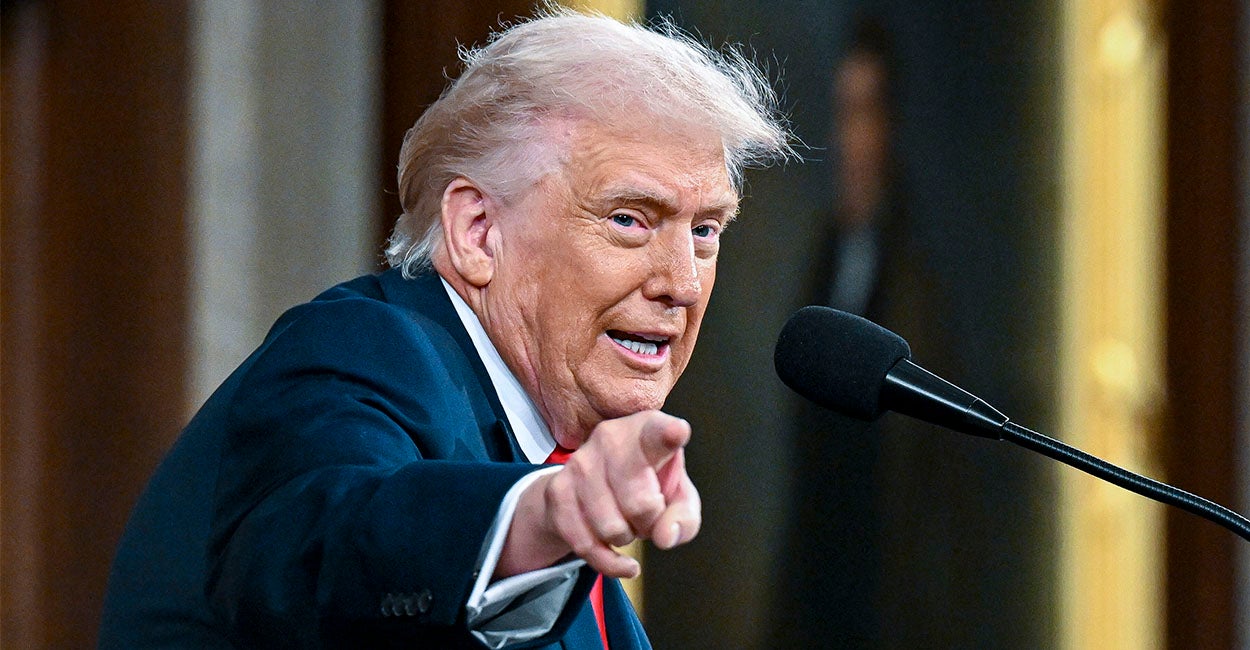
Trump’s SOTU Was a Defiant Commitment to American Self-Rule Over Ideology
What is the state of the union in the 250th year of America’s independence?
Seeing the country’s strength and prosperity today, the signers of the Declaration of Independence would probably agree with President Donald Trump that this is “the golden age of America.” Their last-ditch effort to save their way of life by breaking away from the most powerful empire on earth not only succeeded, it led to the creation of a republic that would more than once save European civilization itself.
“The revolution that began in 1776 has not ended,” the president said in his peroration last night, and his entire address served as an urgent reminder of what the revolution’s political significance really is.
For decades Americans have been taught to understand their revolution in essentially left-wing terms, as a rejection of traditional government—i.e., monarchy—and the beginning of a new, radically egalitarian morality.
Thomas Jefferson may not have known it when he wrote “all men are created equal,” but the implication of his language was that all people are so equal we can’t tell who’s a man or who’s a woman.
It’s taken us 250 years to understand that, but all American history has been the story of progressive liberalism’s germination.
Trump, in this view, is an almost unaccountable aberration. Perhaps he is an importation of “European conservatism” or fascism—he is of German immigrant roots, after all. Liberals are certain they know how history will judge Trump because history came to an end with themselves.
The future is only the enfolding of their ideas: time’s catching up to forward-thinking.
Yet when Trump spoke last night of a revolution that hasn’t ended in 250 years, he was not attempting to curry favor with his opponents. The revolution he invoked is not akin to the French Revolution nor the Bolshevik Revolution nor the many left-wing revolutions of the past two centuries and more.
On the contrary, the nation born of the American Revolution has long frustrated the ambitions of leftist revolutionary powers like 1790s France and the Soviet Union.
The American Revolution was undertaken in the defense of self-government by British subjects who had lived for generations under largely self-chosen local authorities.
If the revolution involved the rejection of the British tradition in some respects, the Americans also had a certain conservatism of their own, and their reluctance to sever their relationship with the king was one expression of it. The Declaration of Independence was a long time coming, and when it did come, it was framed not in terms of aspiring to progress but rather as an acceptance of “the necessity which constrains [the colonists] to alter their former Systems of Government.”
A staunch Tory like Samuel Johnson might accuse the colonists of Whiggish radicalism, but the Americans themselves largely rejected the radicalism of the French republic of letters. Although the French Revolution broke out a decade after our own, the battle lines of that conflagration had already been drawn by the philosophes.
And while the philosophes had their sympathizers in America, as in Britain, the American Revolution was more in keeping with the traditional spirit of British politics than it was with the spirit of French philosophy. The fact that the Americans habitually drew upon the language of the Glorious Revolution of 1688 and British opposition writers from the following generation demonstrates how grounded in the past their politics could be.
The American revolutionary commitment to self-government is antithetical to radical philosophy for the simple reason that however sinful or flawed ordinary voters might be, they are not as perverse as a society’s “advanced” thinkers tend to be.
Self-government empowers a modicum of common sense, patriotism, and religious belief against the rigorously wrong moral and intellectual systems dreamt up by progressives. The practical result is the election of figures like Trump in defiance of liberal opinion.
The president enumerated a great many accomplishments and new initiatives in his remarks last night, the longest State of the Union address yet delivered.
This was more than just an update on his activities in office, however, or even on the state of the country here and now. It was also a report on the ongoing battle between rival interpretations of America.
Though it may have sounded like a line that could have been included in almost any State of the Union address, when Trump said, “Together, we’re building a nation … where government answers to the people, not the powerful, and where the interests of hard-working American citizens are always our first and ultimate concern,” the meaning in the context of the president’s politics was clearly quite specific: “the powerful” are those responsible for the high-crime, high-inflation, high-immigration, and otherwise disastrous policies condemned in the rest of the president’s remarks.
The powerful are those who want to substitute their own ideology for the interests of “hard-working American citizens.”
America marks 250 years of citizen self-rule this year, but those who would like to abolish the distinctions between citizen and foreigner—or male and female, criminal and innocent—are as persistent as ever. This president, as his remarks last night attest, isn’t looking for a compromise between the spirit of ’76 and the spirit of “progress.” He’s on the side of a revolution that does not serve a radical philosophy.
The post Trump’s SOTU Was a Defiant Commitment to American Self-Rule Over Ideology appeared first on The Daily Signal.








 New Posts (Home)
 ChatBox
 Popular Posts
  Game Zone
 Top PodCasts