www.thecollector.com
Is Egyptian Chronology Wrong? Analyzing David Rohl’s Theory
Much of the narrative in the Old Testament of the Bible is interlinked with the history of ancient Egypt. Numerous Egyptian pharaohs appear in the Bible, some of them by name. The appearance of these regal names on artifacts from ancient Palestine informs our understanding of the chronology of ancient Palestine by linking it back to Egyptian chronology. But one Egyptologist, David Grohl, has argued that the current, conventional interpretation of the chronology of ancient Egypt is wrong, and that the Biblical evidence brings it forward by some three centuries. Could he be right?
Problems With the Conventional Chronology
An example of pottery from New Kingdom Egypt, c. 14th century BCE. Source: Metropolitan Museum of Art
New Kingdom Egypt, according to consensus among Egyptologists, began in the 16th century BCE and continued until the 11th century BCE. This chronology is largely based on examinations of ancient king lists and reign lengths, particularly from a 3rd-century BCE ancient historian called Manetho. The established dates for these Egyptian kings are also used to date sites outside of Egypt, as numerous Egyptian items and inscriptions have been found beyond its borders. When these items can be dated to the reign of a particular pharaoh and are found in a clear archaeological context, they serve as a useful dating tool. The Egyptians had regular contact with the nations of ancient Palestine, and as a result, it is primarily Egyptian chronology that establishes the chronology of the archaeology of Palestine.
This is significant because Palestine was the home of the ancient Israelite kings, such as David and Solomon. The Bible describes their activities in detail. However, according to Egyptologist David Rohl, we do not see any evidence of their reigns as described in the Bible when we use the conventional chronology provided by Egypt. David Rohl has proposed a New Chronology that aligns more closely with the Bible’s descriptions. How does this New Chronology work, and how does it supposedly fit the Bible better?
David Rohl’s Revised Chronology of Egypt
Relief at the Karnak Temple depicting Shoshenq I conquering Israelite cities. Source: Wikimedia Commons, CC-BY 3.0, Olaf Tausch
The basic idea behind David Rohl’s New Chronology is that certain dynasties that appear as consecutive in Manetho’s king list were actually concurrent. The dynasties in question are those that belong to the Third Intermediate Period, which is commonly dated to 1070-664 BCE. By making these dynasties overlap, Rohl’s revised chronology shortens that period significantly. The result is that the dates of the New Kingdom of Egypt are brought forward by some three centuries. Consequently, the dates assigned to archaeological discoveries in ancient Palestine are adjusted by a corresponding 300 years, given that they are established by the Egyptian dates.
How does this revised chronology supposedly match the Bible better than the conventional chronology? The study of Bible history is filled with synchronisms, that is, identifications of Bible characters with figures who appear in records outside the Bible. One particularly important example is the identification of the Bible’s Pharaoh Shishak. He is the Egyptian king recorded as attacking the land of the Israelites shortly after King Solomon’s death, and he plundered Jerusalem’s wealth and took it back to Egypt. He has long been identified as Pharaoh Shoshenq I, a king conventionally dated to the 10th century BCE. A contemporary Egyptian monument confirms that he really did perform a major attack against the Israelites.
However, David Rohl argues that Shoshenq’s recorded activities do not match the Bible’s description of Shishak. In the Bible, Shishak is not specifically described as attacking the Northern Kingdom of Israel. He is only presented as attacking the Southern Kingdom of Judah. In contrast, according to proponents of the New Chronology, Shoshenq I seems to have avoided Judah and focused his attacks almost exclusively on Israel to the north.
Biblical Supports for Rohl’s Revised Chronology of Egypt
Jubilee Relief of Ramesses the Great, c. 13th century BCE. Source: Metropolitan Museum of Art
According to David Rohl, the Bible’s Shishak should not be identified with Shoshenq I. Rather, he should be identified with a king conventionally dated much earlier. Rohl argues that the famous Ramesses the Great, usually dated to the 13th century BCE, was the real Shishak of the Bible. Egyptian documents show that he engaged in a major campaign in ancient Palestine. In fact, he campaigned in this area several times, but on at least one occasion, he is specifically recorded as attacking Jerusalem. This would appear to match the Biblical narrative of Shishak. As for his name, Rohl notes that Ramesses the Great was known by the nickname “Shisha” in that region. On this basis, Rohl argues that the Biblical “Shishak” could be easily understood as a slight corruption of this nickname.
This revised chronology is supposedly supported by the Bible in a variety of other ways. For instance, the Bible describes King Solomon as an exceptionally wealthy ruler, the king of a mighty kingdom. According to the conventional chronology, Solomon’s reign corresponds to the archaeological period known as Iron Age IIA. This, according to David Rohl, was relatively impoverished. In contrast, the era usually dated some three centuries earlier, to the Palestine of the Late Bronze Age, was far wealthier and more impressive.
Additionally, Rohl argues that the Amarna Letters, commonly dated to the 14th century BCE, refer to figures whose careers match those of Saul and David in the Bible. Therefore, by bringing the chronology forward by some three centuries, these figures can be identified with the Biblical characters whose careers they supposedly match.
The Identification of Pharaoh Shishak
Scarab with the name of Shoshenq I, c. 10th century BCE. Source: Metropolitan Museum of Art
In some ways, the evidence for this theory might seem compelling. However, when we look more closely at the evidence, we can understand why the overwhelming majority of Egyptologists and Biblical historians have rejected it.
Starting with the identification of Pharaoh Shishak, is it really true that the campaign of Shoshenq I does not match that of the Bible’s Shishak? While it is sometimes claimed that Shoshenq mostly avoided Judah and focused his attacks almost exclusively on Israel, this is simply not true. In reality, the stele, which records Shoshenq’s campaign, mentions numerous locations all across the Southern Kingdom of Judah. One of these locations, Gibeon, is just next to Jerusalem. In fact, of the surviving place names on the list, more of them are in Judah than in Israel. The idea that Shoshenq I cannot be the Biblical Shishak on the basis that he avoided Judah and Jerusalem is emphatically not correct.
Some researchers argue that Shoshenq still cannot be Shishak on the basis that the Bible describes Shishak as having an alliance with the king of Israel. Since Shoshenq did attack Israel’s territory, that supposedly does not match. In reality, the Bible merely mentions that Jeroboam, who later became the king of Israel, fled to Shishak in Egypt during Solomon’s reign, only returning to his land after Solomon’s death. However, alliances change all the time, and the Bible does not reaffirm any relationship between Shishak and Jeroboam after that single earlier statement.
The Wealth of Solomon
Six-chambered gate at Megiddo, built during Iron Age IIA, c. 10th century BCE. Source: Wikimedia Commons
What about the idea that Solomon’s reign does not fit the relatively impoverished Iron Age IIA, and would be better placed in the Late Bronze Age? Again, the evidence does not fit this conclusion when we look closer. The Bible tells us that the population of Israel flourished. It says that the people became like the grains of sand by the sea in Solomon’s reign. That is exactly what we find when we use the conventional chronology. During Iron Age IIA, there was a population explosion in ancient Palestine. Furthermore, the Bible specifically notes that Solomon fortified the cities of Gezer, Hazor, and Megiddo. Archaeologists have found that all three of these cities were indeed fortified with a rare six-chambered gate during Iron Age IIA.
However, is there any evidence for Solomon’s great wealth in this era? Far from this being impoverished in comparison to the Late Bronze Age, archaeologists have found evidence of immense wealth in the traditional era of Solomon. For example, Iron Age silver hoards from the region represent the largest concentration of silver hoards in the ancient Near East. A study from 2013 examined silver hoards from ancient Palestine dating to between 1200 and 800 BCE. Their chemical analysis found that these almost exclusively originated from either Spain or Sardinia, both prime candidates for the Biblical Tarshish. This was the very site from which Solomon was sad to obtain his silver.
Other Problems With David Rohl’s Revised Chronology
One of the Amarna Letters, sent from the king of Tyre to the king of Egypt, c. 14th century BCE. Source: Metropolitan Museum of Art
From the aforementioned evidence, it is clear that the Bible’s description of Solomon’s reign better matches the conventional chronology than David Rohl’s revised chronology. However, what about the other points? For instance, does the Bible really support placing Saul and David in the Amarna Period?
If we were to identify the Bible’s David with the figure named Dadua in the Amarna Letters, this would result in serious problems for the Biblical narrative. Rohl’s chronology would place David in the reign of Seti I, the father of Ramesses the Great. However, the Bible presents David as having a grand kingdom over all of ancient Palestine, a kingdom that even extended into parts of Syria. Yet, the Egyptian Empire in the time of Pharaoh Seti I is known to have extended as far north as Syria as well. He ruled over the cities of Canaan. This leaves no space for King David.
Another crucial point is the fact that the Bible refers to the king of Egypt as merely “Pharaoh” in the writings traditionally attributed to Moses. This usage continues until the time of Shishak, who is the first pharaoh in the Bible to be mentioned by name. This corresponds almost exactly to contemporary Egyptian usage, but only when following the conventional chronology. The king of Egypt was referred to as “Pharaoh” in isolation during the New Kingdom. Then, early in the Third Intermediate Period, in approximately 1000 BCE, the records start referring to the king as “Pharaoh” along with the king’s personal name. This clear correspondence between Egyptian naming conventions and the Biblical usage of this term would break down if we follow Rohl’s New Chronology.
Which Chronology Does the Bible Really Support?
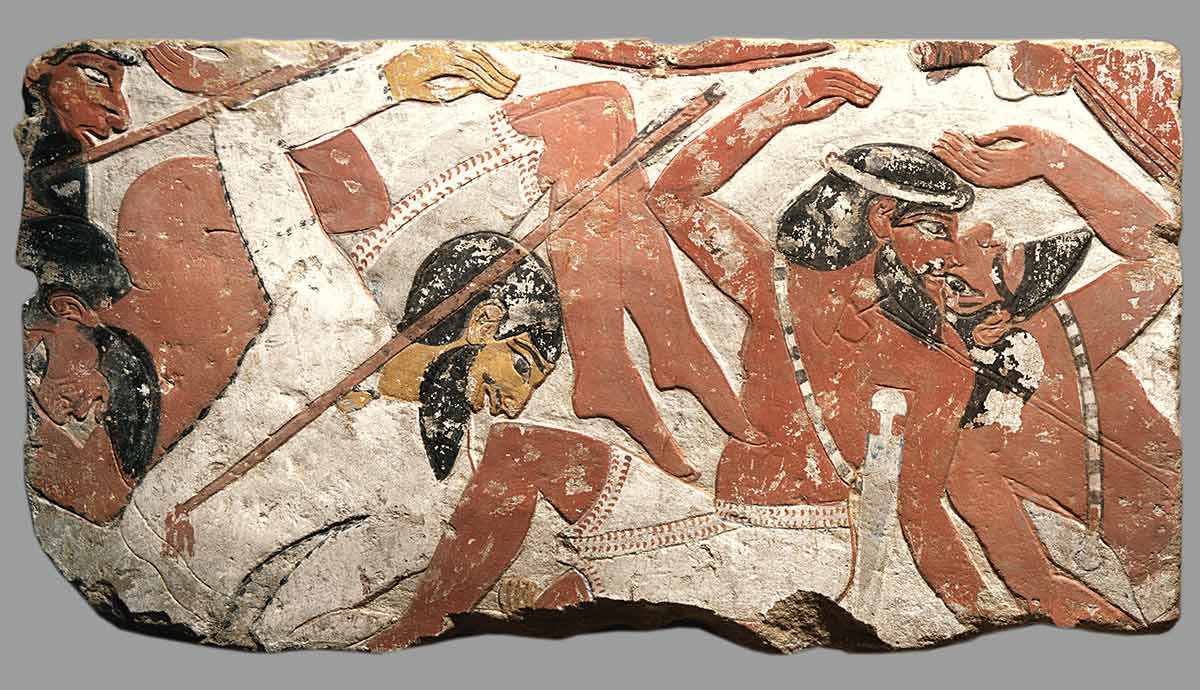
A New Kingdom relief depicting a battle, c. 15th century BCE. Source: Metropolitan Museum of Art
In conclusion, does the Bible really support the idea that the chronology of Egypt should be brought forward by some three centuries? Or, rather, does the Bible better match the conventional chronology of Egypt?
David Rohl argues that the synchronism between the Bible’s Shishak and Egypt’s Shoshenq I is not a good match, and Shishak should rather be identified as Ramesses the Great. He argues this based on the idea that Shoshenq mostly ignored the Kingdom of Judah, but the truth is that Shoshenq captured numerous cities of Judah, just like the Bible describes Shishak as doing. Moreover, associating Shishak with Ramesses the Great would cause serious problems for the Bible’s narrative, as it would place King David’s reign over Israel at the same time as Seti I’s imperial rule over that very same territory; an impossible contradiction. We have also seen that the evidence from Iron Age IIA matches the Bible’s description of Solomon’s reign in all key aspects, including the population growth and abundance of silver. Finally, we have also seen that the Bible’s use of the term “Pharaoh” is a detail that strongly supports the conventional chronology over Rohl’s revised chronology.
Of course, the Bible is not the only yardstick used to assess the validity of David Rohl’s theory. Nevertheless, inasmuch as the Bible is concerned, the conventional chronology is more convincing than Rohl’s New Chronology.








 New Posts (Home)
 ChatBox
 Popular Posts
  Game Zone
 Top PodCasts