www.theamericanconservative.com
The ‘Colonization’ of Britain Comes for Soccer
UK Special Coverage
The ‘Colonization’ of Britain Comes for Soccer
Comments from a Manchester United owner exposed social fault lines in the immigration-swamped UK.
UK Special Coverage
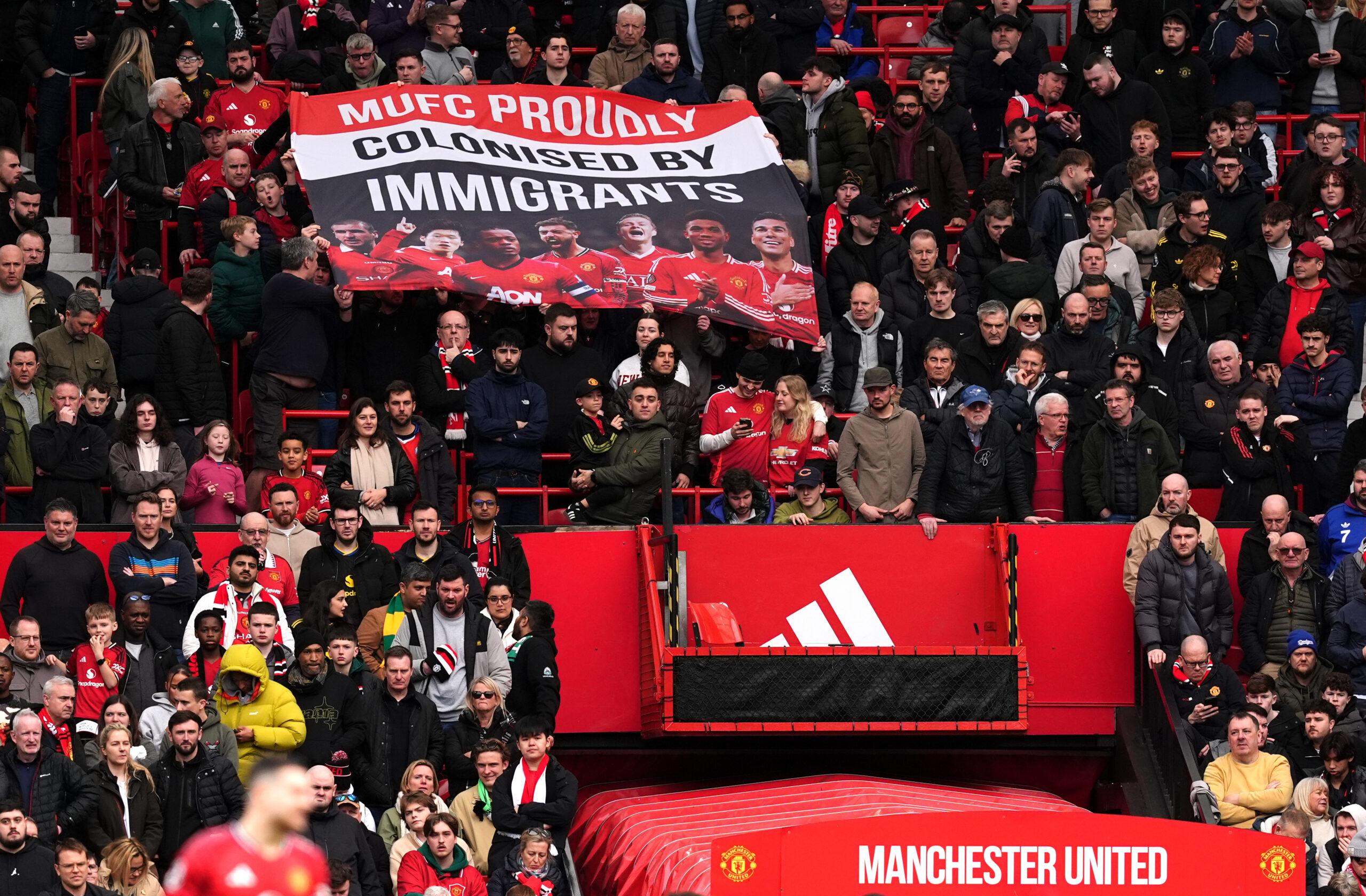
Last month, one of Britain’s most successful businessmen, petrochemicals billionaire Sir Jim Ratcliffe, ignited a political storm over immigration. Ratcliffe, one of the owners of Manchester United soccer club as well as the boss of chemicals giant Ineos, complained about the state of the economy in an interview with Sky News. During the interview, he referred to how Britain had been “colonized by immigrants,” the population had boomed because of immigration, and millions of people were out of work.
This provoked an immediate political debate, particularly over his use of the word “colonized.” Prime Minister Keir Starmer demanded Ratcliffe apologize and mounted a defence of immigration and diversity on X. Nigel Farage, the leader of Reform UK and the de facto leader of the opposition in Britain, took to the airwaves to defend him, sidelining concerns about his phrasing.
Ratcliffe’s intervention matters—even though he subsequently clarified, but did not recant, his remarks—because it is the latest sign of how figures in British public life are linking high levels of immigration with public discontent and a poor economy. While Ratcliffe has strident political views, he is not a political actor, and his comments served to push the debate around immigration further and caused political pain for the government.
Ratcliffe’s status as co-owner of a soccer club—and one of the world’s most famous, at that—makes his remarks more important. Soccer has been used by the modern British state as the safest form of patriotism, national identity, and unifying culture in a multicultural country which didn’t really want to become multicultural. The state has spent decades trying to rid soccer of right-wing sentiment, heavily policing fans for their political views and statements, not just violence or overt racism on the terraces. The owner of a soccer club criticizing immigration in such frank terms breaks the soccer-as-multiculturalism structure that the British government, the Football Association, and a range of NGOs have tried to cultivate, best summed up by the politically correct management of England under Sir Gareth Southgate, who sadly failed to win any trophies during his tenure.
Ratcliffe’s comments caused such a stir because they reflect decades of public frustration with immigration policy. While the eruption of immigration into Britain since the pandemic has attracted global infamy and political turbulence, mass immigration and multiculturalism long predate the Boriswave of 2021–2023. Indeed, while the Boriswave was the largest single influx of immigration to Britain—over 2 million people in two years—it was arguably a chaotic accident, a consequence of poor economic forecasting of the fiscal benefits of immigration, a university sector desperate for fees from foreign students, and the panicked introduction of a health and care visa designed to plug pandemic-driven labor shortages in the health service. While, of course, the government could have changed course before belated visa restrictions were introduced in 2024, the poor quality of data collection and reporting within the Home Office meant that ministers were flying blind until it was too late to stop the wave from coming. Or so they say.
In some respects, chaotic accidents typify British immigration policy. After the Second World War, migrants from the Caribbean and Britain’s colonies in the Indian subcontinent traveled to Britain looking for work, benefiting from free movement to the motherland as imperial subjects. Britain, as an ancient island nation with an historically stable and homogeneous population, had not legally defined citizenship or implemented much of an immigration policy by this time, as it didn’t really need to. Immigration was limited by the cost and availability of travel, and until the late 1940s, that was a very high bar.
Between the 1940s and 1970s, immigration to Britain came in fits and starts. Usually a group of young men would come seeking work in Britain’s declining industries—steelworks and textile mills in particular—and they would eventually be followed by their dependents. Some areas absorbed many more immigrants than others, and the huge numbers in the West Midlands—one of England’s industrial heartlands—provoked public backlash, culminating in Enoch Powell’s 1968 speech in which he said that by embarking on a policy of mass immigration, Britain was a nation building up its own funeral pyre.
Although Powell’s speech provoked political denunciation, a majority of the public agreed with his sentiments, and the government subsequently legislated to restrict immigration in the late 1960s and into the 1970s. The 1971 Immigration Act implemented strong powers to restrict the awarding of visas, and these powers are still in use today. The 1981 Immigration Act ended birthright citizenship in Britain and established the concept of citizenship that is still in force. Though it is fashionable to say that Powell poisoned the cause of immigration restriction with his speech, in reality the British government responded to Powell by functionally closing the borders, and immigration was very low—often net-negative—in the 1980s. This stands in contrast to the liberalization of immigration policy in the United States at the time, where the borders were opened wide by JFK in 1965 after four decades of deliberately restrictive and selective migration policy.
At the start of the 1990s, the British population was 94 percent white, and the population of London was just under 80 percent white, an indication of how historically homogeneous the country was. Yet there had already been instances of Pakistani grooming gang activity as early as the 1950s. There were also cases of large-scale radicalization of the British Muslim population in the 1980s, such as the Salman Rushdie Satanic Verses affair, and the hounding to retirement of Ray Honeyford, a teacher who warned about growing extremism among Muslims in schools in the Yorkshire city of Bradford. One wonders now about the paths not taken in response to these episodes.
After Labour returned to office in 1997, British immigration policy changed. Tony Blair’s government introduced policies deliberately intended to increase immigration. The Primary Purpose Rule—which aimed to restrict sham marriages for immigration purposes—was abolished and this led to a rapid increase in migration, especially, and crucially, from countries like India, Pakistan, and Nigeria. Family reunification routes became a huge driver of migration in the 1990s and 2000s.
By 2001, the white British population of London had fallen to under 60 percent, and by 2011 it was under 45 percent. At a national level, the white British population declined to 87.5 percent in 2001 and 80.5 percent in 2011. For much of this period, the largest influxes came from Africa and South Asia, with migrants arriving on a mixture of routes, some as refugees, others as family dependents, and some as skilled workers. Some parts of the country were transformed. In 2016, the BBC ran a documentary called Last Whites of the East End, which explored demographic change in the London Borough of Newham, which had the lowest percentage of white British residents at the time.
The 2000s also saw the arrival of migrants from Eastern Europe en masse, thanks to the accession of countries such as Poland to the European Union. Britain and Sweden were the only EU countries that did not introduce any kind of transitional controls on migration from the so-called A8 countries, eight Eastern European and Baltic states which had been part of the Soviet Union. Government modeling at the time claimed that only 10,000 people would come to the UK. In reality, over 1 million arrived.
While some people look back nostalgically at the arrival of migrants from Eastern Europe fondly, especially compared to the low-skilled, low-paid, culturally distant Boriswave, the unexpected influx of migrants from post-Communist countries caused huge anger and dislocation in the 2000s. Towns and cities in the east of England, in particular, were transformed, with places like Boston in Lincolnshire and Peterborough in Cambridgeshire experiencing huge and unexpected increases in migration.
Recently, many of these migrants have started to return to their home countries, as the economy in Poland has improved, having saved enough money from working in Britain to secure a high standard of living back home. This should come as no surprise to anyone who actually spoke to a Polish builder about his plans over the last 20 years. The east of England was one of the most Brexit-voting parts of the country, with huge support for UKIP in the 2010s and its successor Reform UK today. The defeat of the Conservatives in 2024 and the establishment of Reform UK as the leading party of the British right since then are the crystallisation of years of frustration against immigration by the British public.
Today, Britain is a multicultural country by accident, or at least one against the will of the voting public. The effects of this are spread unevenly around the country, with some areas—especially in the rural west of England, Wales, Scotland, and Northern Ireland—looking and feeling much as they did 30 years ago, while places like Leicester, London, Birmingham, or Luton are an unhappy mixture of being both highly diverse and highly segregated.
Multicultural Britain is not a cohesive or coherent place; it is more like an empire squashed onto an island, with rival groups awkwardly overseen by a state which tries to balance their interests and maintain its legitimacy at once, pleasing no one. Until recently, all the state could offer as a uniting theme was an ersatz vision of sport as the great unifier: the 2012 Olympics opening ceremony and a stage-managed England soccer team. Today, democracy appears ever more like a census, with voting taking place on sectarian lines and serving merely to indicate how much our demography has changed since the last election. As Jim Ratcliffe’s comments suggest, not even soccer can paper over the cracks anymore.
The post The ‘Colonization’ of Britain Comes for Soccer appeared first on The American Conservative.








 New Posts (Home)
 ChatBox
 Popular Posts
  Game Zone
 Top PodCasts