www.newsbusters.org
Iran’s Partnership With CNN Already Paying Off, Paint U.S. as Bad Guys
A little over a day since Iran gave CNN “permission” to operate inside the country and it was already paying off for the murderous Islamic regime. In a pearl clutching segment on Erin Burnett OutFront Friday night, “investigative reporter” Katie Polglase tried to paint America and Israel as the bad guys in the conflict because sensitive civilian locations close by regime targets felt the blast waves of the bombs. All by citing their sources within the regime, with one reporter uncritically reposting their narratives on X.
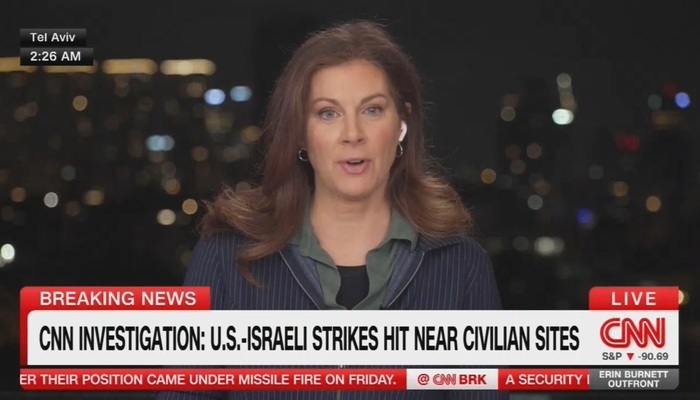
When leading into the segment, host Erin Burnett accidentally shows just how ridiculous their griping was: “This, as a new CNN investigation uncovers just how close U.S.-Israeli air strikes have come to hitting civilian sites like schools and hospitals inside Iran.”
That’s right. The crux of the report wasn’t a rash of civilian locations being blown to smithereens by allied strikes, it was to complain that legitimate targets nearby were being hit with precision.
Polglase started by noting that “U.S. and Israeli bombing campaign of Tehran has been targeting intelligence complexes, police stations and state broadcasters.” But she soon took issue with how “the impact is going beyond that due to the densely packed nature of the city and the large-scale weapons involved.”
In something reminiscent of the liberal media’s coverage of the recent Israel-Hamas War in Gaza, Polglase was aghast that a strike fell on a state-media outlet complex because the windows of a hospital across the street were blown out by the shockwave:
Take a look at this satellite image. This crater is at least 40-foot wide. That means it was likely caused by a 2,000-pound bomb. The target, Iran's state broadcaster, the IRIB. The strike wiped out its communications mast. These bombs, used by both the U.S. and Israel, are capable of killing or wounding people more than 1,000 feet away, and just 100 feet away is the Gandhi Hospital, one of the biggest in Tehran.
“Like here, you can see the blown out windows of the Gandhi hospital from space,” she added, speaking about the damage.
So far, it appears that Iran’s plan to launder their propaganda through CNN was paying off and CNN was more than happy to be a tool.
CNN is upset that sensitive civilian locations close by regime targets felt the blast waves of the bombs and had windows blown out. CNN treats it… pic.twitter.com/Hj6lytSycV
— Nicholas Fondacaro (@NickFondacaro) March 7, 2026
Of course, there was mention that the point of the strikes were to help pave the way for the Iranian people to rise up and take control of their government; a regime that killed 30,000 protesters just a few weeks ago.
Since they were a part of putting down those protests, Iran’s national police force were also targets of the strikes. CNN was upset that their national headquarters were leveled because there was a hospital a few blocks away (Click “expand”):
Over in another central part of Tehran is the Motahari Hospital, and just behind it is the Iranian police headquarters. In fact, you can see a police helicopter pad down here. This image is from just before it was struck. And this is after entire buildings flattened.
The Motahari Hospital is still standing but we verified this video showing substantial damage inside.
It's not the only hospital in the area affected. Over here is the Khatam Hospital. Glass windows shattered and medical staff are seen running out. Further down the same street is the Iranian Red Crescent Society smoke billowing from behind the building. Again, people are fleeing.
It’s ironic that CNN whined about the Red Cresent Society being close to one of the bombed police stations because recent video evidence appears to show a Red Cresent Society official lying to state media reporters and falsely labeling a different police station in Tehran as “civilian.”
ضبط اتفاقی مکالمه مقامات سازمان هلال احمر جمهوری اسلامی در جریان نمایش ویرانههای کلانتری ۱۳۸ جنت آباد تهران به مدیر دفتر کمیته صلیب سرخ (۱۴ اسفند ۱۴۰۴):
- من گفتم مسکونی بوده همهشون
- خوبه، خوبه pic.twitter.com/3MsNHi6LHy
— حافظه تاریخی (@hafezeh_tarikhi) March 6, 2026
The hyperbole was also out of control. Despite the video showing a hospital intact with some debris on the ground and never claiming it was hit by a bomb, Polglase falsely claimed that babies were being pulled from the “rubble” and played dumb about what was actually struck:
Across Iran as a whole, more incidents like these are emerging. We geolocated this video to the Persian Gulf Hospital in the city of Bushehr. You can see newborn babies being carried out amid the rubble. It's unclear what the target was, but it's close to an airport, a military airbase.
Polglase bragged about how they “cross-referenced with satellite imagery to see the damage caused by U.S. and Israeli strikes” and the imagery was featured throughout. But when it came to reporting on how a “gym” in the Fars region of Iran (not a specific city), she didn’t care to show any satellite images when noting “Iranian media said it was also right next to a police station.” It would be helpful to know if the gym was actually part of the station complex.
Deep inside Iran, senior international correspondent Fred Pleitgen was actually on X reporting propaganda from the Iranian regime.
Pleitgen reposted a comment from Ali Vaez, who has worked closely with Iran’s Foreign Ministry to push their narratives in western countries, sharing a post from Iranian Foreign Minister Seyed Abbas Aragghchi.
“The U.S. committed a blatant and desperate crime by attacking a freshwater desalination plant on Qeshm Island. Water supply in 30 villages has been impacted,” the foreign minister claimed, and was shared by Pleitgen without evidence.
To further prove how untrustworthy the people Pleitgen found believable were, check this out: Iran had put out a statement apologizing to their regional neighbors for attacking then for no reason and promised not to do it again. A short time later, they struct their neighbors and Araghchi blamed President Trump for making them do it.
Unlike Iran, which was deliberately targeting resorts, airport concourses, civilian ships, and residential apartment buildings, the U.S. was trying to be as precise as possible and limit the destruction. We’re no longer in the era of the carpet-bombing campaigns of WWII, where massive bomber formations were needed to try to hit a single factory in the in center of a city.
No country has put more toward developing such precise weapons than the U.S. In fact, the U.S. was so concerned about it that we developed the AGM-114R9X (aka the “Flying Ginsu”); a Hellfire missile with swords inside for when Uncle Sam wants to kill one person in particular.
So far, it appeared Iran’s plan to launder their propaganda through CNN was paying off and CNN was more than happy to be a tool.
The transcript is below. Click "expand" to read:
CNN’s Erin Burnett OutFront
March 6, 2026
7:26:12 p.m. Eastern
(…)
ERIN BURNETT: We just spoke to Fred Pleitgen. That was his first live report that you have seen from Tehran and he said that right now, as he's there, there's a massive ongoing wave of airstrikes hitting Tehran with sustained bombing lasting more than an hour, and that the bombing has been going on there for much of the day, according to Fred. This, as a new CNN investigation uncovers just how close U.S.-Israeli air strikes have come to hitting civilian sites like schools and hospitals inside Iran.
Katie Polglase is out front.
[Cuts to video]
KATIE POLGLASE (voice-over): A city under attack. It's also home to millions of people. The U.S. and Israeli bombing campaign of Tehran has been targeting intelligence complexes, police stations and state broadcasters. But we verified videos and analyzed satellite imagery and found the impact is going beyond that due to the densely packed nature of the city and the large-scale weapons involved.
Take a look at this satellite image. This crater is at least 40-foot wide. That means it was likely caused by a 2,000-pound bomb. The target, Iran's state broadcaster, the IRIB. The strike wiped out its communications mast. These bombs, used by both the U.S. and Israel, are capable of killing or wounding people more than 1,000 feet away, and just 100 feet away is the Gandhi Hospital, one of the biggest in Tehran.
Glass shattered, walls collapsed, and patients including babies being rushed out.
POLGLASE: As more videos like this one began to emerge, we started verifying them, pinpointing the hospital where each one was filmed. Then we cross-referenced with satellite imagery to see the damage caused by U.S. and Israeli strikes.
POLGLASE (voice-over): Like here, you can see the blown out windows of the Gandhi hospital from space.
Over in another central part of Tehran is the Motahari Hospital, and just behind it is the Iranian police headquarters. In fact, you can see a police helicopter pad down here. This image is from just before it was struck. And this is after entire buildings flattened.
The Motahari Hospital is still standing but we verified this video showing substantial damage inside.
It's not the only hospital in the area affected. Over here is the Khatam Hospital. Glass windows shattered and medical staff are seen running out. Further down the same street is the Iranian Red Crescent Society smoke billowing from behind the building. Again, people are fleeing.
Across Iran as a whole, more incidents like these are emerging. We geolocated this video to the Persian Gulf Hospital in the city of Bushehr. You can see newborn babies being carried out amid the rubble. It's unclear what the target was, but it's close to an airport, a military airbase.
But it's not just hospitals. Other civilian sites are also bearing the brunt of these strikes this school in southern Iran was directly hit, resulting in the deaths of over 160 students and staff, according to Iranian state media. Neither the U.S. nor Israel have acknowledged they caused the strike. It was just 200 feet from an Iranian military base. You can see multiple of their buildings hit as well as damage to the school.
Another strike hit this gym in Fars, southern Iran. There were reportedly 20 volleyball players inside at the time. Iranian media said it was also right next to a police station.
As strikes continue, access to safe medical facilities will be crucial, but the civilian toll is mounting. The Human Rights Activist News Agency now reporting over 1,000 dead.
Katie Polglase, CNN, London.
[Cuts back to live]
BURNETT: Incredibly important work, as hard as it may be to see that. CNN has reached out to U.S. Central Command and the Israeli military for comment on these strikes and any steps they're taking to prevent civilian harm.








 New Posts (Home)
 ChatBox
 Popular Posts
  Game Zone
 Top PodCasts