www.newsbusters.org
NYT’s Sanger, Deep State’s Bertrand Wildly Insist Iran Was Not an Imminent Threat
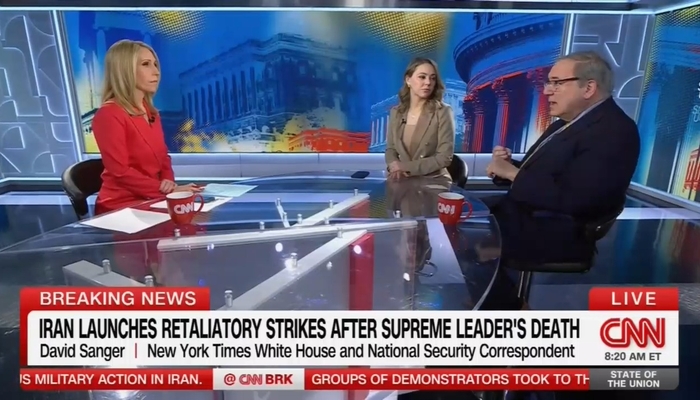
On last Sunday's State of the Union, CNN co-host Dana Bash interviewed New York Times journalist David Sanger and CNN correspondent Natasha Bertrand to discuss the recent attacks on Iran, with both insisting there was “no imminent nuclear threat” from Iran, suggesting the strikes amounted to a “war of choice.”
Bash began by asking Sanger for his opinion on President Trump’s “ultimate war of choice” to which he confidently replied that “there was no imminent nuclear threat.”
Echoing a piece he wrote for The Times, he argued Trump’s missile strikes in June had already “neutralized a good deal” of Iran’s nuclear capabilities. He added that Trump’s claim Iran could soon strike the U.S. with missiles was contradicted by the Defense Intelligence Agency, which reported last year that the Iranians were “probably a decade away from having something intercontinental.”
David Sanger and Natasha Bertrand both claim Iran Was "Not an Imminent Threat." Thoughts?#iran #israel #usa #cnn #war #trump pic.twitter.com/bBb5gwCg3K
— Sarah (@scbpoli) March 6, 2026
Sanger acknowledged the Iranian military “can certainly reach American bases, American allies in the region,” but emphasized that there was “no imminent threat.” He assumed that Trump decided to attack Iran at this time because Iran was in a “moment of weakness” politically, economically, and militarily. Sanger added “wars of choice are illegal under the UN Charter” unless you have an “imminent threat.”
Bertrand -- who wrote the infamous article claiming Hunter Biden’s laptop was Russian disinformation -- chimed in and noted that “administration officials said the Iranians had missiles essentially pointed at U.S. bases and U.S forces.” She added that officials wanted to “take action first to take out these missiles” to ensure that there would not be a “mass casualty incident.”
Regardless, Betrand claimed that there is “no intelligence to support the idea that the Iranians were going to take a first strike against the U.S. or against Israeli assets.”
Betrand concluded that the administration will not only need a justification for the attacks but will also have to vote on a “war powers resolution to say that the U.S. was under imminent threat that there was an imminent attack coming, and so they had to act quickly.”
Click "Expand" to view the transcript:
State of the Union with Jake Tapper and Dana Bash
3/1/2026
8:20:16-8:23:20 AM
DANA BASH: Welcome back to State of the Union. Iran's Islamic revolutionary guard corps said it has launched another wave of missiles and drones on countries across the Middle East. This comes after Israel's defense forces said it had killed 40 senior Iranian commanders, calling it a historic strike.
Here with me now, David Sanger of the New York Times, CNN's Natasha Bertrand and CNN political analyst Barak Ravid of Axios. Starting here at the table, David, I want to start with you because you wrote in a great New York Times piece this morning that President Trump has embarked on the ultimate war of choice.
DAVID SANGER (NER YORK TIMES CORRESPONDENT): Right. There was nothing, Dana, that forced him to act and act now. There was no imminent nuclear threat. He had actually neutralized a good deal of that back in June when he hit Fordow, Natanz and Isfahan and most of the nuclear fuel that is closest to bomb grade is buried at Isfahan and there's been no evidence that anyone was digging it up. His claim that they were soon going to have missiles that could reach the United States is contradicted by his own defense intelligence agency which reported last year that they were probably a decade away from having something intercontinental. They can certainly reach American bases, American allies in the region - that's been true for a long time and there was no imminent threat.
So, the question is, why did he choose to go do this now? And I think the answer, which I think you touched on talking to Senator Coons before, was this was a remarkable moment of weakness for the Iranians politically, economically certainly militarily. He saw his chance. The CIA you know, came in with intelligence about where they'd been tracking the supreme leader, and they've been sharing that with the Israelis. But the fact of the matter is that he did not need to go do this and wars of choice are illegal under the UN Charter. They're illegal by most international law unless you have imminent threat.
NATASHA BERTRAND (CNN NEWS CORRESPONDENT): And I think that's where we're going to see the legal justification start to take shape and we already saw it starting to take shape yesterday in a call with reporters. Administration officials said the Iranians had missiles essentially pointed at U.S. Bases and U.S forces, and they were prepared to use them preemptively and so we had to take action first to take out these missiles, take out the launchers to prevent a mass casualty incident. We're told that that is not true, that the Iranians actually there was no intelligence to support the idea that the Iranians were going to take a first strike against the U.S. or against Israeli assets, unless the U.S. and Israel acted first.
But of course, going back to your point they need a justification not only, you know, under international law, but also to lawmakers who are coming potentially coming back to the Hill this week to vote on a war powers resolution to say that the U.S. was under imminent threat that there was an imminent attack coming and so they had to act quickly.








 New Posts (Home)
 ChatBox
 Popular Posts
  Game Zone
 Top PodCasts