www.upworthy.com
In 1958, a scientist began filling flasks with air. The samples showed the Earth was ‘breathing.’
One of the longest-running scientific studies of its kind might not sound all that interesting on its surface. For more than 60 years, scientists on the flank of Mauna Loa, an active volcano in Hawaii, have been collecting air. Yes, air.
The work, while repetitive and tedious at times, is surprisingly among the most important scientific research ever conducted.
In the early 1900s, a handful of scientists had captured similar air samples from around the globe. An engineer named Guy Stewart Callendar was one of the first to compare these datasets and conclude that the human burning of fossil fuels was causing carbon dioxide levels in the atmosphere to rise.
However, the datasets weren’t very good. They were collected at different locations around the globe and at different times. In the 1930s, there wasn’t a strong baseline for what Earth’s atmosphere should look like, so the scientific community was skeptical of Callendar’s ideas.
That’s where scientist Charles David Keeling comes in.
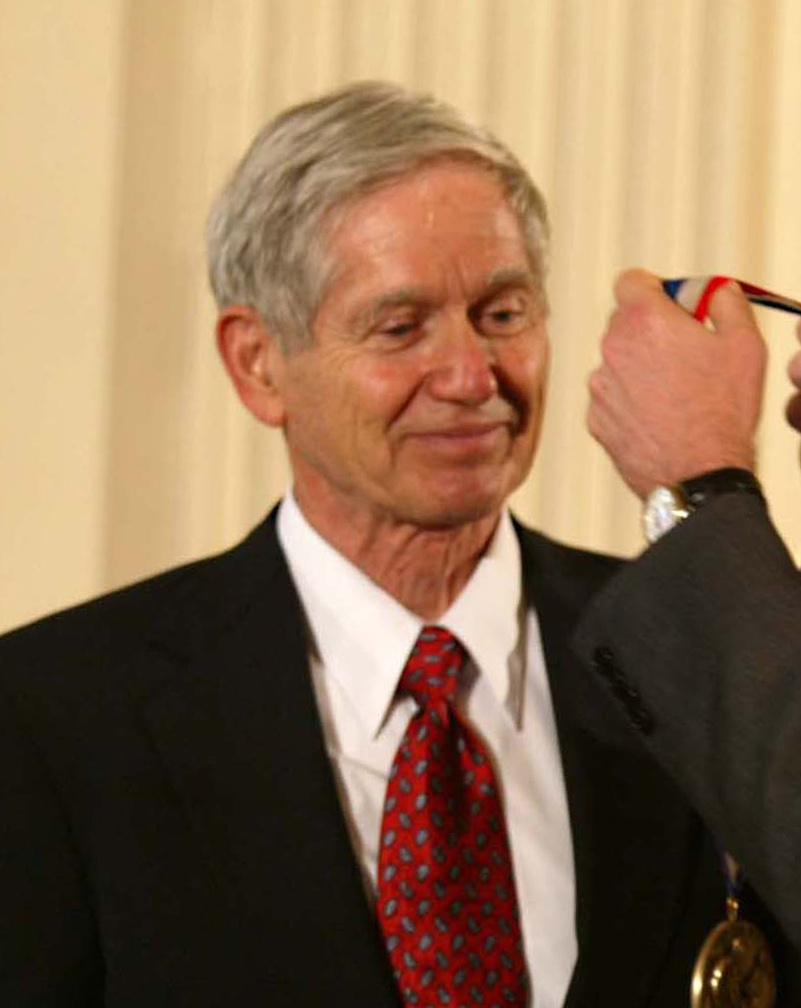
Charles David Keeling. Photo credit: National Science Foundation/Wikimedia Commons
In 1958, Keeling had the idea to collect air samples from the same spot every single day. It was radical at the time. His method required stationing a team at the Mauna Loa Observatory, far from cars, factories, and other human emissions, and collecting air samples in simple flasks.
The entire process doesn’t sound all that scientific. One of the researchers would take a volleyball-shaped glass flask that had all of its air vacuumed out, hold his breath, walk into the wind, and open a valve that allowed air to rush in. Other teams repeated this process at various spots around the world, but the measurements at the Mauna Loa Observatory were where it all began. Despite how it sounds, Keeling was a stickler for precision and helped pioneer more accurate atmospheric measurements than the world had ever seen.
Once Keeling had enough data, he realized two remarkable things about our planet.
For starters, the Earth was breathing
Carbon dioxide (CO2) levels in the atmosphere weren’t exactly steady. Keeling observed that they would rise and fall throughout the day, and even more so in a seasonal pattern.
According to the University of Illinois Urbana-Champaign:
“First, Keeling determined that CO2 levels rise and fall during the day, as well as throughout the seasons, based on vegetation growth. Plants feed themselves through photosynthesis, and CO2 is a vital ingredient of that process. With more plants growing in the Northern hemisphere’s summer months, the CO2 levels drop for a time as the plants ‘breathe’ it in.”
In the winter, as plants die off and begin to decay, they release more CO2 into the air. In the Southern Hemisphere, this pattern is more or less reversed.
Revealing this simple pattern helped form our understanding of Earth’s CO2 cycle, where carbon flows through the soil, oceans, atmosphere, and living organisms on the planet. This discovery also helps scientists build models that calculate the environmental impact of human behavior.
Next, baseline CO2 levels were steadily rising every single year
Soon, a more alarming trend became clear from Keeling’s data. Carbon dioxide levels were rising. He even developed something called the “Keeling Curve,” which is less of a curve and more of a line trending steadily up and to the right, indicating rising carbon dioxide levels.
The Keeling Curve. Photo credit: Oeneis/Wikimedia Commons
The Keeling Curve was one of the first undeniable pieces of evidence of human-caused climate change. As carbon dioxide levels rise, the atmosphere traps more heat and steadily warms the planet. This, in turn, leads to melting ice, rising sea levels, and more extreme weather, to name only a few consequences.
Many scientists consider it one of the most important discoveries of the last century.
Of course, Keeling was not the sole “founding father” of climate science. There was Callendar, whose hypotheses Keeling’s data eventually helped confirm. There was Irish scientist John Tyndall, who in 1861 discovered how certain gases could trap heat—what we now call the “greenhouse effect.” Fascinatingly, a less-heralded amateur scientist named Eunice Newton Foote demonstrated these ideas several years before Tyndall. And we’d be remiss not to give a shoutout to Jan Baptista van Helmont, a Flemish alchemist who helped identify carbon dioxide as a distinct gas.
The sample collection at Mauna Loa continues to this day and remains one of the longest continuously running studies in the field. If anything, in recent years the work has only become more important.
The post In 1958, a scientist began filling flasks with air. The samples showed the Earth was ‘breathing.’ appeared first on Upworthy.








 New Posts (Home)
 ChatBox
 Popular Posts
  Game Zone
 Top PodCasts