www.civilwarmonitor.com
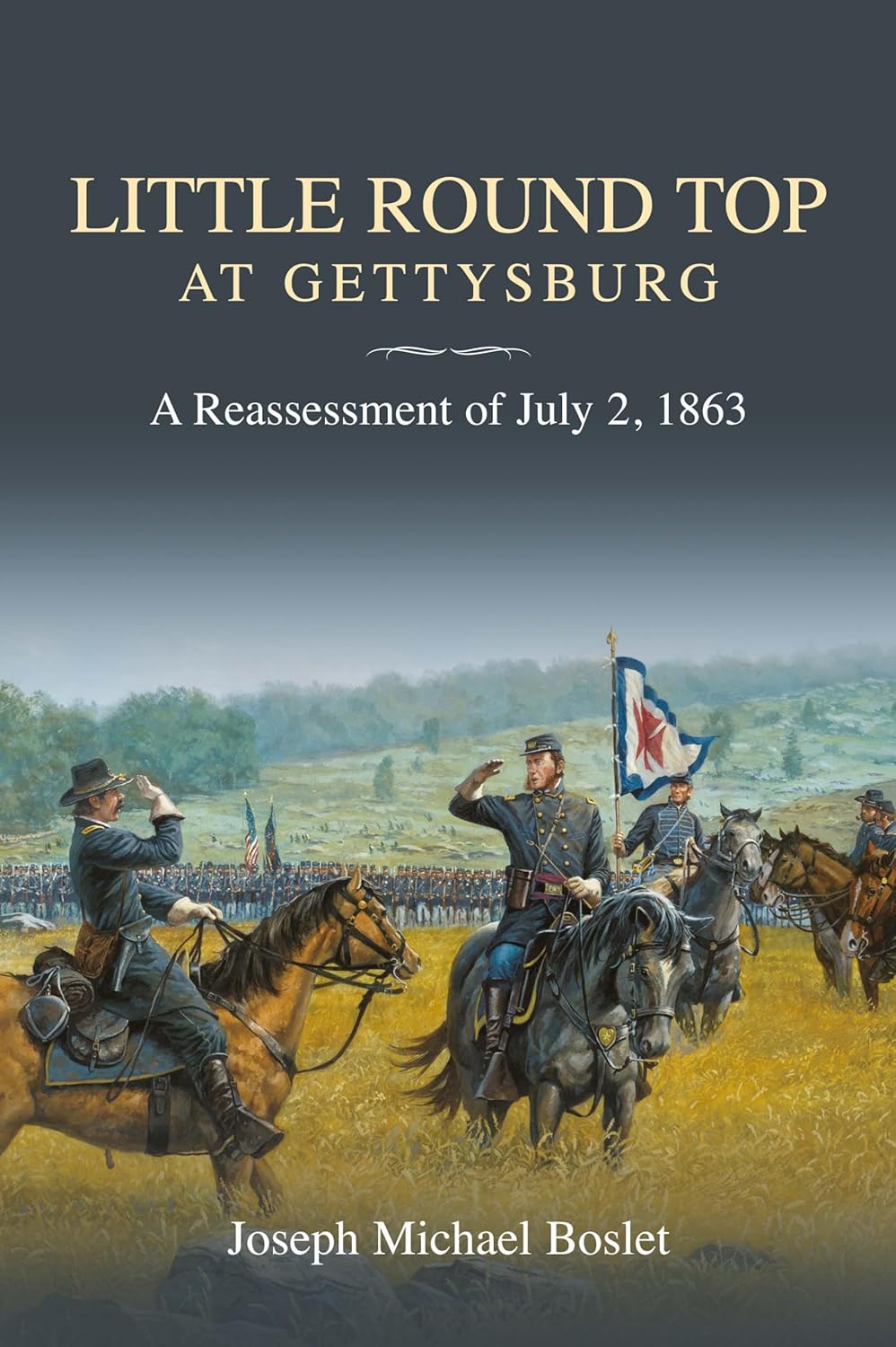
Little Round Top at Gettysburg (2026)
Few sites on the Civil War landscape carry as much weight as Little Round Top, that storied, rock-strewn knob on the southern end of the Gettysburg battlefield. The consequential, cataclysmic, and controversial actions there on July 2, 1863, have resulted in a massive, fabled literature unlike almost any other in the annals of Civil War military history. From memoirs to regimental histories, from assessments of military tactics and strategy to still more recent work on matters of memory and mythmaking, no shortage of ink has been spilled contextualizing, interpreting, and attempting to make sense of Gettysburg’s most iconic natural feature.
In Little Round Top at Gettysburg: A Reassessment of July 2, 1863, author Joseph Michael Boslet contributes to that growing historiography. “As I grew more fascinated with what happened there,” he writes, “it became obvious that not all of the history agreed with itself. This was not just because of author bias either; the basic facts of the engagement varied tremendously” (xiii-xiv).
Boslet has not uncovered a previously unidentified or unused cache of documents, nor does he have any particularly groundbreaking or revelatory discoveries to report. Instead, as the book’s subtitle suggests, his goal is to “reassess” what other authors have written, both in the distant past and more recently. He aims to reinterpret the story of Little Round Top for lay audiences and Gettysburg aficionados alike, filtering the vast catalogue of existing bibliographic entries through his personal experiences as a Vietnam War veteran. “My effort here is to get the history right based on soldier experiences (drawing at times on my own feelings from my combat experience in Vietnam),” Boslet clarifies, “and to offer the most reasonable explanations of what likely happened on that ‘hill’” (xvi).
Boslet revisits several familiar themes surrounding the Little Round Top story: the federal troop movement that left the hill exposed; the significance of the Yankee artillery and United States Signal Corps in shielding its western face; the countermarch that further delayed the Confederate attack; and the brutal fight itself. The author includes analyses of key officers, determining that Gouverneur K. Warren’s “decision-making was absolutely critical” and “justifies a comprehensive review” (24, 134), that Patrick O’Rorke “did not survive to tell his story” but “the valiant colonel[’s]…trademark fortitude would have its desired effect” (157), and that the deaths of Charles Hazlett and Stephen Weed marked a “double tragedy” (171). The same goes for illustrious units, including Boslet’s belief that the underappreciated role of U.S. Sharpshooters “likely turned the tide of battle” (47), that Strong Vincent’s brigade “earn[ed] every bit of its reputation on this day” (99), and that more specifically, “the 20th Maine and other Federal soldiers there carried the day on Little Round Top” (207).
Despite Boslet’s methodical reinterpretation, some readers may be disappointed in the lack of unpublished primary sources from archival repositories, as most firsthand accounts found in the footnotes are culled from other secondary sources. The bibliography contains many famous entries alongside lesser-known books, pamphlets, and articles. But some pertinent, prescient, and recently published books curiously do not find their way into his bibliography, such as Allen Thompson’s In the Shadow of the Round Tops (Knox Press, 2023) and Jon Nese’s and Jeffrey Harding’s The Weather Gods Curse the Gettysburg Campaign (The History Press, 2025). To be fair, Boslet does use a Gettysburg Magazine article by Thompson, and it is possible the latter volume had not yet appeared when Boslet prepared his appendix on “Meteorology of the Battle” (236-241).
Five appendices round out the book. Throughout the volume, ample imagery (including period and modern artwork and a series of tactical maps by Hal Jespersen) supplements the text. Boslet uses nontraditional ways of thinking about Gettysburg, including references to wargaming (66), the World War II film Saving Private Ryan (105), and even the fictional “‘Dark Tower’ fortress” in Lord of the Rings (60). He likewise incorporates oral history traditions, such as his consideration of the veracity of at least one Licensed Battlefield Guide tale (109-110).
“Verdicts [on Little Round Top] are usually mixed,” the author concludes, “just as they are for the fighting and developments across other sectors of the battlefield” (208). Joseph Michael Boslet has read a broad collection of published sources to render more legible a most murky historical record. In his debut book, he has crafted a comprehensive retelling of that fateful scene, inviting readers to render their own verdicts.
Codie Eash serves as Director of Education and Interpretation at Seminary Ridge Museum and Education Center in Gettysburg, Pennsylvania. He is currently pursuing a Master’s Degree in American History at Gettysburg College through The Gilder Lehrman Institute of American History.
The post Little Round Top at Gettysburg (2026) appeared first on Civil War Monitor.








 New Posts (Home)
 ChatBox
 Popular Posts
  Game Zone
 Top PodCasts