www.optimistdaily.com
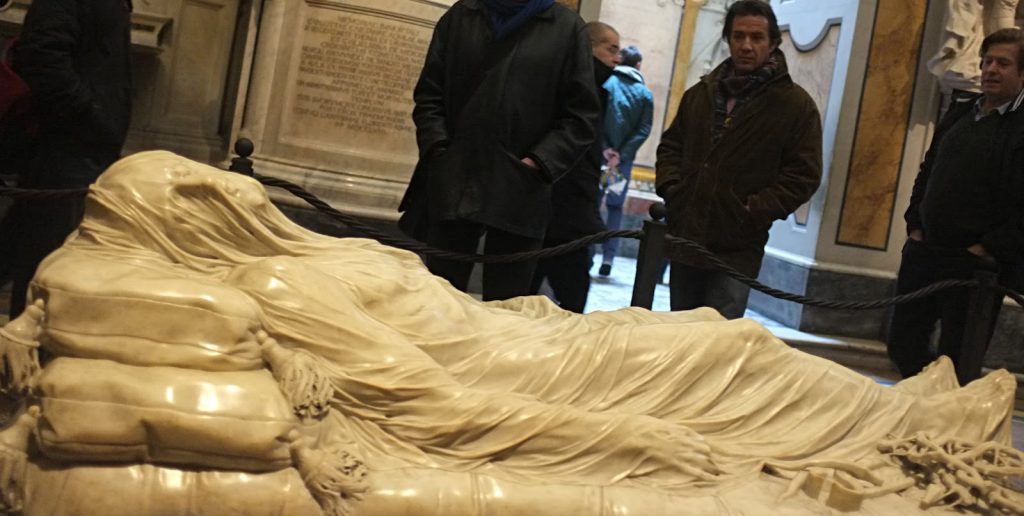
Naples lets blind visitors feel the Veiled Christ
BY THE OPTIMIST DAILY EDITORIAL TEAM
On a Tuesday morning in Naples, a guide named Chiara Locovardi ran her gloved fingers across a marble surface that has baffled art historians for more than two centuries. She was describing what she felt to the group around her, all of them blind or partially sighted, all of them touching the Veiled Christ for the first time.
“The veil covering Christ is extraordinary,” Locovardi said. “It’s impossible to understand how Sanmartino managed to create it. The veil defies explanation — for those who can see and for those who cannot. When you touch it, you can feel the veins pulsing beneath.”
The event, called La meraviglia a portata di mano (Wonder within reach), was organized by the museum in partnership with the Italian Union of the Blind and Visually Impaired of Naples. For one day, the protective barriers around the chapel’s marble masterpieces were removed so that roughly 80 participants wearing latex gloves could explore them by hand. The route included Sanmartino’s Veiled Christ, completed in 1753, and the bas-reliefs of La Pudicizia by Antonio Corradini and Il Disinganno by Francesco Queirolo.
A sculpture that defies physical explanation
The Veiled Christ has amazed viewers for centuries. Carved from a single block of white marble, it depicts Christ in death beneath a transparent shroud that appears to adhere perfectly to the body beneath, tracing the contours of the face, the lines of pain, the texture of skin. Visitors have spent centuries trying to explain it. Many still half-believe it must have involved some lost alchemy that turned real fabric into stone.
A payment receipt for Sanmartino, dated December 16, 1752, and signed by his patron Raimondo di Sangro, the Prince of Sansevero, is preserved in the Historical Archive of the Bank of Naples. Antonio Canova, one of the greatest marble sculptors of the 18th century, reportedly tried to acquire the piece and later said he would have given ten years of his life to have made something of equal quality.
What made this event different
The guides were themselves blind, trained by educator Roberta Meomartini in collaboration with the museum to describe the sculptures through touch rather than sight. The visit was free, by advance reservation only, and each participant could bring a companion or guide dog. At the end, visitors were escorted to the sacristy and given a Braille guidebook produced by the museum and the Italian Union of the Blind and Visually Impaired.
Museum president Maria Alessandra Masucci framed it as part of a longer effort: “This initiative forms part of our wider programme to create a cultural space that is inclusive and accessible through dedicated pathways and tools tailored to the different needs of museum visitors.”
The museum’s accessibility work extends beyond this event. In recent years, it has added audio guides for the visually impaired, sign language video tours for deaf visitors, and itineraries for visitors with intellectual disabilities.
Art belongs to everyone
Giuseppe Ambrosino of the Italian Union of the Blind put it directly: “Art must not be a privilege reserved for sight. Accessibility projects such as this transform a museum into a place of genuine inclusion, affirming that art belongs to everyone. In this case, visitors will not only be allowed to touch the marble sculpture; beauty itself will be able to flow through the hands and reach straight to the heart.”
The Sansevero Chapel is small, crowded with masterworks, and the Veiled Christ usually draws the most disbelieving stares. What last Tuesday offered was something harder to find: the chance to know it through your fingertips, with a sculpture that resists explanation either way.
Did this solution stand out? Share it with a friend or support our mission by becoming an Emissary.The post Naples lets blind visitors feel the Veiled Christ first appeared on The Optimist Daily: Making Solutions the News.








 New Posts (Home)
 ChatBox
 Popular Posts
  Game Zone
 Top PodCasts