www.upworthy.com
Elder female sperm whales seen acting as midwives in historic new video
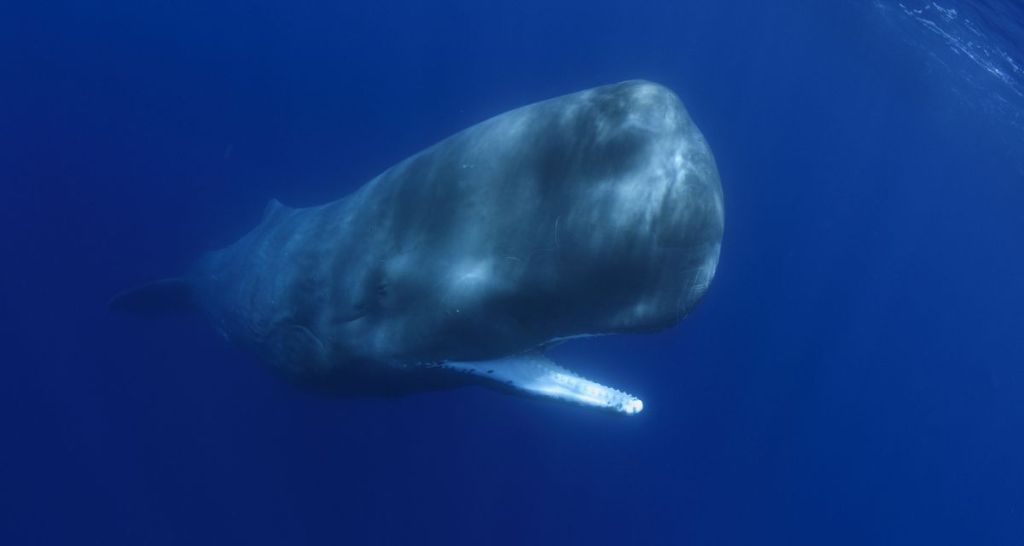
Science lovers got a treat recently when new research on sperm whales was quietly released. Researchers not only witnessed the birth of a baby sperm whale, but also saw elder females, including the grandmother, acting as midwives. Very few species assist with birth outside of humans, but it seems sperm whales can now join that short list.
Project CETI (Cetacean Translation Initiative) released two studies on sperm whales in journals Nature and Science respectively. Nature covers the different vocalizations of the whales during this teamwork process, while Science discusses the collaborative birthing approach by the whales.
A sperm whale. Photo credit: Canva
The sperm whale’s birth was first captured via drone in July 2023. Now that the video has made its way to social media, viewers cannot get over witnessing the whales act as midwives. Typically, scientists don’t get to witness sperm whales’ behavior during birth, likely because they give birth far from shore and avoid boats during this vulnerable process.
With the increasing use of drones, however, scientists can now capture moments like this without disrupting wildlife. In the video, other whales—one identified as the grandmother—surround the birthing whale, named Rounder. Not all of the supporting whales were from the same pod as the mother, but they joined to help ensure the calf’s safe arrival.
Because whales are mammals, they can’t breathe underwater. For this reason, baby whales, also known as calves, are born tail-first. Like other mammals, newborn whales instinctively try to breathe, so exiting the birth canal headfirst could result in drowning, according to National Geographic.
Scientists have been following this pod for a while, so they’re familiar with the whales in the family. As they watched the drone footage from the boat, they were able to identify who was present. Still, the sight of this unique birthing circle shocked the scientists.
A sperm whale near the water’s surface. Photo credit: Canva
While birthing her calf, Rounder was flanked by her sister, Accra, and Atwood, an elder female. Behind the mom-to-be was her mother, Lady Oracle, her aunt Aurora, a juvenile whale named Ariel, and four other unknown female whales. The whales had dual roles: when the calf was born, the assisting whales formed a tight cluster and raised the baby out of the water so it could breathe.
They took turns holding the calf out of the water for three hours. During that time, the females that were not actively lifting the calf to the surface were fending off nosy animals. Once the baby was safe and swimming alongside its mother, the other whales began to depart.
View this post on Instagram
One of the scientists, Shane Gero, told National Geographic, “All the biologists on the boat were losing their minds.” The same could be said for people coming across the video online.
One person wrote, “Women supporting women! Bring it on!”
Another person called out humans, saying, “I think they lied , who said survival of the fittest or only the strong survive. Everything in nature is about collective care. Even other animal species be helping each other. Also even when its predators they only take what they need.”
This commenter admired the teamwork, writing, “I love how whales put so much energy into each other, but it’s even more exciting that members outside of the family pod were being so helpful. I’m invested!”
“This is so frigging cool,” another person gushed. “I love how nature really wants nature to succeed. Absolutely 100% lit. Thanks for this!”
The post Elder female sperm whales seen acting as midwives in historic new video appeared first on Upworthy.








 New Posts (Home)
 ChatBox
 Popular Posts
  Game Zone
 Top PodCasts