www.thegospelcoalition.org
The Heavens Are Still Declaring—and Not Just to Astronauts
Most Christians would likely struggle if, out of the blue, someone asked them to share a message about Easter Sunday. But Victor Glover was put on the spot while 250,000 miles from home and with the whole Earth listening.
“I don’t have anything prepared,” said the unflappable former Navy test pilot and NASA’s current Artemis II pilot. “I’m glad you brought that up, though; I think these observances are important.”
“I think that for me one of the really important personal perspectives that I have up here is I can really see Earth as one thing,” he added. “And you know when I read the Bible, and I look at all of the amazing things that were done for us who were created—it’s . . . you have this amazing place, this spaceship.”
“You guys are talking to us because we’re in a spaceship really far from Earth, but you’re on a spaceship called Earth that was created to give us a place to live in the universe,” Glover said.
“Maybe the distance we are from you makes you think what we’re doing is special, but we’re the same distance from you. And I’m trying to tell you—just trust me—you are special. In all of this emptiness—this is a whole bunch of nothing, this thing we call the universe—you have this oasis, this beautiful place that we get to exist together,” he said, referring to Earth.
“I think, as we go into Easter Sunday, thinking about, you know, all the cultures all around the world, whether you celebrate it or not, whether you believe in God or not, this is an opportunity for us to remember where we are, who we are, and that we are the same thing, and that we’ve gotta get through this together.”
Glover was responding to a question from a reporter who mentioned the Christmas message delivered by the astronauts from NASA’s Apollo 8 mission. During that 1968 mission, about one in four people on the planet watched the video transmission from space on television. NASA’s deputy administrator for public affairs had told the crew before the launch that more people would hear the crew’s voices than any other voice in history. He said, “So, we want you to say something appropriate.”
One of the astronauts asked his wife what the team should say. “Why don’t you begin at the beginning?” she said. And so they did.
On Christmas Eve, the first humans to orbit the Moon read from Genesis. Astronauts Bill Anders, Jim Lovell, and Frank Borman recited verses 1 through 10 of the Genesis creation narrative from the King James Bible: “In the beginning God created the heaven and the earth . . .”
Static We Live In
In any other context, these reflections wouldn’t seem particularly noteworthy. Reading from Genesis has been common for thousands of years, while reflections about “Spaceship Earth” date to at least the 1970s. Yet there’s something about hearing the same words and thoughts from a spaceship that gives them a sense of, well, gravity. Why is that?
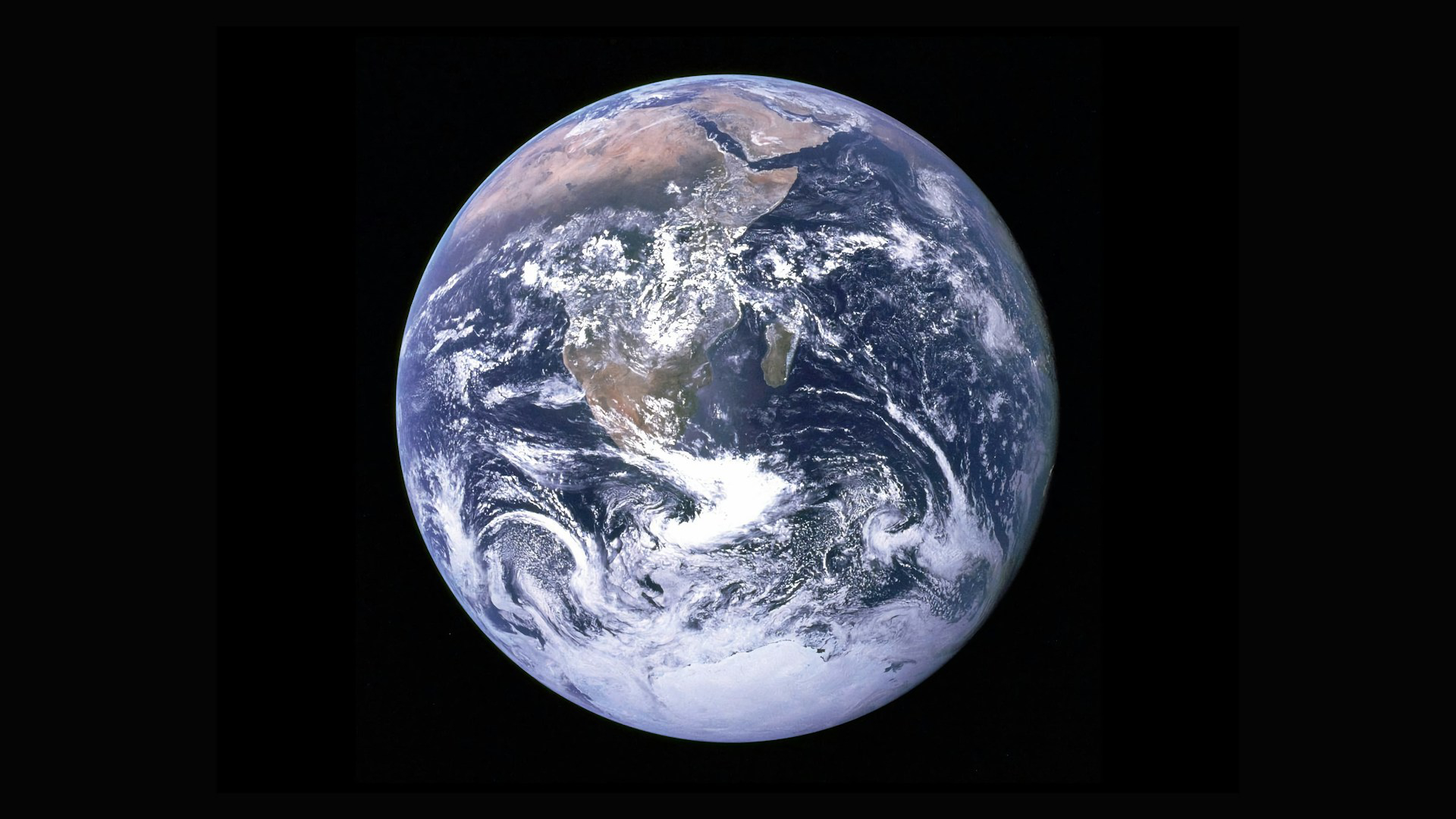
Part of what we’re catching is something called the Overview Effect. That term was coined by “space philosopher” Frank White to describe the perception shift when astronauts view the Earth from space. In interviews with the men and women who had been to space, White found that many were profoundly affected by their experience. They consistently reported an overwhelming sense of Earth’s smallness and preciousness, a feeling of interconnectedness with all humanity, and often a kind of grief that people on the surface can’t see what they’re seeing.
The secular account says that what they experience is merely a perspective shift. The visual data is producing a cognitive reframe, a new way of seeing the world. A more biblical explanation is that astronauts aren’t gaining new information at all. They’re losing the noise that lets them ignore what they’ve always known. Being in space merely helped them to see with more clarity what creation has always been declaring.
Being in space merely helped them to see with more clarity what creation has always been declaring.
As Psalm 19:1 tells us, the heavens declare the glory of God. All humans at all times have access to this information. We refuse to recognize what’s obvious, as Paul tells us in Romans 1, because we actively suppress this knowledge. Ordinary life makes it all too easy to ignore or deny what God is clearly expressing about himself and his creation. Our lives are continuously busy and distracted by things that occur on the human level.
This isn’t just metaphorical either. We almost never change our perspective from looking at what can be seen at the horizontal level of humanity. When was the last time, for instance, that you spent more than a few seconds actually looking at the heavens above us? (In thinking about this question, I realized it has been decades since I had spent even a few minutes pondering the “lights in the expanse of the heavens” [Gen. 1:14].)
What seems to happen for the astronauts is that they gain enough distance from the distractions that it interrupts their internal suppression. They move far enough away from the static of everyday life that God’s signal can once again be heard with clarity. And what they hear profoundly changes them.
What Space Can (and Can’t) Do
It can be tempting to read too much religious significance into these moments. While they’re important culturally, they aren’t exclusively Christian. The Apollo astronauts reading Genesis weren’t proclaiming the gospel. Likewise, although Glover is a follower of Jesus, his off-the-cuff Easter remarks weren’t a profession of faith in the resurrection.
As profound as the Overview Effect may be, a change in perspective doesn’t necessarily lead to a change in heart. General revelation is sufficient to condemn us but not enough to save us, since it cannot provide the “good news” of special revelation. No one has ever been saved by looking up into the night sky—or by orbiting the moon.
No one has ever been saved by looking up into the night sky—or by orbiting the moon.
Still, the astronauts’ experiences are a helpful reminder that God continues to speak through his creation. The heavens have never, not even for a second, stopped declaring the glory of God. It’s just that we have, all too often, allowed the static in our lives to keep us from hearing it clearly.
Few of us will ever know what it’s like to hear God speaking to us while on a spacecraft. But while we don’t have the same seat as NASA astronauts, we all have access to the same heavens. Fortunately, we don’t need to travel a quarter-million miles into the sky to be reminded that the heavens are still declaring. We need only to step outside, look up, and listen.








 New Posts (Home)
 ChatBox
 Popular Posts
  Game Zone
 Top PodCasts