flashbak.com
Nuclear War Comes To Los Angeles – March 31, 1953
“It is clear to me that much opinion, both here and abroad, with respect to thermonuclear weapons, is based on gross misinformation on effects, as a result of journalistic exaggeration”
– FCDA administrator Val Peterson
On March 17, 1953, for the first time ever, viewers could tune into their TV’s to see a live nuclear blast. The Federal Civil Defense Administration (FCDA) ran its Operation Upshot–Knothole Annie in northwestern Nevada. They also conducted a civil defence test they called Operation Doorstep.
Operation Doorstep would test what happens to a typical American street during and after a 16-kiloton nuclear explosion. It would “show the people of America what might be expected if an atomic burst took place over the doorsteps of our major cities”.
In the accompanying booklet published in 1953, FCDA administrator Val Peterson (July 18, 1903 – October 17, 1983) reported that “the family automobile would be relatively safe outside a ten-block radius… provided that some windows were left open to prevent the roof from caving in on the passengers”.
That the blast site contained 50 cars was no accident. Peterson had celebrated the involvement of private industry on the tests, notably “by the entire automotive industry through such groups as the Automobile Manufacturers’ Association, the National Automobile Dealers’ Association and the Society of Automotive Engineers”.
The news was that the cars were all drivable. But what about the drivers? Peterson noted:
“It is clear to me that much opinion, both here and abroad, with respect to thermonuclear weapons, is based on gross misinformation on effects, as a result of journalistic exaggeration…
“More recently, at a meeting of the NATO Civil Defense Committee, the Deputy Administrator of FCDA arranged a showing of the film ‘Operation Ivy‘. She was both taken aback and encouraged by the reactions expressed after the showing. The representatives of both Belgium and Denmark expressed themselves as ‘reassured’! They saw a weapon of horrible power, but not one which would, as they had previously believed, erase their small countries in an instant.”
But, again, what about the people? Well, the booklet notes that people behave differently to the mannequins used in the experiment:
“This mannequin can only stay in the position in which he was placed, staring through the window at the coming disaster. A real occupant of this house could prepare – and survive.”
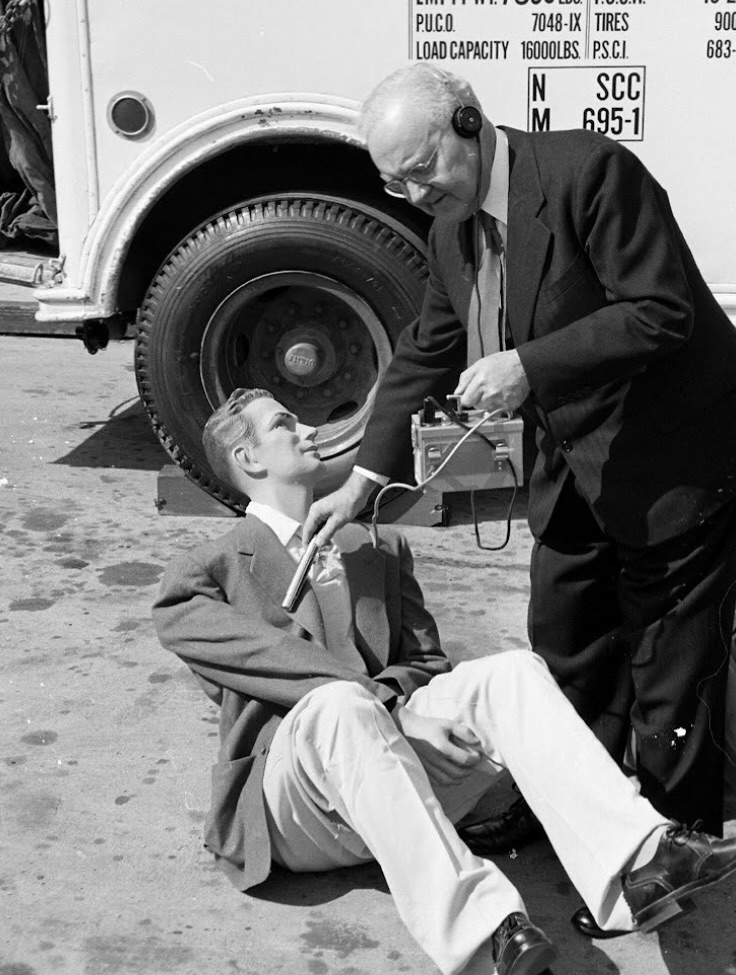
The show went on tour. That same year atom-blasted mannequins appeared in Pershing Square, Los Angeles. Delivered from the Yucca Flats testing site in Nevada, it was the first time mannequins used in atomic testing were put on public display.
Working with the US Department of Energy, the display was arranged by L.A. Mayor Fletcher Bowron (August 13, 1887 – September 11, 1968), commander of the city’s Civil Defense & Disaster Corps, and Rear Admiral Robert W. Berry, then serving as the Civil Defense director of Los Angeles.
Starting at 9:30am on Tuesday, March 31, 1953, the three-day free exhibit consisted of open booths along Hill Street, where crowds could read about the power and the dangers of atomic war and check out the mannequins. Edward Clark (July 3, 1911 – January 22, 2000) took pictures of the crowd.
“It is indeed fortunate that we can examine these mannequins which served as proxy for our citizens,” said Mayor Bowron. “I hope that every man, woman and child in Los Angeles will be able to see this graphic display so that they may learn firsthand what atomic bombs could do if unleashed against us.”
Adm. Berry, an official observer at Yucca Flats when these mannequins were bombed noted that “we would have been able to obtain these mannequins sooner except for the lingering radioactivity which made it unsafe to transport them. The contamination has since evaporated and radiological monitors have now declared [them] safe to be shown to the public.”
.
The post Nuclear War Comes To Los Angeles – March 31, 1953 appeared first on Flashbak.








 New Posts (Home)
 ChatBox
 Popular Posts
  Game Zone
 Top PodCasts