www.dailywire.com
Medicaid Millionaires: How The Feds Pay Immigrants Billions To Hang Out With Their Families
COLUMBUS, Ohio — Just before the Department of Government Efficiency closed its doors, it made a quiet move that may end up its most lasting impact on the federal deficit.
DOGE published a massive trove of data in February that, for the first time, lets the public see what companies are billing Medicaid for. For decades, the payouts have been shrouded in secrecy. One of the largest government programs was a black box.
I’ve spent the past two months diving into the numbers. What I found was the most blatant waste of federal dollars that I have encountered in my two decades as an investigative reporter.
This is the first part of “Medicaid Millionaires,” a Daily Wire series exposing billions of dollars in dubious “personal services” payments where people are paid to spend time with their own family.
I set my sights on Ohio, which like Minnesota has been granted waivers to expand Medicaid well beyond its original purpose. Under the guise of health care, Ohio pays people to go to Medicaid beneficiaries’ homes to perform “homemaking” and “chores” like cooking and cleaning. The people performing these “personal services” tasks don’t even have to be health care workers — and in many cases, are actually relatives of the Medicaid recipient.
According to a Daily Wire data analysis, Ohio spent a billion dollars on home health care in 2024, the last year for which data is available.
Since the services are performed inside private residences, there is no way to know whether the workers went at all, or what they’re actually doing in exchange for taxpayer funds. An infinite number of small black boxes inside a black box. Multiple signs said the service provided, and billed to the government, was sometimes just “companionship & conversation.”
As people have realized the United States government will pay them to hang out with their own families, northeast Columbus has seen its economy replaced by businesses that bill Medicaid. And Columbus, a city with the second largest Somali population in the country, has become, on the surface, the most unhealthy city on the planet.
“Well if the government is going to pay you to do it,” one home health operator told me. “People see it as lucrative, so they just jump on it.”
The new welfare queens aren’t the recipients whose low incomes qualify them for poverty programs. They’re the companies getting rich off them.
A billboard in Columbus / Luke Rosiak
Driving down Cleveland Avenue, in less than 40 seconds you come across endless home health companies. Capital Home Health; Continental Home Health; Dynamic Home Healthcare; Ohio Senior Home Healthcare. Walgreens’ familiar logo is still faintly visible on the sign for what is now a dialysis clinic. Entire buildings throughout the city are filled entirely with what appear to be identical businesses.
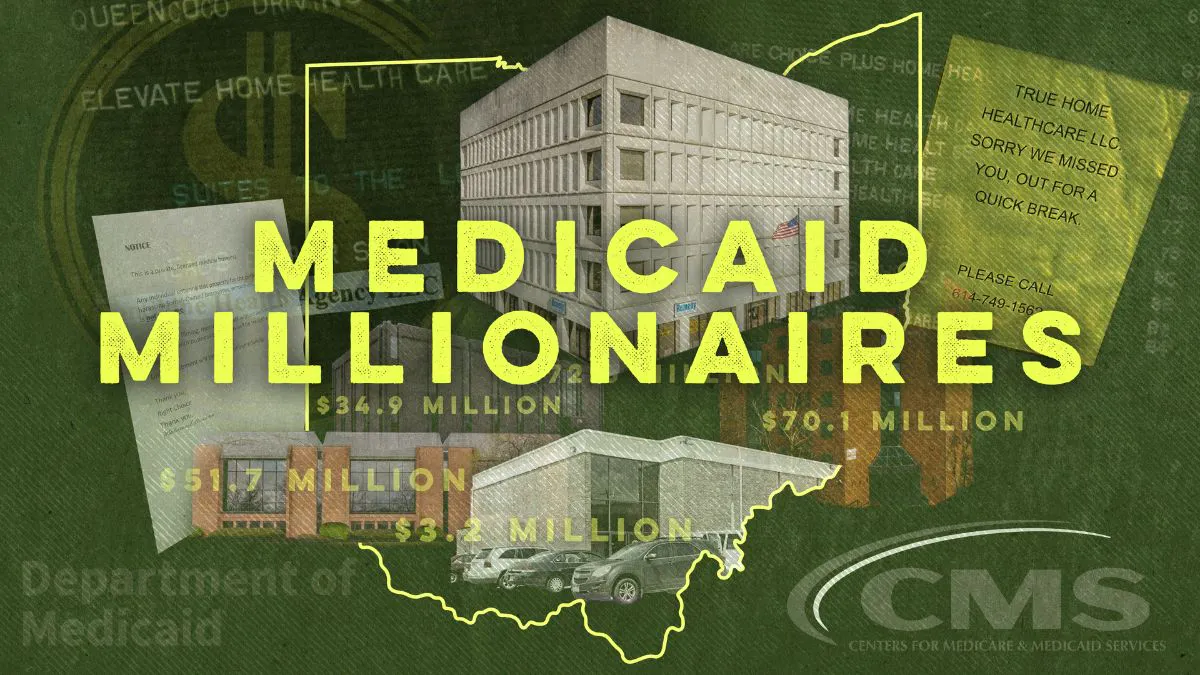
The enormous complex pictured below is 6161 Busch Boulevard. Its lack of windows would be a problem for most office buildings, but there is almost no one in this one. What’s inside is 94 different companies signed up to bill Medicaid, each with a tiny office, often marked with a sheet of paper proclaiming some generic company name ending in “Home Health LLC” — and sometimes another piece of paper claiming the employees had just stepped out for a break.
This building alone billed taxpayers $66 million in the span of a few years, the records show.
Luke Rosiak / The Daily Wire
Pick the owner of a Columbus home health care company at random and look him up in public records, and you are likely to go down an endless rabbit hole: years of unpaid taxes and debts, sometimes criminal records, and an astonishing number of LLCs created in other industries, as if the millions they make from Medicaid are just a side gig.
We went down several of those rabbit holes. In the coming days, you’ll meet:
A politician who founded an $11 million home health care company that he appeared to run part-time — without even mentioning it in his political biography — who funded his campaign with donations from other home health care owners.
A woman who reinvented her janitorial LLC as a “health” provider, then billed Medicaid nearly $100,000 the first month.
A landlord who bought airplanes after renting space to hundreds of home health care companies that billed Medicaid a quarter of a billion dollars.
A million-dollar Medicaid business owned by a couple with repeated fraud, violence, and theft convictions.
A man who went to prison for Medicaid fraud but told the government he was too broke to pay restitution, while his neighbors and associates preside over a poverty-program empire.
An accountant who lost his license for stealing public funds, then opened a $7 million home health company using the address of a convicted money launderer’s teenage son.
These are not business geniuses, nor even people with any training or specialty in the health field. They have often failed at a variety of businesses, before suddenly becoming millionaires in home health care.
Sometimes a company will have a full roster of clients in its very first month, making one wonder where the clients from. The companies don’t have websites or appear to advertise. They can’t stand out from their thousands of rivals based on price, unless they pay kickbacks, because the government pays the same to everyone.
Nearly every owner of home health care companies in Columbus appears to be foreign. They live in a parallel society, where every associate in public records also has a foreign name, and all their business transactions are conducted with other foreigners.
When we asked one what home health care companies did, one man threatened: “Journalists? Who cares? Do you guys pay my bills? I’m going to tell everybody you guys are racist.”
The government is not, and likely has no ability to, monitor all the people it writes million-dollar checks to in Columbus. They all share combinations of just a few names, like Ahmed Mohamed and Mohamed Ahmed. Documents reviewed by The Daily Wire show individuals will spell their own name multiple different ways within a single document. And many of them list their birthday as January 1, because their birthdates are unknown.
The business model is simple: a 40-year old Somali immigrant gets paid for spending time with, and maybe cooking for, his own 65-year-old mother. The middle-man is one of thousands of “home health” firms that have the “NPI” number necessary to bill Medicaid.
The 40-year-old becomes an “employee” of that company, but has no clients other than his mother. There is no way to verify whether he actually even provided the “services” — unless his own mother is willing to testify against him.
This poverty program is different from things like food stamps, because it has no monetary cap and its extent is decided not by politicians, but by any doctor willing to sign a form saying you could use some help around the house. It only takes one doctor who will say yes to churn out enough forms to bankrupt a state.
For years, efforts to rein in waste have nibbled around the edges, shaving off a million here and a million there, while skeptics — and liberals — argued that the cost-cutting exercise was pointless because the lion’s share of federal spending was locked up in “non-discretionary” spending like health care.
The implication was there was no waste in that category, and nothing that could be done about it, even as the nation careened towards insolvency. That premise couldn’t be more wrong.
This blatant waste happened within miles from the Ohio state capital, where Governor Mike DeWine, a Republican, and his appointees run the state. In an age of artificial intelligence, the Medicaid system has seemed disinterested in even the most obvious red flags. Perhaps that’s because it’s largely run by states, but with half or more of the bill being footed by federal taxpayers.
The Trump administration is now turning its sights to Medicaid fraud with a task force led by Federal Trade Commission Chairman Andrew Ferguson and Vice President JD Vance. They may want to start with Vance’s home state.
Parker Thayer, an investigator for the Capital Research Center, contributed to this report.








 New Posts (Home)
 ChatBox
 Popular Posts
  Game Zone
 Top PodCasts