reactormag.com
The Unexpected Genius of Princess Tutu
Column
Anime Spotlight
The Unexpected Genius of Princess Tutu
It’s easy to underestimate this series and its characters, but you’d missing out on something wonderful.
By Leah Thomas
|
Published on May 7, 2026
Credit: Hal Film Maker
Comment
0
Share New
Share
Credit: Hal Film Maker
I will admit that the first time someone told me to watch Princess Tutu, I responded with thinly veiled disdain: “Honestly, princesses and tutus are not really my thing.”
“But it’s my favorite anime of all time, and it’s really amazing, and you should watch it.” She was a college roommate, and she was odd, and she kept a rabbit in her bedroom. Princess Tutu was her long-standing hyperfixation.
I thought I would be magnanimous and indulge her by watching a few episodes. At the time, I took myself very seriously, and could only allow myself to enjoy anime if I could be an obnoxious fucking hipster about it. In the early aughts, it was one thing to be a Lord of the Rings nerd who had a Tim Burton shirt for every day of the week; it was another thing entirely to be caught watching Naruto. I was embarrassed about liking anime, and had to convince myself I was interested in it for artistic reasons.
This roommate—let’s call her Odette—was unabashedly nerdy in a way I envied. She drew malformed fan comics on a Facebook page, and no matter how hard she practiced, she never got better at digital art. She’d grown up in the tiny unincorporated neighborhood of Davisburg, Michigan, which hosts an annual Scarecrow Decorating contest. Odette was a former ballerina herself and practiced locally with a few classmates from her minuscule religious school, where she’d been one of 18 students in her graduating class. I raised my eyebrows at that because I was a bitter asshole, and she didn’t look like a ballerina to me, and I assumed she must have been terrible because, having come from a Michigan village myself, the bar was probably pretty low in Davisburg.
I told myself I felt sorry for Odette and agreed to watch her silly favorite anime to make myself feel like a nice person.
Credit: Hal Film Maker
I have since realized that I spent years of my life avoiding stories featuring female protagonists. Perhaps because I hated myself, or because my brand of queerness made it hard for me to feel like I had a lot in common with other girls, I gravitated towards shows with traumatized, disabled, and gay male leads instead. My own writing reflected this disconnect, too. It wasn’t until my third novel that I wrote characters who could be described as heroines. Others have spoken more eloquently about this phenomenon, and it often boils down to this: a lot of fiction does a poor job of presenting women as developed characters. I think, subconsciously, even though I am a woman, I was conditioned to believe that stories about women were not as worthy. Fuck you, patriarchy.
Sitting down with Odette to watch a childish Ugly Duckling retelling felt beneath me. But I thought I could tolerate the high voices and endless lovelorn gazes of a girl who is actually a duck who is also a heroic shojo princess who dances ballet. I could put up with the object of said lovelorn gazes, a prince named Mytho, who is an emotionless husk because he shattered his own heart to trap his enemy, a vicious crow. See, Mytho and the crow’s daughter—and Duck herself—are actually storybook characters who escaped the confines of their story when their author, a magical eccentric named Herr Drosselmeyer (like in The Nutcracker, yes), died before finishing their book. And I could pretend to appreciate the levels of unique theatrical expertise on display, ranging from thorough knowledge not only of a dancer’s movements, but also the folktale origins of the most famous ballets in existence: Swan Lake, Giselle, Sleeping Beauty. I could fake some appreciation for a series that seamlessly incorporates iconic composers such as Tchaikovsky, Mussorgsky, Strauss, and Delibes into a metacognitive fairytale about trauma and identity. And hey, I used to study German and half my family emigrated in the 1930s, so I could enjoy the episode titles being auf Deutsch, and the entire series being set in a bizarre, timeless little village populated by real and fictional people. And honestly, it’s not hard to love that our characters attend an arts school where several of their classmates are talking animals—not anthros, but actual animals in school uniforms—who take part in ballet lessons without any great fuss being made about them. Crocodelia, Anteaterina, and Arma-Dylan? You own my whole heart.
And you know, it’s kinda neat that the would-be villainess of the series is actually a tragic character herself, abused by her menacing father because she had the misfortune of being born in a “hideous” human body. Oh, and then there’s Fakir, Prince Mytho’s knight and protector, who cannot quite commit to his role because it means being sliced in half if he sticks to the storybook script, and who can blame him for being reluctant to go that far?
…
Well, fuck. This show is actually a work of genius, isn’t it?
I was happily, beautifully humbled. You got me big time, Odette, and I am sorry for my deep-rooted self-hatred. This show was exactly what I needed.
Will You Dance With Me?
Credit: Hal Film Maker
Princess Tutu has enjoyed cult status ever since its two perfectly measured seasons aired on NHK starting in 2002. Created by legendary character designer Ikuko Itoh, who worked on Sailor Moon, the anime focuses on students attending Gold Crown Academy, in the heart of Gold Crown Town, the displaced European-esque village where reality and stories intermingle. Those who arrive in Gold Crown Town feel no desire to leave it behind, and they probably couldn’t even if they did, because mysterious walls appear at its borders if they try. It’s not always apparent which aspects of Gold Crown Town are fictional and which are real, and for the most part, the characters themselves rarely question their existence.
Duck, however, questions her existence from the very get-go, and that makes her the perfect tool for a writer. Drosselmeyer, who managed to preserve some of his consciousness beyond his own death by building a cogwork writing machine that would continue his work, is an omnipresent narrator and commentator throughout the story. His presence is whimsical but sinister. Like all writers, he seeks to entertain, and even though his characters have come to life, he doesn’t seem particularly bothered about their fates so long as it makes for a good yarn. When he spots a small yellow duck looking sadly at his fugitive heartless prince, he sees the potential for a real tragedy.
He gives Duck an amulet that allows her to transform into a girl, and the girl the power to transform into Princess Tutu, who is the only one who can gather the shards of the prince’s broken heart, make him whole, and allow the story to end. Drosselmeyer wants this, but what does ending the story mean if his characters are now alive?
Drosselmeyer can throw story elements at them or set them up for violent deaths or impossible choices, but the characters have free will, and things rarely go to plan. Creators sometimes describe the feeling of losing control of their own characters, and sometimes it’s only then that great writing takes place. Princess Tutu takes this idea literally, and even though it’s a story about stories within a story, it avoids becoming convoluted with masterful panache.
The writers tiptoe along an impressive tightrope. The metacognitive aspects are always present, but cannot be allowed to eclipse the story’s suspense. Duck and the others must be allowed to shape the plot through their own actions, regardless of their creator’s interference. Somehow, too, the episodes have to surprise audiences even though each one starts with clear foreshadowing of events to come, because every episode starts with a quick summary of whatever folktale inspired its storyline. Every episode has similar beats, too, because this is a magical girl anime. There’s the storybook intro, credits, and exposition that leads to a new heart shard being found. Then Duck transforms into Tutu, dances—or dance-battles—with the keeper of the shard, and her heartfelt empathy and the act of dancing liberate the dancer and the heart shards, too.
All of this narrative orchestration—and actual orchestration, too, because smarter people than I have dissected the ways ballet and classical music are intricately woven into the plot—could easily have drifted into heavy-handedness. And sure, there are some moments where Drosselmeyer’s commentary on genre and story and the roles princes and princesses play gets a little old—but isn’t that the point? He’s trying to confine real people to the unreal expectations of the story, while they are fighting to be themselves. For this reason, the formula never grows stale.
But if the characters aren’t precisely who Drosselmeyer wants them to be, well, they’re not necessarily who they themselves want to be, either.
The Troupe
Credit: Hal Film Maker
Four characters form the pillars of Princess Tutu: Duck, Mytho, Rue, and Fakir.
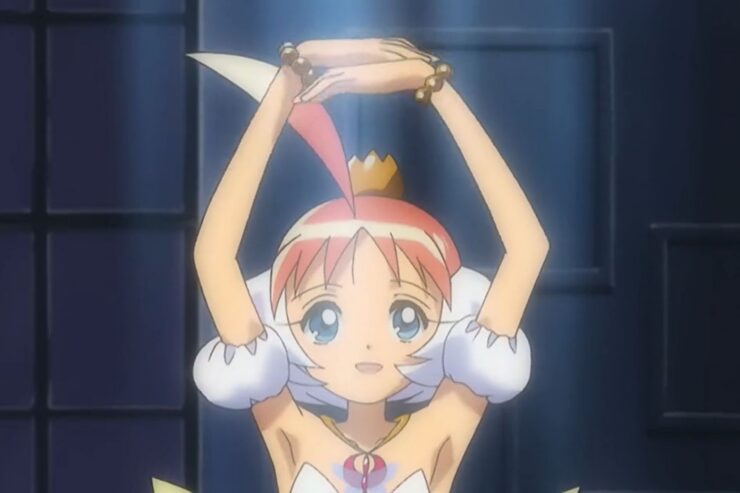
Duck is more than she believes herself to be, and not just because her alter ego is a hero. In her daily life, she is clumsy, not especially good at ballet, noisy, and scatterbrained. As Tutu, she is elegant, insightful, and powerful, and she appeals to the best aspects of human emotions in order to persuade her opponents to see her perspective. Because Duck lacks confidence in herself, much of the series is about the dissonance that forms between the three roles she inhabits: is she just a duck, as she repeatedly insists in her low moments? Is she really just Duck, the messy student? Certainly, she thinks, she cannot be Tutu. But such is the greatness of her characterization that the audience realizes before she does that she can be all three of these personas and none of them. No matter what role Duck is inhabiting, the most important aspects of her goodness remain unaltered. She is passionate, brave, and deeply empathetic, regardless of whether she’s a princess, a girl, or a duck. She’s a fantastic heroine who struggles with self-confidence but inevitably saves the day without ever losing herself. She cannot see that her heart remains unchanged, but others do, eventually.
If Duck is emotion personified at the start of the series, Mytho is her foil. His self-sacrifice has rendered him as charismatic as a wet sock, but even when he’s stripped of his personality, his fundamental response to encountering a creature in harm’s way is to protect it. Unfortunately, the first pieces of his heart to return are negative emotions. He first regains the feeling of bitterness, followed by loneliness, sadness, and fear. Mythos goes from an empty vessel to a creature composed solely of pain, and it takes a long time for him to become a whole person. Duck’s devotion to Mytho—often at her own expense—would be frustrating if he were undeserving of love. But if Mytho has a tendency to protect the vulnerable, Tutu has it too, and he’s the most vulnerable of all.
Mytho’s roommate, Fakir, is his other protector, another fantastic, nuanced character. Fakir is abrasive towards and possessive of Mytho, initially framed as a potential antagonist. His fierce overprotectiveness is a product of tying his life’s purpose to saving the storybook prince. His mother died when he was young, and he was charged with keeping the wandering, empty prince thereafter. Every time Mytho regains a piece of his heart, he changes, and that terrifies Fakir, who has only ever known the blank Mytho. Change, even for the better, is a scary thing. Theirs is a troubling love, but a love all the same.
Fakir is only human, and his actions are not entirely selfless. Fakir also fears his own fate. Drosselmeyer has written him a role that should end in sacrifice, a tragic character who exists to propel the plot and make readers sad. Fakir sees himself as cowardly for rejecting that fate, and it takes incredible willpower for him to resist it. Through his interactions with Duck, to whom he shows kindness even when she is in her duck form, he is revealed as the show’s second hero. Fakir deserves more than the story Drosselmeyer assigned him.
And when it comes to resisting fate, no one has more right to try than the series antagonist, Princess Kraehe. She’s the prima ballerina of the school by day: a beautiful, haughty girl named Rue. It is a given that she and Mythos should be dating, as the two best dancers in the school. Rue is reluctant to make friends, although Duck is very persistent. As Rue’s exterior begins to crack, tragedy strikes—she remembers that she is not a real person, but the crow’s daughter, Princess Kraehe. To fulfill the role she’s expected to fill, she doesn’t get to have friends or be a heroine. She is pressured by her father to harm Mytho, dehumanizing herself to try to earn her father’s approval or what passes for his love. Kraehe comes to believe Rue never existed. Duck knows otherwise: “You must have existed, because you were my friend.” Like all the other characters, Rue will have to reframe the concept of love and embrace its myriad forms to find herself again.
Characters Among Us
Credit: Hal Film Maker
A great joy in the series is identifying which stories have inspired its characters and plotlines. Mr. Cat, the ballet teacher, would be a creep if he weren’t more of a joke to his students. He threatens erring students with the prospect of marrying him in every episode, in an apparent nod to Puss in Boots.Whether this is solely to motivate them to do better or because he genuinely wants to marry a student is sort of dependent on the episode, but it’s the sort of running gag that only works because the characters treat it as ludicrous. Whenever he is rejected, Mr. Cat goes from upright teacher to actual cat, stress-grooming or running in circles around the room. And yet even this character has moments of pathos.
In one of Duck’s moments of lowest confidence, he holds her back from practicing with toe shoes. “Duck, have you given up the idea that you can do anything?” he asks, seeing right through her. And when he recalls the ballet dancer who inspired him to dance, his love for the art form is weirdly touching: “Everyone must practice the basics to succeed.” Duck, for whom things never come easily, who very much has to practice to get anywhere, is no less a ballerina for having worked harder. And the class savants are not any happier because it comes easier to them.
And I was no happier than Odette, even if drawing was easier for me. People who try and fail and try again have grit. Those who don’t pursue what they love for fear of ridicule have only regret.
Another notable side character is Miss Edel, a curious woman who plays a barrel organ, offers peculiar advice to Duck, and gives gems to passersby. Edel is an actual puppet sent by Drosselmeyer to influence the narrative, but when shown affection, even she begins to develop feelings of attachment toward Duck and the others. The idea that emotions can be shared between people, just as dances can be, impacts even inanimate objects.
Drosselmeyer would be obnoxious if it were not obvious that he truly loves stories more than anyone else. It feels hypocritical to judge the narrator when we’re watching him tell the story, too, looking for entertainment. The philosophical elements of Princess Tutu grow more apparent as the story unfolds, ends, and starts again. Can a story ever really end, if not even death can end it? And should Tutu succeed, is that even a good thing? What will become of this town that exists between truth and fiction, and is it worth sacrificing in the name of a story? Somehow, this cutesy-looking, pastel-coated ballerina show manages to contain as much existential extrapolation as Evangelion, as much symbolism as Utena, and as much artistry as it could muster under limited circumstances.
As Odette told me at the time, “They did the best with the small budget they had.”
And did they ever… The stylized character designs, the careful rendering of backgrounds, and saving the best animation for the dance sequences, cartooning the rest and using still frames as art rather than an encumbrance, make it feel more like something you would see on a stage. It doesn’t feel cheap when the still frames appear. It feels like a tableau.
There are shows twenty years newer that look ten times worse. I imagine the storyboards for Tutu are wondrous to behold, akin to riffling through the Ghibli archives. I was unsurprised to learn that this trippy fairytale nightmare dreamscape thing was the project that Aria director Junichi Sato worked on before he took us all to Neo-Venezia.
The Story, Unfinished
Credit: Hal Film Maker
Princess Tutu is a trip in the best of ways—a trip I never would have gone on without the encouragement of a person I dismissed, just as people dismiss Duck. Its insightful characterization, the questions it raises about heroism, love, and villainy, and the message that the things that make us real are not the roles we are assigned but the actions we take, make it a masterpiece. Like Duck, Kraehe, Fakir, and Mytho, many of us spend our lives trying to understand ourselves and feel appreciated. And if we’re fortunate, we can reflect on the stories we’ve lived so far and find we have danced a lot longer and more beautifully than our old selves ever dreamed we could.[end-mark]
The post The Unexpected Genius of <i>Princess Tutu</i> appeared first on Reactor.








 New Posts (Home)
 ChatBox
 Popular Posts
  Game Zone
 Top PodCasts