reactormag.com
Imagining a More Caring Apocalypse in Dimension 20: Gladlands
Featured Essays
Dimension 20
Imagining a More Caring Apocalypse in Dimension 20: Gladlands
While most post-apocalyptic fiction focuses on survival and toughness, Gladlands is all about tenderness.
By Leticia Urieta
|
Published on May 7, 2026
Credit: Dropout TV
Comment
0
Share New
Share
Credit: Dropout TV
Dimension 20, a creation of Dropout TV, has been a source of laughs, imaginative characters and emotional touch points for fans of Dungeons & Dragons and other TTRPG’s over twenty seven campaigns. Planned and led by the brilliant Game Master, Brennan Lee Mulligan, each season of Dimension 20 includes a rotating cast of Dropout TV comedians and special guests playing characters from fae to fantastical high schoolers to dark fairy tale beings.
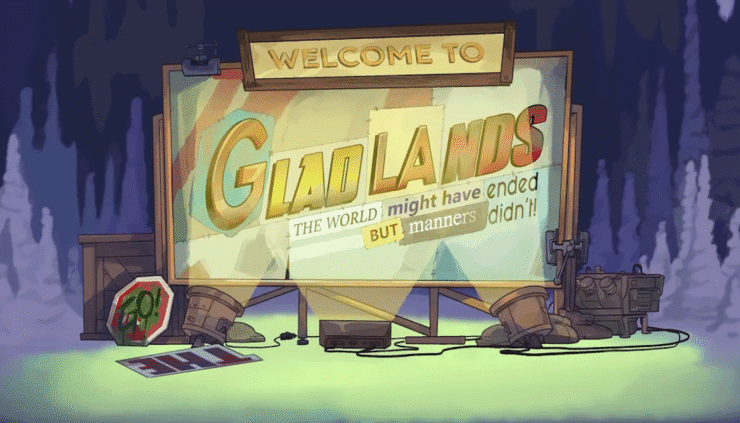
In the most recent season of Dimension 20: Gladlands, Brennan leads players through a post-apocalyptic land called the Gladlands, with Mad Max-style characters who are part of a “Carer Van” roaming the lands, but instead of pillaging and killing, they are committed to helping those they meet along the way. Oscar Montoya plays Poppy Persona, a drag queen scholar from the History Heap and caretaker of the Carer Van’s Truthbrary, who believes that storytelling and fantasy are just as important to people’s well being as gathering truth and knowledge from the “before times.” Jacob Wysocki’s character Kokomo, is a Totoro-esque being full of warmth, perception about people’s needs, and of course, big hugs. Ally Beardsley plays Quinn Wedbush, a cage-headed misfit trying like hell to be a good friend despite her troubled bunker past (which she can’t help but blurt out at every opportunity). Zac Oyama’s character, Conner Kawasaki, is an awkward catastrophizer who gets into scrapes, but also offers bits of off the cuff insight as only Zac can. Kimia Behpoornia’s TessTube5 is a hybrid hottie with the rockin’ body of a surfer dude and the head of a cockroach, always eager to help, and flirt if the occasion calls for it. And Vic Michaelis’ character Hugi, an impossibly tall crow-like figure in a plague doctor’s mask, is a mortician responsible for caring for the dead of the Gladlands and ensuring that they receive proper tribute.
There is a hearty mixture of humor and playfulness for these comedians, much of which works because they have the comedic improv language built from playing with their friends. Most post-apocalyptic fiction focuses heavily on survival and toughness, not on tenderness—but in this season, the players roles and choices in this game are less about combat or completing a particular challenge and much more about leaning into their intuition to meet the needs of the people they encounter, while also not burning out themselves. Instead of their character strengths being based on charisma, stealth, or battle skills, they are based on “warmth,” “awareness,” “resilience,” “determination,” and “creativity.” Equally important, throughout each episode, Brennan is quick to remind the players that their choices are not just about the success of a particular mission to different regions of the Gladlands, but about maintaining the “Good Goo,” a purple test tube that measures the harmony and emotional well being of the Gladlands, as well as the “Bummer-O-Meter”, measuring the outcomes of a particular group action. While the action in this season is much more subdued as the characters get into funny hijinks and awkward moments with the folks they meet, the stakes are as high as ever with the characters working towards maintaining not just the survival but the emotional balance of the Gladlands.
While each episode of D20: Gladlands has poignant moments, Episode 3: “Collabotage” speaks to the kind of awareness and care as the blueprint for creating sustainable communities. Despite the sometimes bleak, survivalist landscape of the Gladlands, there is an emphasis on treating these communities as opportunities to begin anew with a focus on helping one another. This episode centers on the Carer Van visiting Rotglob, a toxic swampland full of skilled folks doing important work. Rotglob is where food is grown and foraged for the Gladlands and where the Maternity Mound cares for newborns. There are also many folks responsible for harvesting moss from the swamps, and for building homes for others. When the members of the Carer Van arrive, the community is gearing up for their annual chili cook-off, the one day in a long time when the folks of Rotglob can stop working and celebrate good food, and one another. But underneath this festive mood burnout and resentment fester, and many of the characters, through Brennan’s incredible acting, slowly reveal to the members of the Carer Van how much their responsibilities weigh on them.
Only the characters of the Carer Van—as outsiders—have the wherewithal to understand how much the community members of Rotglob are struggling and undercutting their own dreams and needs in order to serve others. From Thagomizer, an aging craftsman who worries he isn’t good enough to participate in the chili cook-off, to Clawed Een, the only skilled maternity nurse who doesn’t even have time to stop and eat a bug taco as she cares for the newborns of the Gladlands, even with Kokomo’s help. Hugi becomes responsible for the cremation of Bub Mildew, an older Rotglobber who died, leaving behind his friends, Furnst and Clap, who are grieving the complicated man. Hugi begins to spiral themselves as their repeated failures to sculpt a statue of Bub out of the metal formerly embedded in his body for his friends, demonstrating how easy it is to fall into patterns of heightened self-criticism and emotional repression when others are depending on you and your skills. Justin Sheffield, a newer member of Rotglob, confesses to Quinn and Conner his panic over the pressure to provide enough food for others in the Gladlands and what taking a break, even just to celebrate with a chili cook-off, means for their communal workload. Justin’s character represents an important and often overlooked aspect of community building: that not everyone will be well-liked, and not everyone is good at communicating what they need. As Justin tells Quinn, “it sucks to be the loud one.”
The Dusty Dogooders all fundamentally understand that the community covenant has fractured in Rotglob. Kokomo declares to Poppy, “they need a summer,” his cryptic way of signaling that the people of Rotglob need rest, and something to be hopeful for, but the members of the Carer Van are not united in how to address so much need, making them feel insecure about their own abilities to help. Midway through the episode, Brennan declares a hard truth: the Carer Van fractures and the Good Goo descends. It is not until the group comes back together with the rest of the community for the chili cook-off, where Kokomo is an excited judge and Ash, Tess’ bug-hybrid sibling and Thagomizer are competing, does their shared goals for the people of Rotglob become clear. Through some clever “collabotage,” that is incredibly sweet and hilarious, Tess and Poppy convince Ash that she has found a family in them, and can devote time to helping Thagomizer, who wants to win the cook-off and show everyone what he can do.
The episode’s emotional arc comes when Poppy and Parcel build and unveil the Dome of Dreams for a post-cook-off performance, and the community gathers to watch the members of the Carer Van in a skit written by Poppy about little inchworms collaborating to make food and shelter for one another. The story is inspiring to the folks in Rotglob, but there is a lack of action behind this inspiration. Then, in a surprising moment of initiative and insight, Quinn takes the mic and identifies the rot at the heart of Rotglob: that everyone is struggling with their workload, and hiding how they feel from one another. She tells the crowd, “Sometimes it is braver to say you can’t do something.” This emotional moment is both heart-wrenching and a beautiful moment of vulnerability that viewers can relate to, as so many of us harbor feelings of guilt, even resentment, when we feel overwhelmed but know that others are struggling too.
Once Quinn opens the floor for vulnerability, Furnst steps forward. Inspired by his deceased friend and ornery complainer Bub, Furnst’s confession of frustration at his workload opens the floodgates, and soon several others, including Justin Sheffield and Clawed Een, step forward to unburden themselves, creating a new annual tradition, “Bub Day.” This practice represents the resistance to a culture of abandonment, instead embracing the vital tenet that everyone’s lives are equally important and worth caring for.
The Carer Van has created a sense of found family when so many of the characters have lost their loved ones in the “before times.” Their world has changed so much that there are moments in the game where they must contend with the grief in remembering and understanding artifacts of the past. They are a rag tag group of friends, each with their own baggage and insecurities, but each with a deep wish to do good, even if they don’t always understand how best to help or how their roles in community may have to change.
It’s easy to watch D20: Gladlands and laugh, cry, and then go about your day, appreciating it as good storytelling, and the much needed distraction we need in these dark times. But much of this season, and this episode, mirrors the real struggles of community building in dire times; the overwhelm, the burnout, the grin and bear it mentality that folks, whether they are experienced organizers are not, struggle with. It also shows the power of storytelling like this. The act of radical imagination work can be present both in this episode and in this entire season of Dimension 20. In her book, Emergent Strategy: Shaping Change, Changing Worlds, author and cultural worker adrienne marie brown describes how imagination is imperative to community building,”This is a time travel exercise of the heart. This is collaborative ideation-what are the ideas that will liberate all of us.” In conversation with brown’s words, Tricia Hersey discusses imagination as liberatory practice in Rest is Resistance: A Manifesto, when she talks about the “Dreamspace,” an individual and communal space of radical imagination and futurity people can only reach when they rest and resist the structural harms of capitalism and white supremacy culture. Rob Hopkins echoes this idea in How to Fall in the Love with the Future, iterating that we must “act towards creating a future we want, not just preventing the one we don’t want.” D20: Gladlands is engaging in this kind of radical imagination, and this episode provides examples of how a more caring society operates. And what is D&D or TTRPG if not an exercise in collective imagination?
What is depicted in this episode mirrors the resistance and community building happening both in the United States and internationally in the face of fascism, occupation, abandonment and increasing state violence. I think of the ways in which activists and regular community members in Los Angeles, Chicago, Portland and Minneapolis are showing up for one another in this way every day, distributing zines and whistles to alert neighbors to ICE presence in their neighborhoods and organizing mutual aid initiatives for community members who are afraid to leave their homes. A D&D meetup in Minneapolis even became a place where folks began to organize against ICE violence to protect their immigrant neighbors! Or folks organizing Little Free Pantries and food bank donations for folks affected by cuts to their SNAP benefits.
The incredible writing and performances in Dimension 20 remind us that art has always been political, and that community is intentional, created time and again with messiness and care. The best art is a Dome of Dreams, making space to dream what is possible, and collectively imagine a better world.
The post Imagining a More Caring Apocalypse in <i>Dimension 20: Gladlands</i> appeared first on Reactor.








 New Posts (Home)
 ChatBox
 Popular Posts
  Game Zone
 Top PodCasts