reactormag.com
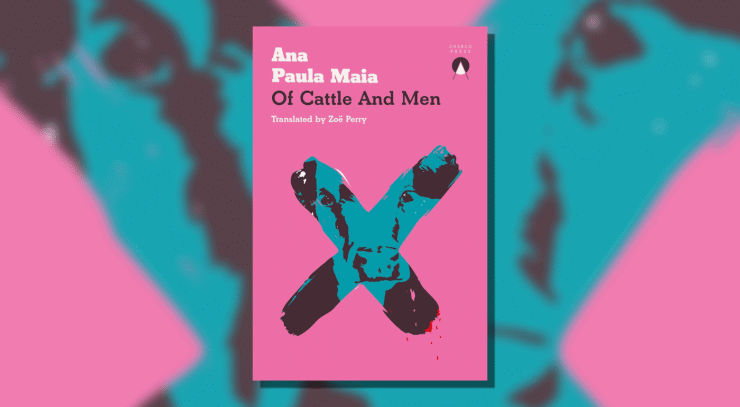
Found in Translation: Ana Paula Maia’s Of Cattle and Men
Books
Found in Translation
Found in Translation: Ana Paula Maia’s Of Cattle and Men
A gruesome dystopia — but not without hope
By Hache Pueyo
|
Published on May 7, 2026
Comment
0
Share New
Share
Found in Translation is a new bimonthly column reviewing books translated to English in a variety of speculative shapes. Some traditional, some experimental, some told through cultural narratives that might seem peculiar if you’re not used to them, but all have the same unifying factor: there is always more out there.
Somebody’s got to do the dirty work. Other people’s dirty work. Nobody wants to do that sort of thing. That’s why God put guys like you and me on this earth.
In the most forgotten depths of Brazil, the blood of cattle and men flows down a river cluttered with human and animal remains. Rio das Moscas—River of Flies—is surrounded by slaughterhouses, and seems incapable of harboring any life, spitting out contaminated fish in a progressively more desolate landscape. Edgar Wilson, a stun operator at one of those facilities, feels no joy killing cows, but it’s what he does, and his preternatural understanding of the animals is as strong as his detachment.
Stoic, hardened and efficient, Edgar Wilson is a man of few words, completing his job day after day and praying for the cows he stuns with a single blow. He doesn’t want them to suffer, nor does he question the need for slaughter: if others eat meat, then someone has to kill animals. And if he has to kill men too, so be it—he’s not seeking to be redeemed.
One day, however, some of the cattle stop facing north, and begin facing west. Edgar Wilson is unsettled by the change, but no one else pays him any mind. Then, the cattle, usually peaceful, start acting erratically, which raises suspicions of possible predators sneaking into the field until twenty-two cows throw themselves off a cliff.
Of Cattle and Men paints a gruesome dystopia. A poisoned river, fish whose eyes keep glowing after they die, cows that only give birth to stillborns. People, too, seem to have been abandoned in this dying world, reacting to violence with more violence. They are also not as hopeless as they believe themselves to be: Edgar Wilson feels empathy for the animals he faces every day, Burunga constantly risks drowning to pay for his daughter’s reading glasses, the cattlemen at Milo’s slaughterhouse feel defensive toward each other, and even Bronco Gil, the foreman believed to be much more brutal than he really is, can’t look away as women and children beg for a scrap of meat every day in front of the facility’s gates.
Originally published in 2013, Of Cattle and Men is part of a larger body of work involving the same cast of characters, particularly Edgar Wilson, crafted by author Ana Paula Maia. There are two standalones, Of Cattle and Men and On Earth as it is Beneath (both published in English by Charco Press), and two separate trilogies, Saga of Brutes (published in a single volume by Dalkey Archive Press) and Trilogia do Fim (roughly Trilogy of the End, with the first book, Bury Your Dead, upcoming by Charco Press in 2026). The latter comprises the more recent books as the plot evolves into an apocalyptic scenario, and has been adapted to the screens as Bury Your Dead, starring Selton Mello (whom international viewers may know from Oscar-winning film I’m Still Here and the most recent Anaconda reboot) as Edgar Wilson. The reader doesn’t need to follow the chronology of the books, and at least half of them can be read independently, including Of Cattle and Men.
Since Brazilian Portuguese is one of my first languages, I have to mention that there are some downsides to the translation. Most of it is competent, but there are some puzzling choices like keeping one of the names as Senhor Milo instead of Mr. Milo, or São Roque instead of Saint Roch. What is an overall effective translation becomes, then, part of a broader issue with the translation of Latin American works into English, which is keeping perfectly translatable words in their original languages like they have some sort of cultural significance when they don’t. If a writer says lua, the translation is moon; if a writer says vermelho, the translation is red; if the writer says senhor (or the Spanish equivalent señor), the translation is mister. Some words can be hard to translate, sure, some depend on context, and others remain the same no matter the language, like tempura or déjà vu. Senhor is not one of them. It’s jarring, and it adds an exotifying lens to almost all the books that come from Latin America.
It’s exciting to know that more books by Maia will be available in English soon, but here is hoping that the next trilogy won’t suffer from the same issue.[end-mark]
De Gados e Homens by Ana Paula Maia was originally published in 2013 in Brazil, and translated in 2023 by Zoë Perry (Charco Press)
Buy the Book
Of Cattle and Men
Ana Paula Maia
Translated by Zoë Perry
Buy Book
Of Cattle and Men
Ana Paula Maia
Translated by Zoë Perry
Translated by Zoë Perry
Buy this book from:
The post Found in Translation: Ana Paula Maia’s <i>Of Cattle and Men</i> appeared first on Reactor.








 New Posts (Home)
 ChatBox
 Popular Posts
  Game Zone
 Top PodCasts