reactormag.com
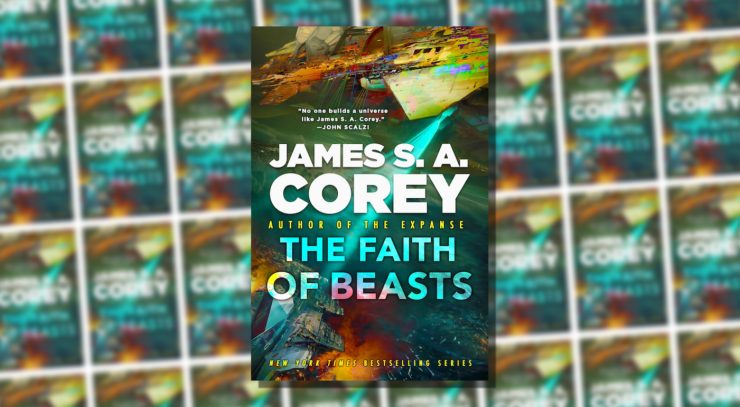
The Long Game Continues: James S.A. Corey’s The Faith of Beasts
Books
book reviews
The Long Game Continues: James S.A. Corey’s The Faith of Beasts
Two books in, The Captive’s War series is quietly radical and intensely hopeful.
By Molly Templeton
|
Published on May 11, 2026
Comment
0
Share New
Share
The first book in James S.A. Corey’s Captive’s War trilogy, The Mercy of Gods, began not with one of its ensemble cast of captive humans, but with an alien. In its final statement, Ekur-Tkalal, “keeper-librarian” of the humans enslaved by the Carryx, describes the beginning of the end of its species’ dominance. “We did not see the adversary for what he was, and we brought him into our home,” Ekur-Tkalal says.
That adversary is Dafyd Alkhor, who begins the first book as the low-level research assistant to a lab full of genius scientists and rises to become the accidental leader of all the humans brought, unwillingly, into the empire of the Carryx. These humans are from the planet Anjiin, where humanity arrived at some unknown time in the past. The history is lost, but they came from somewhere else.
That detail always seemed relevant, in the first book. If you have read Corey’s Expanse series, you know to watch for those seemingly small moments and choices that become transformational pivot points. Here, Corey straight-up tells you to look for them: “Small moments, unnoticed at the time, change the fate of empires.”
The Mercy of Gods is the setup: Select humans from Anjiin are transported to the Carryx homeworld, locked in a tower, and set to a scientific task. Success means survival. Failure leads to destruction. But Corey lets on from the start they’re going to succeed—not just at the science, but at bringing down their oppressors. The question has always been how.
The Faith of Beasts won’t give you the whole answer. It unfolds at a pace both stately and propulsive: Corey builds to every revelation with masterful restraint, and yet this is the kind of book you want to clear your calendar for. I saved it for a weekend and read compulsively, stopping only when I had to. If you liked the first book, the second book is exactly what the first promised: a further, deeper, broader exploration of how people might survive in the most drastically oppressive of situations, and how they might resist without being seen to do so. How to fight back without fighting.
And how long that might take.
(There will be spoilers for The Mercy of Gods below.)
Buy the Book
The Faith of Beasts
James S.A. Corey
Buy Book
The Faith of Beasts
James S.A. Corey
Buy this book from:
AmazonBarnes and NobleiBooksIndieBoundTarget
The Captive’s War is, in a way, a story about humanity running headfirst into a brick wall. The Carryx refer to all of their enslaved species as “animals.” The Carryx do not care about humans’ individual success or individual feelings. The Carryx serve their Sovran, the center of the empire. They have one word for life and war and serving the empire. They become what is needed, physically, transforming their bodies and their uses as the Sovran directs. The Faith of Beasts includes intriguing details about how the Carryx function, how its members are both individuals with their own tasks and directives, and pieces of the massive organism that is the empire. The scale is immense, and humans—with our individuality and our needs—are so small within it.
But humans aren’t helpless. One of the key incidents in The Mercy of Gods is a failed rebellion. Despite the Carryx’s clear instruction—be useful or die—some people want to fight back, immediately, and see only one way to do so: violence. Dafyd, whose focus is on understanding the Carryx, figuring out the most effective way to resist them, wants to play a longer game.
The violent rebellion, as it was always going to be, is crushed, and Dafyd is instrumental in that crushing. This means a lot of things, including that a lot of people hate him and blame him for the deaths of their friends. It also means that the humans that survive are not, for the most part, the ones whose first impulse is to violence. The survivors are the people who watch and learn; the ones who explore and invent; the ones who take care of others, or tell stories, or solve problems using brilliant science. These humans are curious, and clever, and wise, and loving, and sometimes dangerous in less obvious ways. And they will find their own ways to resist.
Sometimes, these paths are spelled out clearly. A new character, Uuya Tomos, was a writer back on Anjiin, and Dafyd enlists her to write stories and songs for the next generation. (The Carryx insist the human population be self-sustaining. This is horrifying, conceptually, but Corey steers clear of the obvious consent issues by solving the problem with science.) Kids born on the Carryx planet will never have known anything else, he says, and they will need to hear stories that tell them it can be otherwise. One of those stories—maybe—serves as interstitial text here. It’s the story of the founding of Anjiin, as written by Uuya Tomos, but it is not clear when it was written. Collected myth from the beforetimes, or created myth for the new generation?
Other paths are less overt. Jessyn, who discovered a capacity for violence in the first book, is sent out to explore a new planet, where she makes a most unexpected discovery. (Those who read the novella Livesuit may connect some dots faster than others, but it isn’t necessary to have read that book.) On a different expedition, Campar befriends a very funny giant slug-like creature (it refers to humans as “meat-on-sticks,” which seems fair), meets a new lover, and also makes a shocking discovery. Tonner, the genius, does genius science. All of them deal with their trauma in different ways: humor, denial, small acts of rebellion. The primary personality trait of almost everyone is exhaustion, yet Corey details with care their individual responses to trauma, their focus and the things that keep them going.
And then there’s the swarm, the alien sentience that landed on Anjiin before the Carryx invaded and has been gathering intel for its own masters ever since. The swarm, at the end of the last book, decided it was in love with Dafyd. The swarm has some very handy skills. It exists by taking over the bodies of humans, who then seem to exist within its shared consciousness, which raises a lot more questions about individuality and survival. It is making itself up as it goes along, which kind of makes me want to snort, lovingly, and ask: Aren’t we all?
The story of The Captive’s War is one of a long game: survival under impossible conditions; resistance when you can’t just resort to fighting in the traditional sense; the careful, precarious, hideous balance of acceptance and horror. More than one character in this novel observes that a person can get used to almost anything. Walking to work through a massive alien cathedral filled with truly alien species; reporting to a giant cockroach with too many legs; learning to make babies in sacs; considering that freedom may be the fight of generations; exploring an alien ship full of dead aliens—there’s a lot, here, for the humans of Anjiin to wrap their heads around. And yet, to borrow a bit of that now-tired phrase, they persist.
Even in a world where individuals have little power, they have choices. They can choose who to blame for their situation, and who to listen to, and how to react; they can choose to deny the situation or accept it and try to work through it. Sometimes they can and do choose to do things that might get them killed, for better or worse. (Sometimes people are the least likely heroes.) Sometimes the little choices mean everything, and sometimes they mean very little. Sometimes the choice is all about who to become, and how to leave yourself behind.
I really don’t want to spoil anything for you with this one. The Faith of Beasts is a novel full of huge revelations delivered quietly, world-changing moments that creep up on people. It is, like the first book, character-driven, because that’s the kind of story Corey is interested in telling: one where people cannot make the romanticized, epic, straightforward, heroic choices, but have to find other ways to manifest epic change. One of those ways is to pass the fight on to the next generation. Is that fair? Is anything? As Uuya Tomos says, “It’s never your responsibility to do something that can’t be done. You do your part, and you help the next generation carry it a little farther, and then the one after that.”
Two books in, The Captive’s War series is quietly radical and intensely hopeful. Corey doesn’t dodge the tale’s inherent bleakness—another species has been enslaved by the Carryx for generations—and every life is believably, terribly fragile. But over and over, The Faith of Beasts is a reminder that there is no one way to fight, to retain one’s self, to care for others, to make connections. To exist against the odds.[end-mark]
The Faith of Beasts is published by Orbit.
The post The Long Game Continues: James S.A. Corey’s <i>The Faith of Beasts</i> appeared first on Reactor.








 New Posts (Home)
 ChatBox
 Popular Posts
  Game Zone
 Top PodCasts